

"You Have Made Yourselves Slaves": Mohammad Adeeb on Fifty Years of Muslim Political Failure
The former Rajya Sabha MP argues that India's secular parties, not just the BJP, engineered the Muslim community's political disappearance — and that only a collective, cross-community leadership can now reverse it.
Contents · 8 sections
- A witness to how the RSS actually rose
- Socialism's Muslim vote, and what it bought them
- Vajpayee, Modi, and the line Adeeb draws between them
- A boycott as leverage
- The record on secular parties
- A leadership that never built successors
- A call for collective leadership
- Constitution as the only remaining ground
A witness to how the RSS actually rose
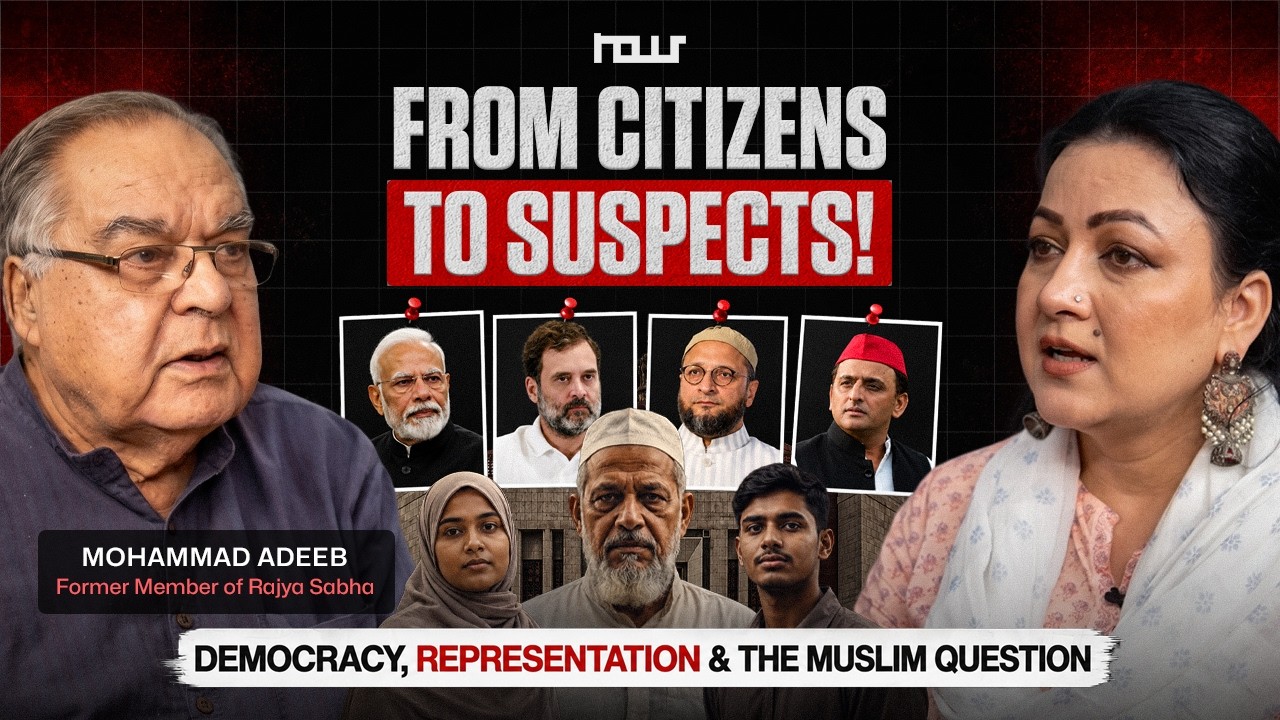
Mohammad Adeeb has watched India's political currents from close range for over half a century — through the socialist movement's rise and fall, the birth of the RSS-BJP combine, and stints of proximity to both the Congress and the socialist bloc before winning a Rajya Sabha seat as an independent candidate backed by the Congress, the RLD, and the Samajwadi Party. Speaking to Nous, he begins with a confession he frames as generational: that his own generation's participation in Jayaprakash Narayan's movement against Indira Gandhi's Emergency, however well-intentioned, ended up being the vehicle through which the RSS entered the mainstream of Indian politics.
Adeeb recalls warning JP directly that Jana Sangh members were marching prominently within his coalition. JP's reply, as Adeeb remembers it, was that the Jana Sangh was more upset with him than anyone, but that it had organisation the movement needed, and that there was nothing to fear. What followed, in Adeeb's account, was fragmentation: small parties splintered off from the movement's socialist core, and Muslims were steadily pushed to its margins. He recalls a former chief minister, Hemwati Nandan Bahuguna, telling him after the Emergency that opposing Indira Gandhi so fiercely had been "a great sin," because it let the very Jana Sangh cadres who once hid their RSS affiliation entrench themselves at the grassroots. When V.P. Singh became prime minister soon after with Jana Sangh-descended support, Adeeb argues, the RSS received the formal recognition it needed to become, in his words, "the master of the era" — a slow, unhurried ascent enabled by the parties that positioned themselves as its opposition.
Socialism's Muslim vote, and what it bought them
Adeeb is unsparing about the movement's other legacy: politicians who built entire careers on caste-based mobilisation — the "Yadav politics," the "Kurmi politics" that produced Bihar and Uttar Pradesh's regional parties — treated Muslims as their second-largest vote bank without ever building comparable Muslim political power in return. Muslims, he says, gave these parties their votes "again and again, not once," and received tokenism in exchange: a ministry here, a departmental portfolio there, never real authority.
He illustrates the point with Azam Khan, once so central to Mulayam Singh Yadav's Samajwadi Party that he was given a helicopter during election campaigns specifically to bring in the Muslim vote. In the two elections since Narendra Modi's rise, Adeeb notes, Azam Khan has not even been given a party bicycle symbol to campaign with, let alone a platform — a leader once so influential, now sidelined by his own party for fear of alienating Hindu voters who, in Adeeb's telling, the party assumes will stay regardless because it believes Muslims have nowhere else to go. "This is the servitude I want to end," he says. "How long will you keep serving them?"
Vajpayee, Modi, and the line Adeeb draws between them
Pressed on why he mentions Atal Bihari Vajpayee in the same breath as Nehru and Gandhi, given that Vajpayee once spoke of "levelling" the Babri Masjid, Adeeb draws a careful distinction. Vajpayee, he argues, was a democrat and a man of education and civility who never spoke of violating the Constitution, even if his party did, and who condemned the Babri Masjid's demolition after the fact and publicly urged Narendra Modi, then Gujarat's chief minister during the 2002 riots, to uphold his "raj dharma." Adeeb concedes Vajpayee's RSS affiliation and ideological differences with his own but insists that as prime minister, Vajpayee did not seize control of independent institutions the way he says has since occurred. He extends a similar, qualified respect to Indira Gandhi, whom he opposed over the Emergency but credits with holding a free election afterward and losing it — a test, he implies, the current government would not permit today, pointing to what he calls a "nominated" Election Commission following the removal of the Chief Justice from the body appointing it.
A boycott as leverage
Adeeb's most provocative proposal is that Muslims should, as an experiment, withdraw entirely from voting in a single election cycle. His logic: Muslims function as a "catalyst" whose presence lets ruling coalitions form around opposing them, and whose absence would force politics back onto ordinary material concerns — jobs, prices, livelihoods — while also depriving the Special Intensive Revision of electoral rolls of its justification, since voter list purges are conducted, he argues, expressly to remove Muslim names under the pretext of catching "infiltrators." He recalls the veteran journalist Kuldip Nayar warning him decades ago that such a step would only fracture Hindu society along caste lines instead. Adeeb's rejoinder is that Muslims currently function as society's unifying scapegoat — "if you want to run your government and hide your own flaws, create a villain," he says, quoting Chanakya — and that removing the community from the electoral equation would strip that villain of its political utility, forcing secular parties to finally offer partnership rather than convenience.
The record on secular parties
Adeeb reserves particular anger for the parties that call themselves secular. He argues they have failed not from a lack of courage alone but from calculation: raising Muslim grievances risks the departure of Hindu votes they fear losing, so all-in-one-line political statements — a tweet, a press conference — substitute for the organisational fight he says the moment actually demands. He recounts a Congress meeting where Rahul Gandhi told party members that failing to speak up for Muslims and minorities would itself amount to a betrayal of Congress's own identity — a stance Adeeb credits as more direct on the RSS specifically than any Congress leader since Nehru, while noting that Congress state leaders like Digvijaya Singh and Kamal Nath simultaneously chase religious symbolism, such as pilgrimage yatras and reminders of Rajiv Gandhi's own decision to unlock the Babri Masjid site, producing what Adeeb calls "a very confused Congress."
He is equally scathing about Muslim voting behaviour toward All India Majlis-e-Ittehadul Muslimeen leader Asaduddin Owaisi, arguing that even Muslims who admire Owaisi's willingness to speak for the community decline to vote for him because his party cannot actually win — a hesitation Adeeb reads as evidence of political timidity rather than strategy. Asked why Muslim-led parties are branded communal while caste-based parties representing Sikhs, Dalits, or other groups are not, he calls the double standard explicit: parties built entirely around Dalit or Sikh identity face no comparable stigma, while a party built around Muslim identity is treated as inherently sectarian — a framing he traces to the trauma of Partition, after which, he says, Muslims who chose to remain in India were treated as accused parties rather than equal citizens from the day after independence itself.
A leadership that never built successors
Adeeb turns the same critical eye on Muslim leadership itself, arguing that community representatives — from the Muslim Personal Law Board to state-level politicians — have failed just as thoroughly as secular parties, in part by hoarding influence rather than cultivating successors. He names Dr. Syed Mahmud and Fakhruddin Ali Ahmed as among the last Muslim leaders granted genuine authority within Congress, arguing that no comparable figure has emerged since, and that even Dr. Abdul Jalil Faridi, who attempted a Dalit-Muslim political alliance decades ago with backing from Kanshi Ram, secured barely 2–3 percent of the vote and was subsequently forgotten by the very community he tried to organise. Faridi's approach — an alliance between Muslims, Dalits, and other backward groups — is, in Adeeb's account, precisely what should have been built and was not.
He identifies a further split within the Muslim community itself: south Indian Muslims, he argues, have advanced educationally and economically far more than their north Indian counterparts, because the south never experienced 1857, Partition, or the successive waves of communal violence — from Bhagalpur to Gujarat — that left north Indian Muslims permanently defensive. He cites Tamil Nadu, where Muslims are roughly 4 percent of the population but hold around 10 percent of government jobs, as evidence of what parity in education can produce. In the north, he argues, the modern school network founded by Sir Syed Ahmad Khan — starting with an English school in Ghazipur in 1862 and culminating in Aligarh Muslim University — went uninvested-in after 1947 and has fallen behind ever since, even as Muslim families with means increasingly send their own children to Christian-run convent schools rather than community institutions.
A call for collective leadership
Adeeb describes founding a small organisation of retired judges, retired military officers, professors, and lawyers to attempt, in his words, work that "should have been done 25 or 50 years ago" — convening around 150 people this month to decide a collective path forward, precisely because, he says, no individual Muslim leader today commands the following to be followed. His proposed remedy is explicitly cross-community: a "collective leadership" built jointly with secular Hindus, Christians, Sikhs, and other deprived communities, on the theory that a storm this size cannot be weathered by any one community alone. He argues that internal community divisions — distinctions of biradari and sect, Ashraf versus Pasmanda — must be set aside first, insisting that once Muslims organise coherently, "a great many secular Hindus are watching you, waiting for you to stand up," and that visible unity is the precondition for allies to act rather than the other way around.
He offers Iran's decades under sanctions as a model of resilience worth studying, while carefully noting the disanalogy — Iran is a Muslim-majority state operating on its own terms, India a secular republic in which Muslims are a minority — arguing that the lesson to draw is not the specific method but the discipline of building capacity for the long term rather than reacting event by event.
Constitution as the only remaining ground
Running through the conversation is Adeeb's insistence that the Constitution, and specifically the secular settlement Nehru sought a mandate for in 1952, remains the only ground Muslims have left to stand on — not a request for special treatment, but the basic bargain struck when the community "divided its own blood" at Partition rather than migrating to Pakistan. He directs a challenge at Hindu nationalist politicians who invoke Hindu Rashtra: hold a referendum, he says, and ask not only Muslims but Sikhs, Christians, south Indian Hindus, and any group outside the mainstream Hindutva fold whether they wish to live in a Hindu nation — if the vote favours it, he says, Muslims will not raise their voice again, but a government elected on the existing Constitution has no standing to violate it unilaterally in the meantime.
He closes by describing his own refusal to be silenced despite his advancing age, a withdrawn FIR filed against him for a defamation counter-suit, and family pressure to stop speaking publicly. "I don't have two square feet of land for a grave," he says. "Why would I be afraid of them?" His parting message to the community he has spent his career trying to represent is less consoling than demanding: that prayer and ritual observance are not, on their own, the fulfilment of religious duty — that duty, in his reading of the faith, lies in raising one's voice for the wronged and standing beside the innocent, an obligation he believes the community's own institutions have too long treated as optional.


Discussion
0Readers only · Comments are reviewed by the desk before they appear
The journalism is free for everyone — create a free account to join the discussion.