

Why ‘Uniform’ Is Not the Same as ‘Equal’
Eight years into researching India’s Uniform Civil Code, legal philosopher Sania Ismailee argues that the debate has confused sameness with justice — and that the confusion is doing real damage.
Contents · 6 sections
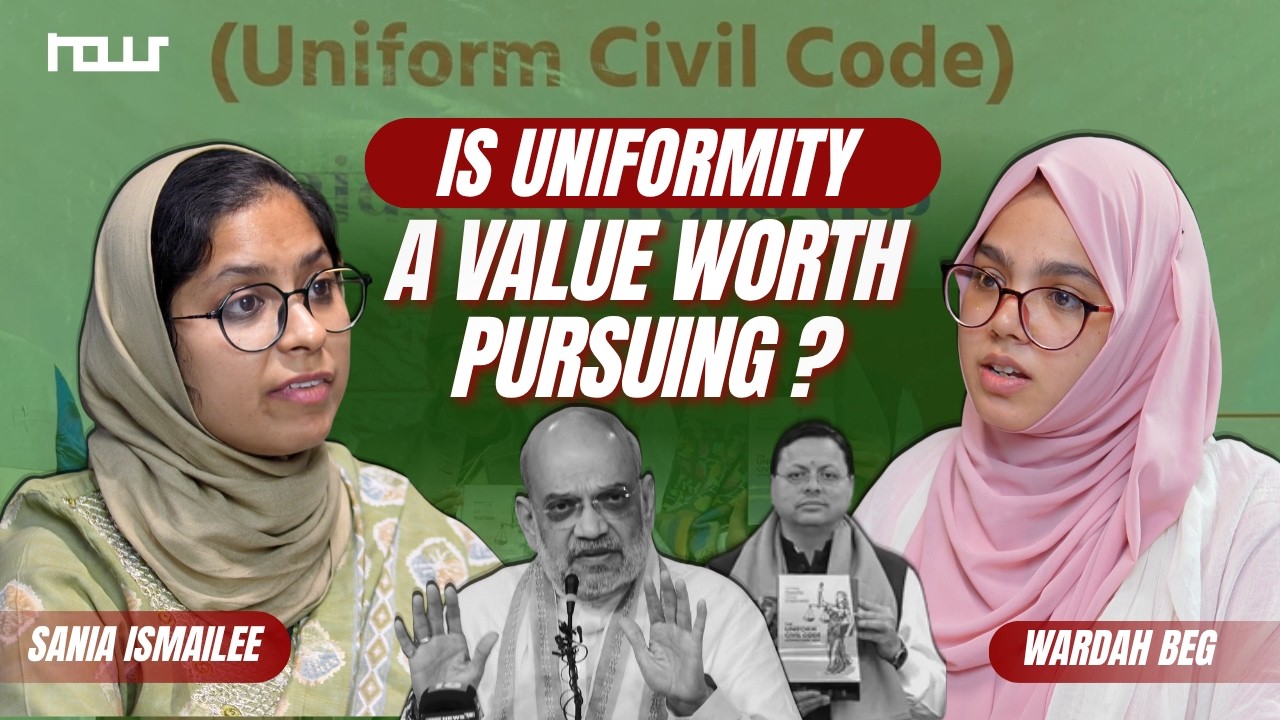
The Uniform Civil Code is no longer a hypothetical. It is now law in Uttarakhand, has been rolled out in Assam and Gujarat, and is due in Madhya Pradesh. For years, the standard response to questions about the UCC was that no one had actually seen a draft. That excuse no longer holds. What remains unsettled is not whether the UCC exists, but what it is actually for — and whether the values it claims to serve, secularism and gender justice, really point in the direction its advocates assume.
That is the question Dr Sania Ismailee has spent eight years sitting with. An assistant professor of social sciences at BML Munjal University who carried out her doctoral research across IIT Delhi, Columbia University and Oxford as a Commonwealth and Fulbright fellow, Ismailee is one of the few scholars in India to have approached the UCC from political philosophy rather than law or sociology. In a conversation with host Wardah Beg on Nous’s new interview series, Emerging Perspectives, she laid out why she thinks the entire debate has been asking the wrong question.
A Question With No Good Answer
Ismailee traces her interest in the subject back to a single classroom humiliation. In ninth or tenth grade — the only Muslim student in her batch — a teacher raised the subject of triple talaq mid-lesson, turned to her, and asked her to stand up and explain it to the class. “I had no answer to their question,” she recalled. She sat back down in silence. The pattern repeated through university: friendly, curious classmates who would periodically ask her to account for practices in “her religion” that she had never been taught to defend. The gap in her own knowledge, she said, eventually became the starting point for a PhD.
The bigger intellectual challenge, she said, was disciplinary. Her training was in philosophy, but the UCC had mostly been written about by lawyers, sociologists and historians. Working out how a philosopher could even enter that conversation — and resisting pressure to simply declare whether the UCC should exist or not — shaped the method she eventually built her research around.
Stepping Outside the Argument
That method is what Ismailee calls “critical distancing.” Her observation, surveying decades of writing on the UCC, was that almost every argument traced back to the same reference point: the Shah Bano case of the 1980s and the Hindutva politics that followed it. Because the BJP had made itself the loudest champion of a uniform code, much of the opposition to the UCC took the form of opposing whatever Hindutva wanted — a reasonable political instinct, Ismailee argues, but not actually an argument about the UCC itself. “If we assume for a moment that Hindutva ideologues did not appropriate the UCC,” she asked, “does that mean the UCC should exist?”
Bracketing the political identity of whoever is making an argument, she suggests, clarifies what is actually at stake. Stripped of party politics, there are essentially three positions in play: a secular case (the state should not be in the business of enforcing anyone’s religious law), a sameness case (one law, for everyone, on marriage, divorce, inheritance and succession), and an equality case that rejects sameness in favour of what Ismailee calls substantive or intersectional equality — the idea that women from different communities may need different legal routes to reach the same destination. Set against all three is a religious-autonomy argument: that families should be free to live by their faith without state interference.
Ismailee’s own finding, developed against the grain of how the debate is usually presented, is that the secularism camp and the gender-justice camp are not actually opposed to each other. Both want change. They disagree only on method. Secular reformers want the state out of religious law altogether. Gender-justice scholars — she cites Flavia Agnes, Nivedita Menon and the Law Commission’s own 2018 report — want personal laws reformed from within, community by community, until each one independently meets a constitutional standard of equality. “They are not saying there shouldn’t be uniformity,” she said. “They are offering a different interpretation of how uniformity should be understood”: achieved gradually, through piecemeal reform, rather than imposed in one legislative stroke.
What ‘Uniform’ Actually Changes
Where that distinction matters, Ismailee argues, is in what a uniform code actually does to existing legal protections once it is written into statute. Muslim personal law, for instance, bars a person from writing off their entire share of inherited property — a provision designed, she notes, precisely because women in a patriarchal society face constant pressure to renounce their claims. She points out that Belgium has a near-identical protection. Uttarakhand’s new uniform code removes that constraint altogether, making a complete disclaimer of inheritance fully legal. The result, in her reading, is not a gain in equality but the removal of a safeguard that functioned as one.
A similar problem arises with the “degrees of prohibited relationships” that a uniform code must specify in order to define who may marry whom. Cousin marriage, often framed in public debate as a peculiarly Muslim practice, is legal and common within several Hindu communities in South India. Writing one standard into law is not neutral, Ismailee argues — it is the codification of one community’s norms as the default, with everyone else absorbing the cost of conforming to it.
The clearest case, for her, is the abolition of iddat — the waiting period observed by Muslim women after divorce — without, as far as she can establish, any consultation with the women who actually observe it. For a woman who understands herself as answerable to her faith rather than only to the state, a civil divorce does not settle the religious question. Removing legal recognition of iddat strips away the workplace accommodations women have relied on, without engaging the conscience-based reasoning behind the practice at all.
Whose Customs Count as an Exception
Perhaps the sharpest asymmetry Ismailee identifies is in who gets carved out of the UCC altogether. Every draft so far has fully exempted Scheduled Tribes. The reasoning, she explains, goes back to the Constituent Assembly: land was understood as central to tribal identity and survival, so customary law governing land was left to autonomous district councils rather than ordinary legislatures. Muslim, Christian and Hindu personal laws were treated differently from the start — not protected for their own sake, but targeted as obstacles to “national integration” in the aftermath of Partition.
That history, Ismailee argues, undercuts a common claim that Muslims have always been granted special legal exceptionalism. Citing the historian Soumya Saxena’s book Divorce and Democracy, she points out that the Nehru government formed committees to reform Hindu, Christian and Muslim family law alike in the 1950s and 1960s. The Hindu Code Bill went through; the reform of Muslim and Christian personal law was shelved once Nehru and Ambedkar were no longer in government to see it through. “Exceptionalism was not always created for Muslims,” she said. “This is a false narrative.”
The Hijab as a Test Case
Ismailee draws a direct line between the UCC debate and the 2022 Karnataka hijab ban, which she has also researched. A uniform dress code, justified as neutral and secular, produced starkly unequal outcomes: a report by the People’s Union for Civil Liberties, using the Karnataka Legislative Assembly’s own data, found at least a thousand Muslim girls dropped out of school, principally over the hijab ban. The Karnataka High Court, meanwhile, ruled that Sikh turbans were an essential religious practice to be accommodated, while classing the hijab alongside the saffron shawls that had become, that year, a tool of political mobilisation rather than a mark of faith. if even one person’s chance at an education or a job is damaged by it, Ismailee argued, “what is the purpose of that neutrality?”
She extends the comparison abroad. Seventh-day Adventists, whose faith prohibits work on Saturdays, have had competitive exam schedules adjusted around their observance in many countries — though not, she notes, in Romania. Jewish communities in Britain and the United States have built religious tribunals, Beth Din, to resolve disputes left unaddressed by civil divorce; Sikh organisations in Britain have recently opened a Sikh court for the same reason. “To say that unity and neutrality exist everywhere, or only in the Western context,” she said, “is simply a false statement.” Even officially secular states carve out space for religious life within an outwardly uniform legal order.
Uniformity Is Not a Value
Ismailee returns, in the end, to a single governing claim: uniformity has no independent justification. She points to Goa, long held up as a model of successful uniform civil law, where the old Portuguese code — as scholars Flavia Agnes and Albertina Almeida have documented — permits a Hindu man to take a second wife if his first has borne no son by age thirty. “Unity is being discussed,” she said, “but how it is beneficial for women’s rights is not being discussed as much.” A law can be perfectly uniform and still be unjust, if the uniformity simply spreads one community’s norms, or one gender’s disadvantage, evenly across everyone else.
What should replace the pursuit of sameness, in her account, is a harder and less photogenic commitment: substantive equality, pursued community by community, law by law, with the people actually governed by each law consulted before it is rewritten. It is a less satisfying answer than a single code imposed by decree. It is also, Ismailee insists, the only one that takes seriously what the Constitution actually promises — not identical treatment, but a fair outcome for everyone measured by where they actually start.


Discussion
0Readers only · Comments are reviewed by the desk before they appear
The journalism is free for everyone — create a free account to join the discussion.