

Who Really Fought for India's Freedom? A Historian Turns the Loyalty Test Around
Asked why some Muslims did not back Partition, a historian speaking to Nous flips the question onto the RSS and Hindu Mahasabha, asking what role they played in the freedom struggle at all.
Contents · 5 sections

A question answered with a counter-question
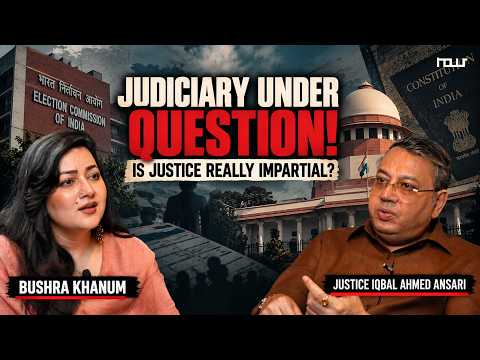
The clip opens mid-conversation, with Nous's Bushra Khanum asking a historian about his book's central claim: that the Muslims who opposed Partition and a separate Pakistan were being written out of the story of 1947, while all Muslims were collectively made to answer for the minority who did not. The historian, whose episode does not give his name on screen, calls the demand itself the problem. Indian Muslims are routinely asked to prove hubb al-watan — love of country — as if patriotism were a debt they alone owe, he says, describing the exercise as "horrendous" and "dangerous." His answer is not to defend Muslims against the charge but to redirect it: before Muslims explain themselves, he argues, it is the RSS and the Hindu Mahasabha who owe the country an account of where they stood between 1925, the year the RSS was founded, and 1947.
Measuring the record against the movements
The historian runs through the landmark campaigns of the independence movement — the Khilafat movement, the Non-Cooperation Movement, the Salt Satyagraha, and the Quit India Movement of 1942, whose 84th anniversary he notes falls in the very week of the interview. The “Angrezon Bharat Chhodo” call, he says, was given by the Indian National Congress under Mahatma Gandhi's leadership and Maulana Abul Kalam Azad's, and taken up by Subhas Chandra Bose and Sardar Patel — not by the RSS, and not by the Hindu Mahasabha. He goes further, alleging that in the early 1940s, while Congress ministries resigned in protest against India's conscription into the Second World War, Hindu Mahasabha politicians entered coalition governments with the Muslim League in Sindh, Bengal and the North-West Frontier Province — the same Muslim League, he points out, that the Hindu Right now treats as the sole embodiment of Muslim politics in that era.
The tricolour, “an evil in itself”
The historian's sharpest piece of evidence is a claim about the English-language press on the day after independence. He says that on 14 August 1947, an English newspaper close to the Hindu nationalist camp ran a passage — which he reads out in English before promising a Hindi translation — arguing that power had come to India's new rulers “by the kick of fate,” and that they had put the tricolour in the country's hands only to see it “never be respected and owned by Hindu.” The number three itself, the passage went on, was inauspicious, and a three-coloured flag would produce “a very bad psychological effect” on the nation. It is this history, the historian argues, that makes it galling to watch the same political family now demand that Muslims wave the tricolour to prove their love for it. Turning the challenge back on them, he asks Hindutva organisations to name a single member who was hurt, jailed or martyred in the freedom struggle, or who raised the slogan “Vande Mataram” against British rule in private meetings between 1925 and 1947.
The men who dropped “Vande Mataram”
He points to Subhas Chandra Bose's Indian National Army as a rebuttal in itself: a force of Hindus, Muslims and Sikhs whose two leading field commanders, he says, were Muslim. Bose, he adds, understood how divisive “Vande Mataram” — drawn from a novel he associates with scenes of violence against Muslims — had become, and chose “Jai Hind” as the INA's rallying cry instead. He contrasts this with what he describes as a documented friendliness between V.D. Savarkar and Muhammad Ali Jinnah, the two men he casts as leaders of communities that, in his telling, stayed out of the mass movements — while insisting that the “traitor” label belongs to the Muslim rulers and princely states who collaborated with the British after 1857, and whose political descendants later populated both the Muslim League and the Hindu Mahasabha.
1857, revisited
Pressed to go back further, the historian turns to the Revolt of 1857, citing what he calls government data to say Muslims made up roughly 25 percent of India's population by the 1947 census but accounted for around 40 percent of those martyred in the 1857 uprising — a claim he says he can back “brick by brick” from primary-source documents in his possession. Hindus, Muslims, Sikhs and Christians, he says, fought that war shoulder to shoulder, and no part of the country's soil was left unmarked by it. The clip ends abruptly, mid-sentence, as he begins tracing how the princely states that collaborated with the British after 1857 fed into the RSS, the Hindu Mahasabha and the Muslim League over the following decades — a thread the fuller interview, not included in this excerpt, presumably picks up.
What the clip leaves us with is less a settled verdict than a provocation: a historian insisting that any reckoning with Muslim loyalty in 1947 has to first pass through an accounting of who actually built the movement that won independence, and who did not.


Discussion
0Readers only · Comments are reviewed by the desk before they appear
The journalism is free for everyone — create a free account to join the discussion.