

What Is Law, Really? A Conversation on Power, Justice and the Indian Courtroom
The legal scholar Dr. Nizamuddin Ahmad Siddiqui tells Nous that justice is not a fact courts discover but an assumption they generate — and that understanding modern India's courts requires accepting that law is, by its nature, political.
Contents · 9 sections
- The Question That Never Gets a Final Answer
- Justice Is Not a Fact. It Is an Assumption.
- Why Law Needs Authority — and Why Authority Needs Force
- Where the Subjectivity Actually Lives
- Politics Inside the Judgment: The Bail Order as Case Study
- Constitutional Morality, Sealed Covers, and the Physics of Friction
- When Dissent Becomes Law
- Why Global Anxiety Is Reshaping the Nature of Law
- A Verdict That Refuses to Be a Verdict
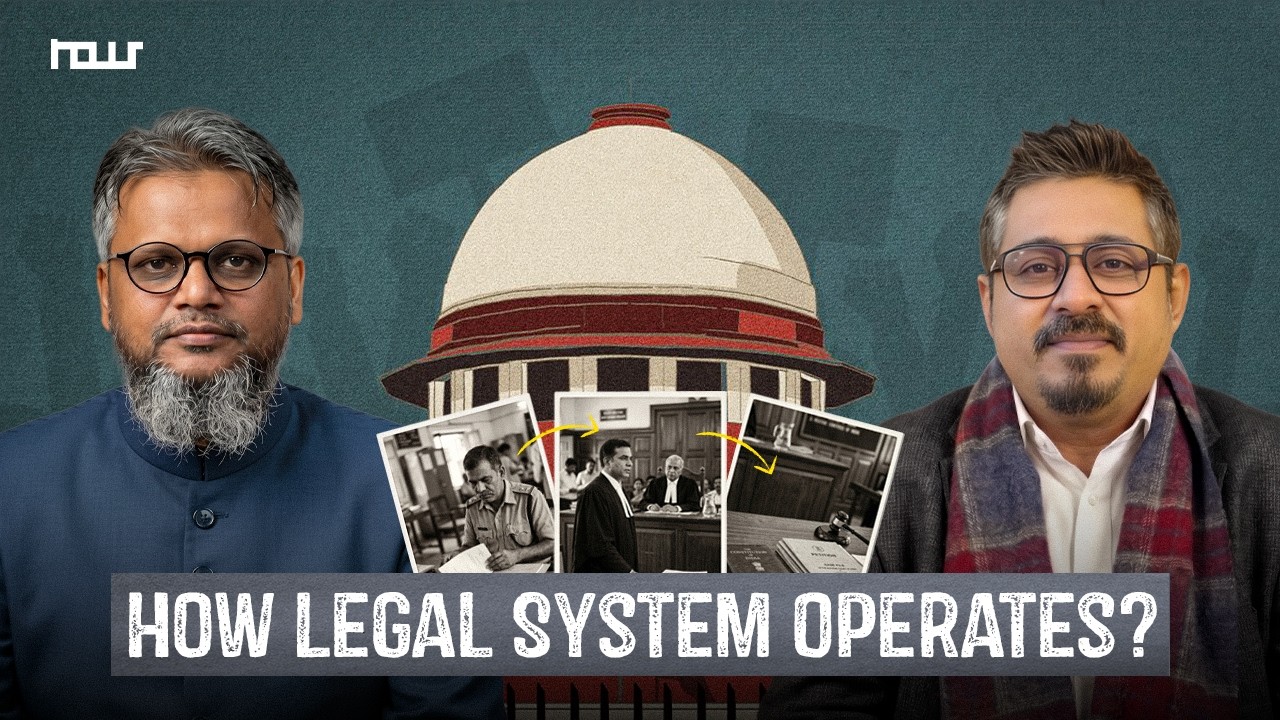
The Question That Never Gets a Final Answer
"What is law?" is the kind of question, Dr. Nizamuddin Ahmad Siddiqui tells his host Asad Ashraf, that most disciplines never have to ask about themselves. No physicist opens a textbook by defining physics; no chemist agonises over what chemistry is. Law is different — every serious legal theorist eventually wrestles with defining its own subject, because the answer depends entirely on who is asking. For a judge, Siddiqui explains, law is a source: the basis on which a dispute gets settled. For a lawyer, it is raw material for argument — a tool to convince a judge, not an abstract pursuit of justice. For a teacher, it is a body of concepts to be explained: where law comes from, how institutions create it, how courts interpret it. For an ordinary citizen, law is mostly an expectation, one frequently disappointed. And for a government, law is authority — validation for whatever it wishes to do, which is precisely why governments work so hard to have legislatures pass what they want into law rather than simply decreeing it.
That plurality of meanings, Siddiqui argues, is why law resembles theology more than it resembles science. Every major theological tradition treats justice as its central concern, and law, likewise, is inherently about justice — yet, like theology, it remains "scholar-centric," dependent on interpretation rather than settled by observation.
Justice Is Not a Fact. It Is an Assumption.
Perhaps the conversation's sharpest turn comes when Siddiqui interrogates the word "delivery" in the phrase "delivery of justice" — a phrase, he notes, that borrows the language of childbirth, implying a gestation period before an outcome arrives. But what actually gets delivered, he argues, is not justice itself; it is the settlement of a dispute. When the Supreme Court decides who owns a piece of property, or answers a presidential reference on a constitutional question, there is no dispute in any metaphysical sense — only a question requiring an answer, and a court settling it. "If you look at it in the hard, technical sense, that is not justice," he said. "So what is justice, then? Justice is your assumption" — the understanding that because a dispute has been settled by a final authority, justice must have occurred. This is why finality matters so much to the idea of justice: an endless chain of appeals would never produce it, so legal systems cap the process — district court, high court, Supreme Court, review, curative petition — and treat that endpoint as justice achieved, in the same way, Siddiqui notes, that Islamic theology locates ultimate justice in the finality of Allah's judgment on the Day of Judgment.
Why Law Needs Authority — and Why Authority Needs Force
Law, in Siddiqui's account, is inherently "top-down": without authority, there is no law, and authority itself, as the twentieth-century legal philosopher Norberto Bobbio argued, is ultimately established through force. This is why criticising the judiciary so often collapses into accusations of "challenging the court's authority" — because authority is genuinely foundational to how law functions, not incidental to it. Historically, this took its purest form under monarchy: whatever the king said was law, a position formalised by the jurist John Austin as the "command of the sovereign" — a structure, Siddiqui notes, strikingly similar to theological reasoning in which whatever God has ordained simply is the law.
Democracy complicates this picture without eliminating it. A bill must pass through parliament, one house to another, then to the president or governor — a process saturated with protest, lobbying and negotiation at every stage. Because law is produced by a political process, Siddiqui argues, it is "inherently political" in nature, whether the subject is the height permitted for construction in the Aravalli hills, the treatment of stray dogs, Kashmir's Article 370, the Citizenship Amendment Act, or the appointment of judges. This is also, he argues, why identity politics is not a distortion of democratic life but a precondition for it: representation in parliament requires groups to organise around identity in order to be heard at all, which is why B.R. Ambedkar so strongly championed Dalit political organisation — without it, Dalit concerns could never be translated into law. Siddiqui extends the point pointedly to the present: as Muslim political organisation has diluted, he argues, the relationship between law and Muslims has grown correspondingly ambiguous.
Where the Subjectivity Actually Lives
Asked to describe how, concretely, non-legal factors shape a judgment, Siddiqui walks through the entire pipeline of a case. It begins with the police, who frame the initial charges — a stage he says is often neither fair nor neutral. It continues through lower courts, where, he says bluntly, corruption and delay are a documented reality that litigants must reckon with. It continues into advocacy itself: senior counsel command extraordinary fees not for legal knowledge alone but for the ability to read a bench's mood in real time and adapt an argument accordingly — sensing that a particular judge dislikes a particular line of reasoning, or that only two minutes remain to make a point meant to take twenty. Siddiqui calls this "courtroom theatrics," recalling an environmental lawyer who reportedly told a bench he could barely speak "because of the pollution" — a way of making an argument without technically making one.
Beneath all of this sits the judiciary's own subjectivity, including judges' political leanings — a factor Siddiqui says is far more openly acknowledged in the United States and Britain, where judicial ideology is discussed as a matter of course, than in India, where the judiciary is treated as too sacrosanct for such scrutiny even though frequent courtroom observers understand it perfectly well. He illustrates judicial interpretation's capacity to stretch a record with the Ayodhya title dispute, where an Allahabad High Court order calling for excavation beneath the disputed site — despite excavation having no bearing on legal title, which under both English and Indian common law rests only on documentary deed or long possession — was later folded into the reasoning that ultimately awarded the site.
Politics Inside the Judgment: The Bail Order as Case Study
Siddiqui uses the much-debated bail proceedings involving Umar Khalid, Sharjeel Imam and others charged in the 2020 Delhi riots case to illustrate how reasoning itself can carry an outcome pre-installed. He notes the striking argument that releasing the accused could endanger the lives of protected witnesses — an argument that, properly read, already assumes the guilt the trial has not yet even begun to establish. "You have already assumed culpability," he said, adding that this is precisely why the reasoning has drawn sustained criticism from practising advocates: it does not behave like an ordinary legal argument, yet remains binding because, in Siddiqui's account of how law ultimately works, "law is what the courts tell you it is" — full stop, regardless of whether outside observers find the reasoning persuasive.
Constitutional Morality, Sealed Covers, and the Physics of Friction
Siddiqui distinguishes three sources courts must reconcile: positive law (what legislatures enact), natural law (norms — murder is wrong — embedded in human nature independent of scripture), and divine law (the Quran, the Vedas, the Bible). Because a secular constitutional democracy formally sets divine law aside, the vacuum has to be filled from somewhere, and India's answer, he argues, is "constitutional morality" — a doctrine combining positive law's structure with a moral compass derived not from priests or public sentiment but from the constitutional text itself, used to police boundaries such as when courts should exercise judicial restraint or when legislatures should not dictate to judges.
He describes recent controversies over the collegium system, the abandoned National Judicial Appointments Commission, sealed-cover evidence, and courts reversing their own earlier orders — as in disputes over Aravalli hill heights or the treatment of stray dogs — not as anomalies but as an ordinary "balancing act" between institutions that both depend on each other's cooperation to function. When executive and judiciary come into direct, face-to-face confrontation, he notes — as happened over the judicial appointments commission — one side typically asserts itself and the other, however reluctantly, cedes ground, precisely because "that is how the state works." He points to the removal of law minister Kiren Rijiju amid sustained public friction with the judiciary as one visible resolution of such a standoff.
When Dissent Becomes Law
One of the conversation's most striking passages concerns judicial dissent — illustrated through the account of the 1994 Ismail Faruqui judgment on the Ayodhya dispute, where Justices A.M. Ahmadi and S.P. Bharucha dissented from the majority. Citing a documented account of the deliberations, Siddiqui recounts Ahmadi refusing to sign the majority's position even under pressure, retreating to write a separate dissenting opinion instead — one that, in Siddiqui's reading, thoroughly dismantled the majority's reasoning on the basis that a court cannot decide a title dispute according to religious faith. A dissenting opinion is never binding, he notes, but it is far from meaningless: it preserves an alternative jurisprudence that later, differently composed benches can — and sometimes do — elevate into binding law.
Why Global Anxiety Is Reshaping the Nature of Law
Siddiqui situates India's judicial and political turbulence within a wider global pattern. Globalisation, he argues, dissolved the sense of local, rooted identity — a Shaheen Bagh protest becomes as legible as an international human-rights story as a domestic one — leaving people without the "self of identity" that community and locality once supplied, a gap that liberal individualism, focused on individual autonomy rather than communal belonging, has failed to fill. Into that vacuum, majoritarian politics rushes in easily, since democracy's basic logic — whoever commands the larger share prevails — always carries the latent capacity to tip into majoritarianism, especially around a sufficiently polarising figure. Compounding this, he argues, is the diminished capacity of the political left globally to offer a competing framework. None of this bypasses the judiciary, in his account, precisely because law's political nature means that whichever politics dominates a society's institutions will inevitably find representation within them, including the courts.
A Verdict That Refuses to Be a Verdict
Asked, finally, whether Indian courts today advance the promise of justice or function purely as an instrument of control, Siddiqui declines to deliver a single verdict on the judiciary as a whole. Courts, he argues, must be judged issue by issue rather than as a monolith: disability rights jurisprudence, environmental law, labour law and much of company law, he notes, "translate well" through India's courts and rarely make headlines precisely because they are neither politically charged nor legally ambiguous. It is the genuinely contested terrain — identity, national security, religious dispute — where reasoning grows most visibly strained. Even former Chief Justice D.Y. Chandrachud, criticised over the Ayodhya and Gyanvapi rulings, deserves credit, in Siddiqui's account, for expanding disability-rights jurisprudence and modernising court infrastructure. "You have to look at it context-specific," he said — a fittingly unresolved conclusion for a discipline he has spent the conversation arguing can never quite resolve what it fundamentally is.


Discussion
0Readers only · Comments are reviewed by the desk before they appear
The journalism is free for everyone — create a free account to join the discussion.