

Uttam Nagar: How a Family Feud Became a Charge Sheet Against All Muslims
Professor Apoorvanand argues that a Holi-day fight between two Delhi neighbours only turned communal after the state bulldozed a Muslim family's home without due process, opening the door for Hindutva groups to convert one death into a campaign of collective punishment.
Contents · 9 sections
- A Quarrel, a Death, and a City on Edge
- Where the Communal Turn Actually Begins
- A Familiar Sequence, From Shaheen Bagh to Uttam Nagar
- Genocidal Calls and a Double Standard in Policing
- Peace Committees and an Unequal Burden of Proof
- A Hundred Years of Preparing the Ground
- The Impossible Position of Being Muslim
- Institutions That Have Taken a Side
- Waiting for Eid, and for Someone to Show Up

A Quarrel, a Death, and a City on Edge
On the afternoon of Holi this year, a long-simmering dispute between two neighbouring families in Uttam Nagar, in west Delhi, turned fatal. The two households, one Hindu and one Muslim, had fought for years over ordinary things: parking spots, garbage, the small frictions of shared walls. Accounts of what triggered this particular flare-up diverge. The Muslim family says a young man in their neighbour's circle, Prince, threw colour on a woman of their house; the Hindu family says the reverse, that a young girl in their home was struck by a water balloon thrown from the other side. Words were exchanged, then blows, in what Professor Apoorvanand, a Delhi University professor and long-time political and social commentator, described as an ordinary occurrence that plays out somewhere in India most days.
The first clash appeared to end there. But Tarun, a Hindu man from one of the two families, then returned with associates from a gym, and a second, larger confrontation followed in which people on both sides were hurt. Tarun died of his injuries. Apoorvanand did not equivocate on this point: whatever the provocation, "yeh hatya hai" — this is a killing — and the ordinary machinery of criminal law, an investigation, charges, a trial, must now run its course. Members of the Muslim family were also seriously injured; their lawyer says some suffered deep wounds and were beaten again after being taken into Tihar jail. A minor from the family, a 14- or 15-year-old referred to as Rizwan, went missing in the aftermath, with fears — unconfirmed — that he may have died; there has been no further word of him in the days since. Several members of the Muslim family, including women, were arrested.
Where the Communal Turn Actually Begins
Apoorvanand's central argument is that the fight itself was not a communal event. Two neighbours who happened to be Hindu and Muslim had a violent altercation of the kind that recurs across the country regardless of religion; nothing in the transcript of events he describes suggests that other Muslims joined in against Tarun, or that the clash spread beyond the two households. "Yeh sirf do parivar tak" — this stayed confined to two families, he said, arguing that by any ordinary reading this was not, in itself, sectarian violence.
What changed that, in his account, was the state's own response. Soon after Tarun's death, authorities demolished the home belonging to Rizwan's family, officially justified as action against an unauthorised structure. Apoorvanand calls this the first act of communalisation, and insists it was carried out by the government itself: no notice was given, no time allowed, and the demolition proceeded in defiance of the Supreme Court's own directions on how such actions must be conducted. "Yeh pehli sampradayik karyavahi hai" — this was the first communal act, he said, delivered by the state before any Hindutva organisation had even mobilised.
He drew a direct parallel to an earlier case in Rajasthan, where a school fight between two children, one Hindu and one Muslim, ended with the Hindu child stabbed and killed. There too, he said, the administration's first response was to bulldoze the home the Muslim family lived in, a rented house belonging to someone else entirely. When civil-liberties activists asked the district magistrate to explain the demolition, the officer said it was done to placate the mob and prevent further violence. Apoorvanand's rejoinder was blunt: that is not justice for the dead child, it is an attempt to satisfy what he called a Hindutva sensibility, punishment delivered before any FIR, any court hearing, any investigation had taken place.
Only after this state action, he said, did the second wave of communalisation begin: Hindu Raksha Dal, Bajrang Dal and the Vishva Hindu Parishad converged on Uttam Nagar and recast a death between neighbours as an attack on Hindus as a category. Tarun, in this retelling, stopped being an individual and became a stand-in for all Hindus; the accused family became, in the same move, representative of all Muslims. Apoorvanand noted, without confirming it, that lawyers involved in the case have claimed Tarun's own family had links to Bajrang Dal.
A Familiar Sequence, From Shaheen Bagh to Uttam Nagar
Asked to compare this with the Delhi riots of February 2020, Apoorvanand distinguished the two while insisting on a shared pattern. That earlier violence followed a sustained, months-long protest at Shaheen Bagh against the Citizenship Amendment Act, a movement he said was overwhelmingly Muslim in composition and entirely peaceful. What preceded the violence, he argued, was a state-driven rumour campaign: central ministers claimed terrorists and rapists were hiding among the Shaheen Bagh protesters, and senior leaders of the ruling party described the sit-in itself as an act of terrorism. He recalled a widely noted remark from a Union minister about pressing the voting button so hard that Shaheen Bagh would feel the shock, calling it a direct incitement to violence. When Bharatiya Janata Party leaders then warned that protesters would be removed by force if they did not leave the streets themselves, he said, police allowed the threat to be made openly and did nothing to stop it. The chants of that moment, he recalled, made the alignment explicit: "Delhi Police lath chalao, hum tumhare saath," and its companion, invoking the prime minister directly.
Uttam Nagar lacks that organised backdrop; there was no protest movement to be smeared before the violence. But Apoorvanand sees the same institutional posture repeating: police standing by while a mob mobilises, and administrative machinery treating one community's grievance as license for collective retribution. "2020 mein bhi police ne unka saath diya, 2026 mein bhi" — in 2020 the police sided with them, and now again, he said, describing an unbroken thread of permissiveness toward Hindutva mobilisation regardless of which government or year. He also dismissed as false the claim, repeated by protesters, that the incident had ruined Hindu households' Holi; Hindus in the area, he said, celebrated the festival as they normally would, making the grievance a fabricated pretext rather than a lived injury.
Genocidal Calls and a Double Standard in Policing
The slogans and demands circulating in Uttam Nagar have gone well beyond grief. Protesters have declared that Eid will not be allowed to be celebrated, that the next Holi will be played with Muslim blood, and chanted that they are ashamed because Tarun's killers still live. Some have called openly for an extrajudicial "encounter" killing of the accused, in the middle of a public street. Apoorvanand's response was to turn the demand back on itself: should the country adopt a rule that anyone who considers a person responsible for a death may simply shoot them, and then shoot everyone else they hold responsible too? He noted that no Muslim organisation, anywhere, has ever demanded that arrests be halted after a Muslim was accused of killing someone; by contrast, he said, when Hindu men are arrested for lynching or rape, crowds often surround the police station itself demanding that they be freed.
He pointed to a structural asymmetry in how the two families are being heard. Tarun's parents have spoken to the media about their own injuries and grief, while the accused family's account has reached the public mainly through their lawyer, since its members are in jail; the lawyer says they too were badly hurt, and beaten again inside Tihar. Apoorvanand argued that Tarun's character, good or bad, and any past association with an organisation like Bajrang Dal, is irrelevant to the wrongness of his death — but by the same logic, he added, it is equally irrelevant to how much protection the accused family deserves under the law while the case proceeds.
The area itself has begun to harden along communal lines: Uttam Nagar's blocks have effectively been divided into a Hindu side and a Muslim side, each hardening its own narrative. Apoorvanand said he sees the same pattern recur wherever such violence has occurred. He described visiting Shiv Vihar in northeast Delhi as recently as late February, five years after the 2020 riots, and finding a lane that had once been mixed now clearly split, with residents pointing out exactly where the "Hindu" stretch ends and the "Muslim" one begins. In Khajuri Khas, he recalled seeing bamboo barricades still separating burned Muslim homes from a Hindu side where residents showed no remorse and, if anything, resented those who expressed sympathy for the Muslim victims. "Hinsa turant baant deti hai" — violence divides a place instantly, he said, and once a side feels blamed for that violence, even correctly, it tends to grow more defensive and resentful rather than less.
Peace Committees and an Unequal Burden of Proof
Apoorvanand pointed to a telling contrast in footage of Uttam Nagar's peace-committee meetings. An elderly Muslim man, speaking calmly, insisted the two families had lived as neighbours for years, that this was a private dispute rather than a communal one, and that the whole community should not be blamed for it. A Hindu speaker at the same gathering, whom Apoorvanand identified as upper-caste, responded by telling Muslims present that they suffered from a lack of education, then suggested Muslims collectively raise a large sum of money for Tarun's family as proof that they truly stood with their neighbours.
Apoorvanand called this a revealing double standard: no equivalent demand has ever been made of Hindus, that they collectively raise money for a Muslim family killed by Hindu men, after any of the many such killings across the country. The unequal expectation, he said, exposes something durable, "ek ganth jo Hinduon ke dil mein hai" — a knot lodged in the Hindu heart that resurfaces at moments exactly like this one. He also noted that the community elders who once quietly contained such tensions before they escalated have largely disappeared, leaving fewer people equipped, or willing, to do that work now.
A Hundred Years of Preparing the Ground
Pressed on whether this radicalisation could be confined to fringe Hindutva organisations, Apoorvanand rejected the framing outright. He traced it instead to the Rashtriya Swayamsevak Sangh and its network of affiliated organisations, which he said have spent a century filling minds, through institutions such as Saraswati Shishu Mandir, Vidya Bharati, Seva Bharati and Sanskar Bharati, with a particular idea of the nation and a particular image of Muslims. The result, in his description, are minds conditioned not to mind if Muslims are killed, because, in that worldview, they should not exist in that place at all, are seen as fundamentally different, and are believed to have taken something that belongs to others.
What was once confined to shakhas and classrooms, he argued, is now spoken openly by the country's most powerful office-holders, and amplified by television channels, newspapers and films. Where such rhetoric once produced at least some public hesitation, he said, it is now voiced with pride. He cited footage of children on camera calling for violence against Muslims, and recounted an activist's account of schoolchildren spontaneously chanting "Jai Shri Ram" as their auto-rickshaw passed a mosque, on their way back from a picnic. He connected this to the normalisation of Ram Navami processions in which boys as young as twelve now carry swords, a practice he said was once condemned but is now treated as admirable, on the reasoning that if the prime minister behaves a certain way, ordinary citizens feel licensed to follow.
The Impossible Position of Being Muslim
Asked what Muslims could realistically do to defuse this atmosphere, Apoorvanand's answer was that the question itself has no honest answer, because every path is foreclosed. Muslims are called backward when they are uneducated, he said, and "shatir" — cunning — when they are educated, citing court remarks about activists Sharjeel Imam and Umar Khalid suggesting their education made their intentions harder to detect. They are told not to confine themselves to mosques and graveyards, and then accused of pursuing "jihad" when they build schools, colleges and hospitals instead. When they enter the civil services, he said, they are accused of infiltrating the state apparatus, a phrase he attributed to RSS chief Mohan Bhagwat.
His conclusion was that Muslims are fighting what amounts to a battle for survival, and doing so entirely within constitutional and democratic means: seeking not a pro-Muslim state but a secular, democratic order that protects life, property and dignity, and voting accordingly. He drew a sharp contrast between this record and the fear routinely invoked to justify surveillance and suspicion of the community. Despite decades of anti-Muslim violence, in the Partition era, in the 2002 Gujarat riots, and in outbreaks in Mumbai, Bhiwandi, Jamshedpur and Bhagalpur, he said no organised Muslim terrorist movement has taken root in seventy years. The response to injustice, he argued, has instead run almost entirely through the courts: he cited Zakia Jafri's more than two-decade legal fight over her husband's killing in the 2002 riots, Bilkis Bano's fifteen-year pursuit of justice, and the unlettered mothers of victims like Junaid and Pahlu Khan who have nonetheless pursued their cases in court. He also referenced a recent account of the trial following the 2020 Delhi riots, describing how dangerous it can be for any Muslim witness simply to hold their ground under testimony, and noted that people do so anyway.
Institutions That Have Taken a Side
Apoorvanand extended his critique to the institutions meant to check this kind of majoritarian mobilisation. He pointed to a change in the recorded rate of anti-Muslim incidents in Karnataka after the state's government changed from the BJP to the Congress, arguing that this shift shows police and administrative behaviour tracks political leadership far more than it reflects fixed institutional values. His broader claim was that neither the bureaucracy nor the police in India currently have the independent courage to act impartially, and that they instead require what he called a "political boss" willing to insist on it. It followed, in his view, that changing the ruling political leadership matters more, in the near term, than hoping individual attitudes will soften on their own, since, as he put it, "Muslims can't afford to wait" for that slower change of heart, and neither can Christians.
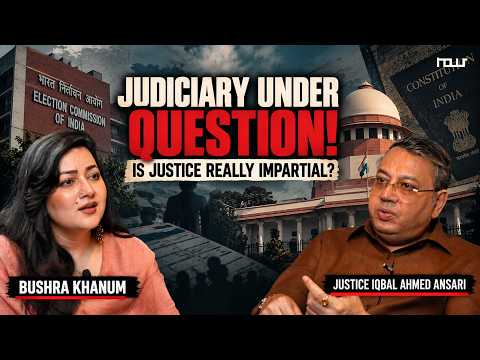
His sharpest words were reserved for the judiciary, which he called complicit in what he described as the most shameful period in its history. He faulted courts for failing to act against demolitions carried out in violation of the Supreme Court's own guidelines, and for not curbing open hate speech, while contrasting this with the readiness of the same courts to take up matters like a school textbook chapter on their own initiative. He named former Chief Justices D.Y. Chandrachud and S.A. Bobde, along with sitting Chief Justice Surya Kant, predicting that history would eventually judge this generation of judges the way Nuremberg-era judges were judged for what they failed to do when it mattered. He described the state's institutions collectively, the Election Commission, the bureaucracy, the police and the judiciary, as having effectively settled into cementing what he called an undeclared Hindu Rashtra. Still, he pointed to lawyers such as Nitya Ramakrishnan and Kapil Sibal, and to judges such as S. Muralidhar and a transferred Allahabad High Court judge, along with court orders questioning why restrictions imposed on Muslim gatherings were not applied equally after the Kumbh stampede, as evidence that the fight against this drift has not been entirely abandoned.
Waiting for Eid, and for Someone to Show Up
With Eid approaching and threats still circulating that it will not be allowed to be celebrated in Uttam Nagar, Apoorvanand said predicting whether the threats will turn into actual violence is genuinely difficult, since a determined group can act regardless of warnings. But he insisted the risk is not unmanageable: Delhi Police, he noted, routinely prevents far smaller and less threatening gatherings from forming at all, which means its continued tolerance of these mobilisations reflects a choice rather than a limitation of capacity.
His deepest frustration, though, was directed at politicians across the spectrum. Every major political party has its national headquarters in Delhi, he pointed out, and yet none of their senior leaders have travelled to Uttam Nagar to hold a peace meeting or speak directly to the Hindu residents whose anger is driving the mobilisation. He noted that only a retired IIT professor, B.K. Tripathi, had gone there alone, at real personal risk, while national leaders who invoke Gandhi's name constantly have ignored Gandhi's actual example of travelling personally to Noakhali and other sites of violence to restore calm. Justice, he said in closing, cannot be delivered on the terms the loudest voices in Uttam Nagar are demanding, since the rule of law does not operate by public sentiment or a logic of a death for a death, however common that sentiment may be. What is underway, he said, is not simply a fight to protect Muslims but a broader, uncertain struggle to keep India itself from settling permanently into majoritarian rule, a struggle he does not expect to win outright, but one he said has not yet been abandoned.


Discussion
0Readers only · Comments are reviewed by the desk before they appear
The journalism is free for everyone — create a free account to join the discussion.