

The Map of Medina: Why Fiqh Is a Blueprint for Society
Scholar and National Zakat Foundation chief Dr Sohail Hanif argues that Islamic law was never meant as a private rulebook — it is an institutional plan for building community, with or without a state to enforce it.
Contents · 6 sections
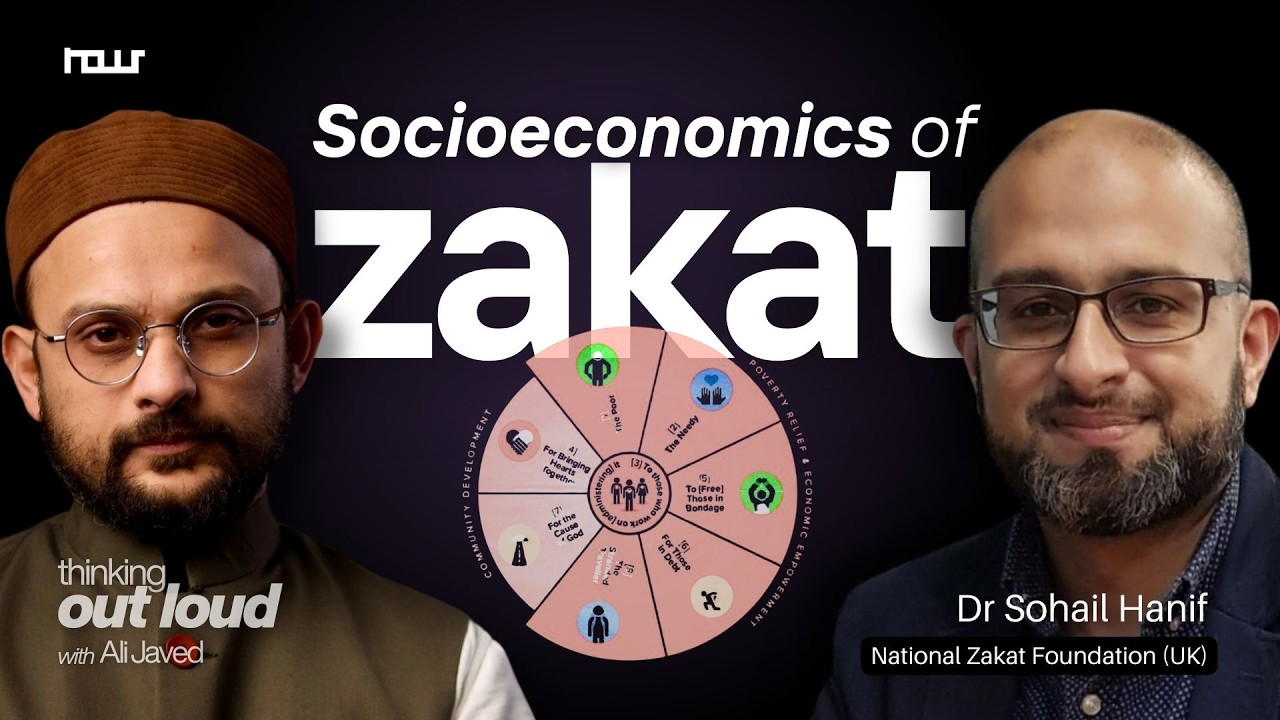
What does it actually mean to live by Islamic law? For Dr Sohail Hanif, chief executive of the National Zakat Foundation in the UK and a scholar trained for over a decade in the Hanafi legal tradition in Jordan and at Oxford, the question is badly served by the way it is usually asked. Fiqh, he argues in a wide-ranging conversation on the Nous Podcast, is not primarily a personal rulebook of what a Muslim may or may not do. It is a blueprint for building a society — and the place that blueprint was first drawn up was the Prophet Muhammad's Medina.
From Mecca's Ethics to Medina's Institutions
Hanif's framing rests on a distinction between the two cities central to early Islamic history. Mecca, in his reading, is where the ethical content of Islam — how to treat women, the poor, the enslaved, one's neighbours — was internalised by individuals without any accompanying state structure to enforce it. Medina is where the Prophet got the chance to convert those same internalised values into functioning institutions: prayer, Friday congregation, zakat, arbitration, marriage as a publicly recognised contract, a free market, leadership, and defence. "The mosque is the entire Sharia," he says — meaning that everything else Medina built, from welfare to markets to courts, is simply the mosque's logic extended into every part of collective life.
This is why he resists reducing Sharia to a personal code, a reduction he says the modern world has largely settled for. If he had to compress the entire Islamic legal tradition into one instruction, he says, it would be this: build Medina wherever you are, to the best of your ability. Everything else in classical fiqh, in his account, sits underneath that single civilisational command.
Crucially, Hanif argues this vision of Medina was never a single uniform code imposed on everyone within it. Jewish communities living there were told to organise their own affairs, follow their own rabbis, and have their marriages and internal disputes legally respected — a form of protected religious pluralism he says is foundational to the Sharia, not incidental to it. He offers a deliberately uncomfortable example from Hanafi law: jurists held that Muslim judges had no authority to intervene in incestuous marriages practised by Zoroastrian communities under Islamic rule, because those communities had been guaranteed the right to regulate their own affairs. The point, for Hanif, is that a legal system built on an absolute truth claim nonetheless chose, by that same truth claim, to protect a plurality of other truths living under it — which is precisely what a claim of Islamic domination gets backwards.
Zakat as the Engine of Medina
If Medina is the blueprint, zakat is what Hanif calls its most important engine. He insists on calling it what it is: taxation, not charity — a state-administered, rate-fixed levy first specified after the migration to Medina, collected and redistributed by appointed officials, structured around eight defined categories of recipients. Unlike an ordinary tax, though, its rate and its destinations are fixed by revelation rather than by government discretion, which is precisely why Hanif thinks it matters for arguments about limiting state power today: a government administering zakat cannot simply decide to raise the rate or redirect the funds. "Sharia is a code of systems that can give more autonomy to people," he argues, by deliberately strengthening loci of authority — the family, the mosque, the local community — that sit outside the central government, at a moment when he sees both Muslim-majority and Muslim-minority societies alike anxious about centralising, technology-driven state power.
Zakat's economic logic, in his account, is equally deliberate: wealth is not meant to sit idle. A Muslim either circulates liquid assets through productive investment or hands a share to those in need; hoarding is what the tax structurally discourages. And the relationship it builds between giver and recipient is not one of charity flowing downward from the fortunate to a burden on society. "The poor are economic saviours," Hanif says, framing them as the very means through which a wealthy person's assets are purified — an inversion, he argues, of how modern welfare economics tends to frame poverty.
He traces zakat's historical arc carefully: revealed conceptually in Mecca, but only fixed as a rate and formally collected once the Medinan state existed to administer it. Early on, under Abu Bakr and Umar, it was fully centralised; after Uthman, jurists began distinguishing public wealth (agriculture, livestock), which stayed centrally administered, from private wealth (gold, silver, trade goods), which individuals self-declared and could distribute more directly — a distinction Hanif reads as an early legal safeguard against government intrusion into private life. Its default, though, remained local: wealth collected in a town was meant to be redistributed within that same town, tying zakat directly to place-based community-building rather than to abstract, borderless charity.
Building Medina Without a State
The harder question, which the conversation returns to repeatedly, is what any of this means for Muslims who form minorities inside modern nation-states, with no sovereignty of their own — whether in Britain or in India. Hanif's answer is that the absence of sovereignty does not suspend the obligation to organise; it just changes its shape. Muslims in minority settings are still instructed, in his account, to self-organise to the best of their ability — appointing prayer leaders, informal arbitrators and community institutions that replicate Medina's functions even without a Muslim government behind them.
He points to a very practical version of this in Britain, where local authorities such as Birmingham's are effectively bankrupt while serving large Muslim populations. If Muslim communities can organise their own welfare, their own zakat distribution, and fill the gaps a failing local state can no longer cover, they are not withdrawing from wider society, he argues, but becoming a necessary partner within it — a distinction he considers essential, since he sees non-Muslim societies as often (and understandably) wary that such organising is really a bid for separatist control rather than collaboration. The goal, in his words, is presenting self-organisation as advantageous to the whole of society, not as a threat to it.
A Structure Built to Fracture Well
One recurring image in the conversation is that Medina's model was designed to scale down as much as up, replicating like a honeycomb rather than requiring one unbroken chain of command. Hanif points to Islamic history itself as evidence: after the early caliphs, the Umayyads still pursued something like a single centralised authority, but the Abbasid caliphate fractured quickly into effectively self-governing regions, with the caliph's authority becoming largely symbolic even as cities such as Basra and Kufa continued running their own affairs within the same broad legal blueprint. Rather than reading that fragmentation as decline, Hanif treats it as evidence the system was built to survive a weak or compromised centre — stability came from the repeatability of the local unit, not from an unbroken hierarchy running through it.
That is also, in his account, exactly what the Prophet modelled directly: when Mecca itself entered the fold in the seventh year after the migration to Medina, the Prophet did not relocate the capital back to Mecca but instead appointed a twenty-year-old governor there, complete with his own zakat collector and market official — in effect exporting a miniature Medina into a newly joined city. Every faith community that later swore allegiance was sent its own judge, tax collector and governor along the same template. The implication for a Muslim minority today, on this reading, is not that self-organisation requires waiting for sovereignty, but that the model was always meant to be planted wherever a community exists, at whatever scale is available to it — a household, a mosque, a neighbourhood council — without needing the whole apparatus of a state behind it.
How Different Countries Actually Run Zakat
Pressed on what this looks like in practice, Hanif surveys a genuinely varied global landscape. Malaysia runs zakat collection at the state level, each state with its own central body, backed by a tax incentive that lets zakat payments offset income tax — a structure that has pulled in substantial funds precisely because it is embedded in the formal tax system. Singapore embeds zakat collection still more formally: a government Minister of Muslim Affairs oversees Majlis Ugama Islam Singapura, the official state-linked zakat authority for the country's Muslim minority. Indonesia runs parallel centralised and semi-centralised systems side by side. Pakistan's experience, by contrast, has been rockier — zakat historically deducted directly by banks under central government rules proved unpopular enough that, as Hanif notes, some people reportedly declared themselves Shia specifically to be exempted from the collection. In most Muslim-majority countries, he says, there is no formal state zakat system at all; private charities merely facilitate ad hoc giving, without the systemic, place-based redistribution the Medinan model implies.
This survey sets up a discussion of what a comparable structure might look like in India, where — as the host notes — waqf institutions have come under severe legal and political pressure and zakat giving remains highly dispersed, with individual donors often having little visibility into where their own contributions end up. The proposal on the table is a national zakat body organised around local surveys of rural, small-town and urban Muslim localities; a digital layer matching givers to recipients within their own communities; and coordination with existing bodies such as Imarat-e-Sharia and Jamiat Ulama, rather than an attempt to centralise everything under one new authority. The Mughal-era model of the Fatehpuri mosque in Old Delhi, whose adjoining shops generated rental income that funded a school, a madrasa and communal infrastructure, is invoked as a template for combining zakat with revenue-generating waqf property rather than treating them as separate problems.
Hanif's own organisation offers a working case study of how that trust gets built incrementally rather than declared into existence. The National Zakat Foundation, fifteen years old in the UK and since extended to Australia, Canada, the Netherlands, New Zealand and Germany, built participation gradually: first establishing that poverty is a real and severe problem within Britain's Muslim community — among the most impoverished of the country's faith groups, he notes — then building transparency and independent Sharia and financial audits, then using technology to match individual givers to recipients in their own locality, and now partnering directly with local mosques so that donors trust people they actually know rather than an anonymous national charity. The next step, he says, is convening local leadership forums — starting with Birmingham — that can negotiate directly with local government on Muslim welfare, turning a charitable structure into a recognised civic partner. The Foundation has also begun collecting non-zakat donations so the same systems can serve non-Muslim neighbours, deliberately building what he calls a public solution rather than a purely communal one.
A Vision, Not a Nostalgia
Underlying all of this is a broader argument that recurs throughout the conversation: fiqh, done properly, is neither museum-piece nostalgia for seventh-century Arabia nor abstract philosophy detached from lived communities. Hanif is explicit that Islamic scholarship has often collapsed into rote repetition of legal statements rather than training people in the underlying craft of reasoning that classical jurists like Abu Hanifa pioneered — and that recovering that craft is what allows the Medinan blueprint to be reapplied intelligently to radically different contexts, from twenty-first-century Birmingham to Old Delhi, without pretending those contexts are identical to seventh-century Arabia.
He ends on what he frames as the real stakes of the conversation: a global Muslim community still working through the aftermath of colonisation and the loss of centralised religious authority needs leaders capable of building coalitions in the actual places people live, not just producing ideas about what an ideal Islamic society would look like in the abstract. "Our leaders will be the ones who know how to build bridges," he says. "Our leaders will not be the ones who break the bridges."


Discussion
0Readers only · Comments are reviewed by the desk before they appear
The journalism is free for everyone — create a free account to join the discussion.