

The Long Silence: How South Asian Islam Tried to Rebuild Its Theology
In a wide-ranging conversation with Nous, the scholar Dr Waris Mazahri traces two centuries of Muslim thinkers trying, and mostly failing, to rebuild Islamic theology for a world remade by modern science.
Contents · 10 sections
- A Book About an Unfinished Project
- Why the Old Theology Stopped Fitting
- Philosophers, Theologians and a Rope of Many Strands
- Al-Ghazali, and the Gap That Followed
- Shah Waliullah's Innovation
- Sir Syed's Naturalism and Its Costs
- Shibli Nomani's Incomplete Synthesis
- Iqbal's Reconstruction and the Ijtihad Question
- Three Ideas of Islam as a "Holistic System"
- The Unfinished Curriculum, a Century On
A Book About an Unfinished Project
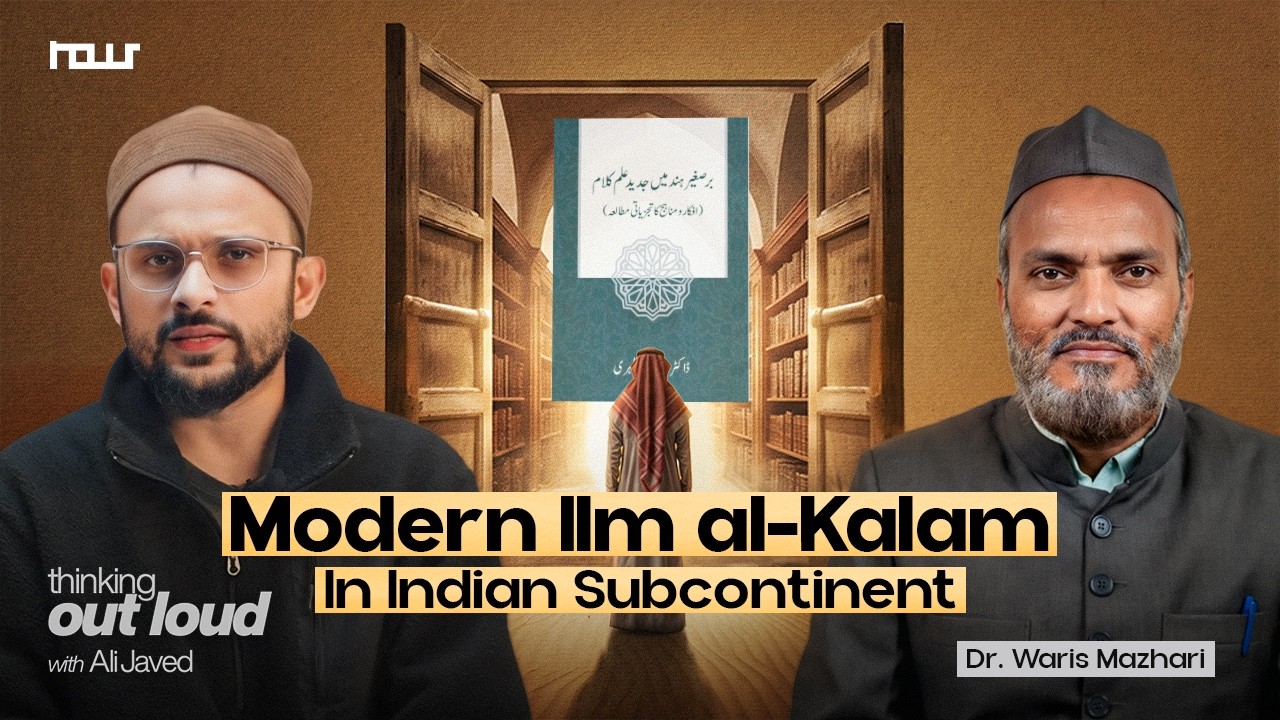
Dr Waris Mazahri, an assistant professor of Islamic Studies at Jamia Hamdard in Delhi, has spent his career on a question most religious scholars would rather not ask: does Islamic theology as it has been taught for a thousand years still have the tools to answer the modern world? His recent book, Barre Sagheer Hind mein Jadeed Ilm-e-Kalam ("Modern Ilm al-Kalam in the Indian Subcontinent"), surveys roughly the last 150 to 200 years of attempts by South Asian Muslim thinkers to answer that question. In conversation with Nous, Mazahri walked through that history in detail — not as a tour of dead debates, but as the story of an intellectual project started several times over by the subcontinent's most consequential thinkers, and never quite finished.
Ilm al-Kalam is usually translated as Islamic scholastic or dialectical theology: the discipline devoted to defending the articles of Muslim belief through structured argument, rather than through fiqh's legal reasoning or tasawwuf's mystical experience. Mazahri's case is that classical kalam was built almost entirely on the scaffolding of Greek philosophy — specifically Aristotelian physics and metaphysics — and that this scaffolding began to buckle the moment modern science offered a different picture of the universe. What he calls "jadeed ilm-e-kalam," or modern kalam, is the accumulated, incomplete effort of the last two centuries to build new scaffolding. Mazahri traces the term itself to Sir Syed Ahmad Khan, or possibly the Turkish scholar Ismail Hakki, and notes it is now standard usage across the Muslim world.
Why the Old Theology Stopped Fitting
The problem, as Mazahri lays it out, is concrete rather than abstract. Classical kalam texts inherited a Ptolemaic cosmology: the earth was treated as static and, in some formulations, as flat rather than spherical. Mazahri points to Abd al-Qahir al-Baghdadi's Al-Farq bayn al-Firaq, a foundational heresiographical text, which folds a static earth into the creedal positions of Ahl al-Sunnah wal-Jama'ah. For centuries this caused no friction, because the reigning natural philosophy agreed with it. But from the sixteenth and seventeenth centuries onward, Descartes and the wider current of modern science began dismantling Aristotelian physics altogether, and suddenly the old kalam texts and the new picture of nature were making incompatible claims about the same physical world.
This, Mazahri argues, is the actual origin of the crisis modern kalam exists to address. "Those questions were not in front of the Mu'tazila," he says of the early rationalist school, noting that not even the Ash'aris confronted a worldview built on telescopes, falsifiability and observation-driven law rather than reason-driven speculation. The direction of inquiry had reversed: classical thought moved from reason toward objective reality, while modern science moved from observation toward law, treating reality as something to be measured before it was theorised. Sir Syed Ahmad Khan, faced with this reversal, adopted what Mazahri calls scientism — the conviction that science is the sole and final arbiter of what is real, so that whatever it could not verify had to be rejected. That commitment would define, and eventually distort, one of the most influential modernist projects in Indian Islam.
Philosophers, Theologians and a Rope of Many Strands
Before getting to the modern period, Mazahri insists on a point he considers widely misunderstood: kalam, falsafa (philosophy) and fiqh were never separate, self-contained tracks running in parallel. He describes the Islamic intellectual tradition as a rope of interwoven strands — religious sciences (manqulat) and rational sciences (maqulat) — present together from the first century of Islam onward. Groups like the Qadariyya, who denied predestination on largely rational grounds, appeared almost immediately. Even usul al-fiqh, the methodology for deriving Islamic law, opens its classical texts with what is essentially a kalam debate: what is reason, and how is knowledge obtained and authenticated.
Within this tradition, Mazahri identifies several distinct camps. Muslim philosophers — al-Kindi, al-Farabi, Ibn Sina, and later Ibn Rushd — were steeped in Aristotelian logic and worked to reconcile Islamic belief with the rational science of their day; Mazahri is insistent that they were not, as some retellings suggest, enemies of the tradition but rather its "servants." But in rationalising everything, including matters of ghaib (the unseen) — prophecy, the afterlife, revelation itself — some philosophers drained these categories of their literal reality, treating revelation as a purely internal psychological process and resurrection as metaphor rather than event. This provoked the mutakallimun, the theologians proper, who accused the philosophers of stripping wahy (revelation) of any real external agency.
Out of that argument came the Mu'tazila, who Mazahri says over-elevated reason to the point that revelation lost its due weight, and then the Ash'aris, who over-corrected in the opposite direction, curbing reason and weakening the causal reasoning by which people make sense of the world. Abu Mansur al-Maturidi, in Mazahri's account, tried to strike the balance the Ash'aris had missed. All of this, he stresses, unfolded alongside genuine hostility to the entire enterprise of kalam from within the tradition: Imam al-Shafi'i is reported to have said that anyone who studies or teaches kalam should be flogged and paraded through the streets, while Abu Yusuf, the student of Imam Abu Hanifa, held that "whoever learns kalam becomes a heretic." Suspicion of rationalist theology, in other words, is not a modern import — it is as old as kalam itself.
Al-Ghazali, and the Gap That Followed
Mazahri devotes considerable attention to correcting what he sees as a Western misreading of Abu Hamid al-Ghazali — the idea that Ghazali single-handedly "destroyed" philosophy and reason in the Muslim world. He rejects this outright. Ghazali's actual project, in works like Kanun al-Ta'wil, was to hold reason and revelation together without letting either side capture too much ground: he catalogued five positions on the relationship between aql (reason) and naql (transmitted text), placing himself in the fifth, which treats both as necessary and mutually informing. If God created both the world and human reason, Ghazali argued, a genuine revealed law would necessarily be revealed, reasonable and provable all at once — a synthesis Mazahri describes as one of the most consequential moves in the history of kalam, shaping everyone who came after, including Fakhr al-Din al-Razi and Ibn Taymiyyah.
But then, in Mazahri's telling, something goes quiet. After Ibn Taymiyyah, Ibn al-Qayyim, Ibn Rushd and Ibn Khaldun — broadly, by the fourteenth and fifteenth centuries — no comparably major intellectual figure emerges anywhere in the Muslim world for several hundred years. He attributes this partly to the Ottomans' near-constant wars with Europe and defence of the caliphate, which consumed attention that might have gone into sustained scholarship; partly to a failure, which the Ottomans themselves later recognised, to build the intellectual infrastructure earlier centuries had sustained; and partly to a broader civilisational insularity toward the new world Europe was constructing across the sixteenth to eighteenth centuries. He cites Bernard Lewis's What Went Wrong as a useful account of the same drought. The Muslim world, in Mazahri's phrase, lost its grip on "the pulse of time" precisely when Europe was remaking its understanding of nature, and by the time colonial powers arrived, the reckoning came too late to prevent institutional collapse — the caliphate's fall, and the absorption and eventual secularisation of Islamic personal law under colonial legal categories.
Shah Waliullah's Innovation
Into that gap steps the eighteenth-century Delhi scholar Shah Waliullah, whom Mazahri treats as the pivotal transitional figure between classical and modern kalam — someone who, in his phrase, appears "when the treasury of learning had been plundered and the markets of scholarship had gone cold." Shah Waliullah was not yet in contact with the European Enlightenment; nothing in his writing shows he had encountered Kant or Hegel. His importance lies instead in recognising, from within his own tradition, that the old intellectual tools were no longer sufficient. His major work, Hujjat Allah al-Baligha, is essentially a rationalisation project: he states explicitly, in its preface, that Islamic shariah must now be understood and expressed through reason, in the idiom of aql.
That claim is, in Mazahri's account, Shah Waliullah's most distinctive move — one the historian Shibli Nomani himself flagged as his central contribution: Shah Waliullah made shariah, and not merely doctrinal belief, a part of kalam. Before him, kalam had confined itself to core articles of belief — God's existence, prophecy, the afterlife — while Islam's legal and ritual apparatus operated as an independent, unphilosophised domain. Shah Waliullah insisted that the "why" behind ritual obligations — why one prays, why one fasts — deserved the same rational elaboration as theology's core doctrines, treating shariah itself as a theologised, holistic system rather than a set of self-justifying rules. He was also candid about breaking from taqlid within kalam specifically, since he considered kalam a purely rational project rather than one anchored in Quran and Sunnah — freely absorbing ideas from Ibn Sina, al-Farabi, Mulla Sadra, Ibn Arabi and Suhrawardi, including concepts like alam-e-misal, the "world of images," while still insisting on taqlid in matters of fiqh proper.
Sir Syed's Naturalism and Its Costs
If Shah Waliullah supplied the foundation, Sir Syed Ahmad Khan supplied the first sustained modern building on top of it — and, in Mazahri's reading, the first major modern collapse. Sir Syed was deeply influenced by Shah Waliullah and quotes him extensively; his originality lay not in inventing the need for modern kalam but in forcing it into public consciousness, "shaking people's minds," as Mazahri puts it, at a moment when almost nowhere else in the Muslim world had this urgency been felt. Iqbal himself, in a letter, credited Sir Syed with exactly this: creating the awareness before anyone had produced the answers.
The cost of that urgency was Sir Syed's near-total absorption of Newtonian scientism — the belief that whatever science could not verify should be rejected outright. Applied to Quranic material, this produced conclusions that alarmed even sympathetic readers: Sir Syed held that a genuine miracle was categorically impossible, since it would violate fixed natural law, and reinterpreted Quranic references to the miracles of Musa and Isa as figurative. He treated the angel Jibril not as an external agent delivering revelation but as an internal faculty of the Prophet's own mind. Mazahri notes that Sir Syed did not invent these positions from nothing — earlier Muslim philosophers had entertained versions of them — but that he pushed further than his intellectual resources, including limited exposure to Western-language scholarship, could properly support.
Shibli Nomani's Incomplete Synthesis
The corrective came from Shibli Nomani, who had studied under Sir Syed at Aligarh but broke from his naturalism, writing two books — Ilm al-Kalam and Al-Kalam — that attempted to hold classical and modern kalam together rather than discarding the old for the new. Mazahri suggests few scholars of that generation had read as widely in Greek philosophy and classical kalam as Shibli had; his ambition was to preserve whatever in the old tradition remained useful while compiling new answers to new questions. But his own letters — to figures like Hamiduddin Farahi — reveal the limits of the project: he repeatedly asks correspondents to explain what new ideas were emerging in the West, admitting he could not follow the debates himself, hampered by a lack of English at a moment when the crucial scholarship was appearing in European languages. Shibli died in 1914 with the project, by his own later admission recorded in Sayyid Sulaiman Nadwi's biography Hayat-e-Shibli, left incomplete — the foundation laid, the building unfinished.
Iqbal's Reconstruction and the Ijtihad Question
It is Muhammad Iqbal, in Mazahri's account, who finally possessed the equipment the project required: fluency in both traditions from their original sources, a doctorate on Persian metaphysics completed in Germany, and a mind capable of moving between Ghazali, Ibn Rushd, Ibn Taymiyyah and Jamal al-Din al-Afghani on one side, and Einstein, Whitehead, William James and Bertrand Russell on the other. His Reconstruction of Religious Thought in Islam, composed in English and therefore accessible to a global audience in a way the Urdu works of Sir Syed and Shibli were not, opens with a question nineteenth-century philosophy of religion had already posed sharply, largely following Auguste Comte's schema of religion as a stage of social development destined to be superseded by science: is religious reality even rationally possible? Iqbal's answer draws on William James's account of intuition, arguing — against Ghazali, whom he otherwise reveres — that wijdan (intuition) is not separate from reason but a part of it, and that the ultimate reality science and religion both investigate is accessible through this unified rational faculty.
Mazahri singles out the sixth chapter of Reconstruction, on ijtihad, as the book's most important contribution — a chapter, he says, that nothing written on the subject since has matched. Iqbal's central diagnosis is that the "principle of movement in Islam," which he identifies with ijtihad, had become almost entirely marginalised, ossified into taqlid somewhere after the fourth Islamic century — the traditional marker for "the closing of the gates of ijtihad." For Iqbal, recovering the right to independent reasoning, even where it meant disagreeing openly with earlier generations, was the mechanism by which Islamic thought had always renewed itself, and its absence explained the intellectual decline he diagnosed in his own time. Iqbal's influence on later kalam scholarship — Hasan Hanafi, Nasr Hamid Abu Zayd, Mohammed Abed al-Jabri, Mohammed Arkoun in the Arab world, Abdolkarim Soroush in Iran — is, in Mazahri's view, difficult to overstate, even where he disagrees sharply with where some of them took the project.
Three Ideas of Islam as a "Holistic System"
One of the more striking threads in the conversation is Mazahri's observation that twentieth-century South Asian Islam produced at least three distinct but related responses to a totalising modern scientific worldview, each casting Islam as a comprehensive system in a different register. Maulana Maududi framed Islam itself as a holistic system — a complete socio-political order. The Deoband school of thought, in Mazahri's account, effectively reframed the madrasa curriculum as a holistic system, treating the coherence of the tradition as something embedded in how it is taught rather than argued. Iqbal, by contrast, cast metaphysics itself as the holistic system, building the case at the most foundational level — first questions about existence, self and reality — rather than at the level of law or curriculum. Mazahri sees this trio as evidence that Shah Waliullah's original insight, that Islam's claim to completeness leaves no legitimate space unaddressed, science included, was inherited and pursued along genuinely different paths.
The Unfinished Curriculum, a Century On
Mazahri is unsentimental about where this leaves the present moment. A century after Iqbal, he argues, the dominant class of Muslim modernist scholars remains too captured by the very materialist ideology of the modern West it claims to answer, producing an approach to Islamic reform that — much as happened with Christianity, in his account, after its own confrontation with modern science — risks secularising belief until only an outward shell remains, evacuated of its spirit. Meanwhile, the harder work of building a genuine synthesis, one that takes both the Islamic tradition and modern knowledge fully seriously rather than judging the larger paradigm by the standards of the smaller one, proceeds at real scale in Egypt, Morocco, Algeria and Iran, but has produced comparatively little in the Indian subcontinent.
He locates the institutional root of this gap in the madrasa curriculum. He cites the scholar Manazir Ahsan Gilani's Hindustan ka Nizam-e-Talim-o-Tarbiyat for the claim that roughly forty books of rational sciences (maqulat) were once part of the standard course of study; that number has since been reduced to a handful, and even those few have not been meaningfully updated. The consequence, he says, is a student body "frozen in time" — able to recite the historical positions of past controversies but unequipped for live ones, including the resurgent debates over atheism now circulating in Indian public life, of the kind that produced the widely discussed exchange between religious scholars and the writer Javed Akhtar. Rebuilding modern kalam, in Mazahri's closing formulation, requires reintroducing the rational sciences and contemporary scientific literacy into the madrasa curriculum itself, so a new generation trained inside the tradition can also produce serious scholarship for the world outside it.


Discussion
0Readers only · Comments are reviewed by the desk before they appear
The journalism is free for everyone — create a free account to join the discussion.