

The Difference Between Losing Rights and Losing a Nation
Sociologist Tanweer Fazal argues that what Indian Muslims face today is not simply citizenship erosion suffered by other marginalised groups too, but a deliberate, decades-long project to strip them of any claim to India as their own.
Contents · 8 sections
- Not Just Rights, But the Nation Itself
- A Constitution That Was Never Fully Composite
- Learning From the Sikh Precedent, Without Equating It
- From the Streets to the Statute Book
- Otherisation as Deliberate Policy, Not Cultural Drift
- Why the "Hyderabad Model" Does Not Travel
- Impunity as a Structure, Not an Accident
- Comparisons to Rohingya, and Reasons for Guarded Hope
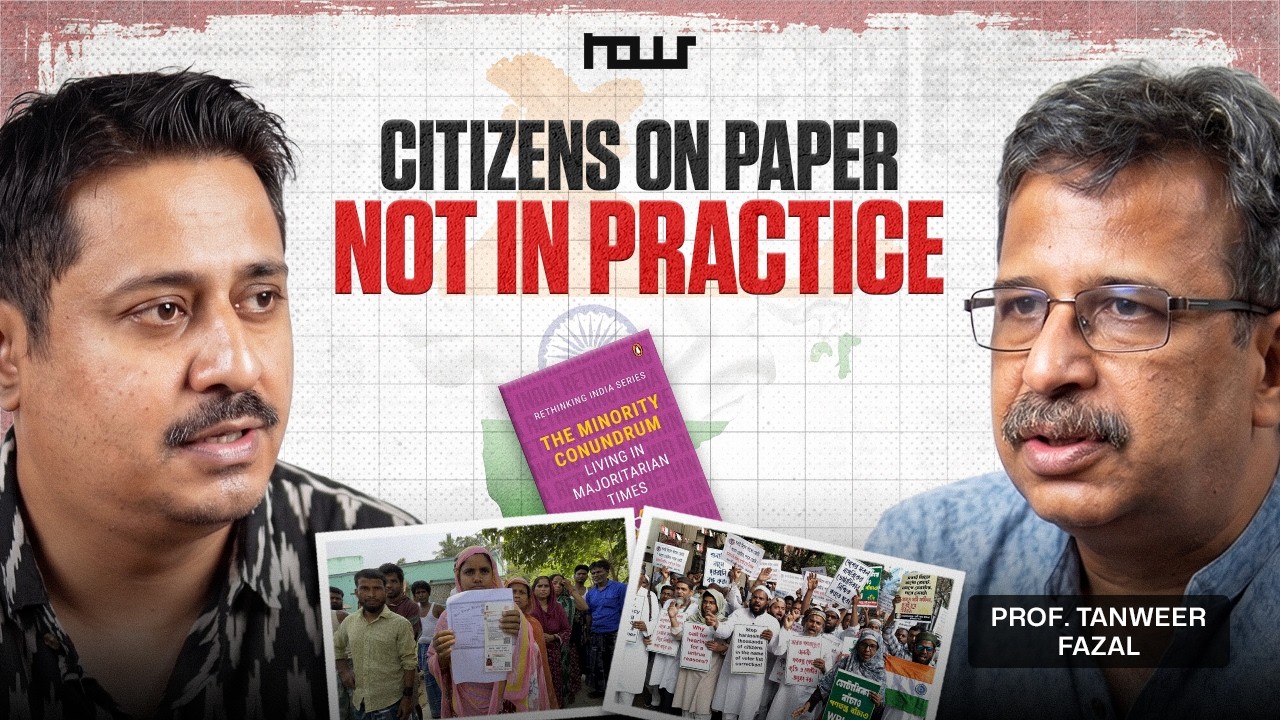
Tanweer Fazal, a political sociologist who has written extensively on statehood, minority rights and exclusion, opened his conversation on the Nous Podcast with host Asad Ashraf by naming the central idea running through his work: "illusive citizenship" — a term, borrowed from his recent book with co-authors, for the gap between the equal legal membership the Indian Constitution promises every citizen and what actually happens on the ground. That gap, Fazal argued, has not narrowed with time. It has widened, reinforced both by social inequality within Indian society and by an increasingly hostile political establishment that has, in the last decade or two, moved from neglecting constitutional promises to actively eroding them.
Not Just Rights, But the Nation Itself
Fazal's sharpest distinction was between citizenship erosion, which he said other marginalised groups — Dalits, Adivasis, the rural poor — also experience in different forms, and what he called "denationalisation," a project specific in intensity to Muslims. Citizenship erosion takes away legal protections and equal treatment. Denationalisation goes further: it questions a community's very claim to India as a homeland, branding its members outsiders, traitors, and permanent suspects regardless of what they do to prove otherwise. He offered a pointed illustration: Asaduddin Owaisi's efforts to appear as aggressively nationalist and anti-Pakistan as any Hindutva figure change nothing, Fazal said, because "the denationalisation project is so deep in the Indian subconscious" that any such gesture is read as performance rather than genuine belonging.
He traced this asymmetry to how Hindutva discourse treats Dalits versus Muslims. Dalits, despite facing real violence and untouchability, are not typically accused of disloyalty to the nation; the Hindutva movement has, in fact, worked to accommodate them within its fold — hence a prime minister who claims OBC status and prominent Dalit figures within the BJP. Muslims cannot be absorbed the same way, Fazal argued, because Hindutva's politics has been organised around Muslims as its foundational "other" since its inception; RSS chief Mohan Bhagwat, he noted, has said as much, remarking that Hindutva politics is difficult to imagine without positioning itself against Muslims.
A Constitution That Was Never Fully Composite
Asked why "composite nationalism" — the founding vision of Nehru, Azad and others that all identities could be accommodated within a single Indian state — failed to prevent Hindutva's rise, Fazal resisted treating this as simply a betrayal of an otherwise pure ideal. Majoritarian tendencies, he said, were embedded in the constitutional structure from the start. He pointed to state-level anti-conversion and anti-cow-slaughter laws passed even under Jawaharlal Nehru's government, a 1955 Sanskrit Commission that seriously proposed Sanskrit — a language nobody speaks — as India's national language on the grounds that other Indian languages derive vocabulary from it, and Article 341's exclusion of Christian and Dalit Muslims from Scheduled Caste status, with only Sikh and Buddhist converts granted exceptions in 1956 and 1990 respectively. This distinction between religions of supposed "Indian origin" and those considered foreign, Abrahamic imports, Fazal said, traces back to Savarkar's writings on Hindutva and shaped Indian constitutional thought far more than is usually acknowledged — meaning Hindutva did not need to invent its ideological resources from nothing; it concretised material that was already present.
Learning From the Sikh Precedent, Without Equating It
Fazal has separately studied Sikh political identity alongside Muslim identity, and he was careful to explain both the parallel and its limits. Both communities, in the colonial and early independence periods, produced strands of thought imagining themselves as distinct nations — a strand of Muslim political thought that culminated in Pakistan, and a Khalistan movement grounded not in theology but in the specific politics of Partition-era Punjab, where Sikhs, having been a plurality in undivided Punjab, became a minority within the reorganised state and felt their distinctiveness threatened. Both movements, Fazal stressed, were products of history and political economy rather than anything intrinsic to Sikh or Islamic theology — a point he underlined by noting Indian Muslim scholars historically developed the concept of "dar-ul-aman" (abode of peace) and "dar-ul-ahd" (abode of covenant), building on precedents including the Prophet's pact with Medina's Jewish tribes, specifically to theorise coexistence within a non-Muslim-majority state, a lineage that critics invoking "dar-ul-harb" conveniently ignore.
The crucial difference, in Fazal's account, is duration and structure. Sikh targeting — during and after Operation Blue Star, including being branded separatists and terrorists — was traumatic but comparatively short-lived, roughly four or five years at its most acute. Hindutva politics, he argued, cannot organise itself against Sikhs to the same structural, permanent extent it does against Muslims, because its foundational grammar was never built around Sikhs as the constitutive threat.
From the Streets to the Statute Book
Much of the conversation traced how citizenship erosion has moved from abstract policy into daily, lived experience. Fazal pointed to the 2019-20 anti-CAA/NRC protests as evidence of a changing Muslim civil society: a movement notably led by articulate women in decision-making roles, largely free of religious orthodoxy, framed around a material, existential claim — "our very existence is being challenged" — rather than the symbolic or cultural grievances Muslim politics is often accused of prioritising. That momentum, he said, was cut short by two forces arriving almost together: the COVID-19 lockdown, which forced immediate demobilisation, and a severe state crackdown that he compared to colonial-era repression — students shot in Uttar Pradesh, police entering Jamia Millia Islamia and Aligarh Muslim University campuses to beat students, a pattern Fazal said had no real precedent in independent India's handling of civilian protest.
He argued that the current Special Intensive Revision (SIR) of electoral rolls should be read as a direct continuation of the CAA-NRC project by other means, particularly in West Bengal, where more than ninety lakh names were removed from voter lists, with a newly introduced and undefined category — "logical inconsistency," covering spelling errors or minor variations in parents' names — disproportionately applied to Muslims, who Fazal said made up roughly 65 percent of those excluded under that specific category despite being a much smaller share of the state's population. Because the process targets Muslims without naming them, he added, it manages to function as a polarising instrument without generating the cross-sectional public anger a more explicit exclusion might provoke: much of the wider population is simply unbothered, or even satisfied, by exclusions it believes are deserved.
Otherisation as Deliberate Policy, Not Cultural Drift
Fazal rejected the idea that Muslims are simply "othered" through organic cultural difference, insisting the process is deliberate and traceable through specific policy choices: Assam Chief Minister Himanta Biswa Sarma's population and land policies aimed, in Fazal's reading, squarely at Bengali Muslims; Hindutva-inflected popular culture and cinema; and a labour market where, by his informal observation, roughly eight in ten service workers a household calls on are Muslim, doing the lowest-paid, least secure work, with employers increasingly wary of hiring Muslims at all — a wariness Fazal, an academic who has never publicly foregrounded his own identity, said he now feels affects him personally in professional contexts. He cited the prime minister's own remark about "punctured-wala" repairmen — widely understood as a coded reference to Muslims in that trade — as an example of how such stigmatisation operates at the highest level of political rhetoric and cascades downward into ordinary commercial life, including campaigns against halal food labelling and pressure on Muslim shopkeepers to display Hindu-sounding names.
Why the "Hyderabad Model" Does Not Travel
Fazal was equally wary of one-size-fits-all prescriptions for Muslim political mobilisation, pushing back on the idea that any single party or strategy — including the AIMIM's Hyderabad-centred politics — could simply be exported to Bihar or Bengal. Muslim experience varies sharply by region, he argued: Kerala and parts of Hyderabad show Muslim populations with a substantial business and professional class alongside the poor, while Muslims in Bihar, Bengal and Assam are overwhelmingly poor, disproportionately rural and agrarian rather than urban, a demographic profile that runs against the common assumption that Muslims are predominantly a city-dwelling community. Decades of socialist and Left politics in Bihar and Bengal, he noted, did not meaningfully lift Muslim socio-economic indicators any more than thirty-five years of OBC-centred politics in Bihar has lifted OBCs out of being among the state's poorest groups — representation, he argued, has improved in some places, but the deeper social and economic transformation that politics promised has not followed, and may require a longer, harder, more determined organising effort than electoral politics alone has attempted.
Impunity as a Structure, Not an Accident
Fazal connected Muslim citizenship experience to a broader pattern of impunity for mass violence in India, drawing on his own research into the Lakshmanpur Bathe massacre in Bihar, where roughly sixty-five people were killed by the Ranvir Sena in a single night — convictions won at the lower court were overturned entirely on appeal, and the memorial listing victims' names has since been relocated to a more remote corner of the village. He described a similar structural pattern in the 1989 Bhagalpur riots, where most FIRs were never filed, filed against unnamed persons, or filed with the accused's names misspelled, and delays in registering complaints were later used in court to argue the FIRs were opportunistic afterthoughts rather than genuine testimony. This is, he argued, precisely where the Muslim case converges with other victims of mass violence — Ranvir Sena's killings, anti-Sikh violence, and caste atrocities against Dalits in Tamil Nadu all share this structural impunity. What distinguishes the Muslim case now, in his view, is a further step: convicted perpetrators are not merely freed but publicly celebrated as heroes, citing the garlanding of convicts in the Bilkis Bano case and similar incidents in Jharkhand, Haryana and Rajasthan.
Comparisons to Rohingya, and Reasons for Guarded Hope
Asked whether Indian Muslims could ultimately face a fate resembling the Rohingya's, Fazal acknowledged some commentators, including a recent US senator, have described India's trajectory as somewhere on a spectrum toward genocide. He pushed back only partially: India's sheer diversity and regional variation, he argued, make a uniform nationwide project unlikely to unfold identically from Kerala to Kashmir, and the scale of India's roughly 200 million-strong Muslim population makes any Rohingya-style expulsion logistically implausible. What is more likely, he said, is a "continuous operation" of pressure and exclusion without a fixed endpoint — not extermination, but permanent, unresolved otherness, formalised recently through the government's newly announced Demography Commission, whose mandate to examine "unnatural growth of population in certain communities" leaves little doubt, in Fazal's reading, about its intended target despite avoiding the word "Muslim."
He drew an explicit comparison between Hindutva's ideology and German fascism, arguing the mechanisms are nearly identical except that Hindutva, unlike Nazism, does not currently show serious appetite for territorial expansionism — though he noted the "Akhand Bharat" idea carries a latent expansionist charge. On efforts by groups like the Muslim Rashtriya Manch to build bridges with the RSS leadership, Fazal was skeptical, comparing the impulse to Shiva drinking poison to save the world — a well-meaning but naive strategy, he argued, since Hindutva's targeting of Muslims is not a misunderstanding correctable through historical clarification or friendly engagement, but a century-old organisational project with its own internal logic. Still, he closed on a note of qualified hope: history, he said, shows fascism and colonialism have collapsed before under pressures that seemed, at the time, impossible to reverse — and that same possibility, however distant it feels today, has not been foreclosed.


Discussion
0Readers only · Comments are reviewed by the desk before they appear
The journalism is free for everyone — create a free account to join the discussion.