

The Corruption Alibi: How Bengal's Hindu Vote Consolidated Behind the BJP
Political analyst Mohammad Reyaz argues that the Bharatiya Janata Party's historic breakthrough in West Bengal was powered less by Hindutva rhetoric than by an anti-incumbency narrative that only ever seems to stick when a large-scale Hindu vote consolidation is already under way.
Contents · 7 sections
- A result nobody was fully ready for
- A theory about when anti-incumbency "sticks"
- A "micro-managed" election
- Mamata's "soft Hindutva" and the appeasement narrative that cuts both ways
- Why the Muslim vote fractured — and why Humayun Kabir won
- Debunking Bengali exceptionalism
- What is left for Bengal's Muslims
A result nobody was fully ready for
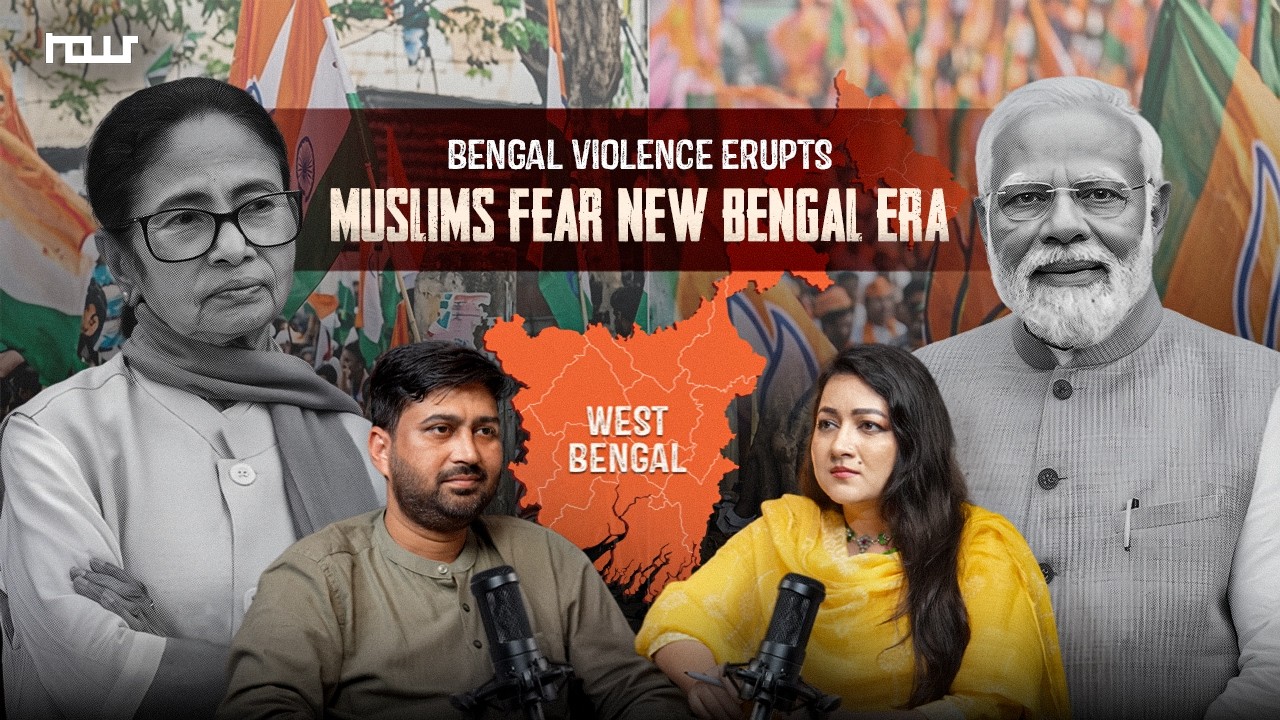
When the Bharatiya Janata Party won power in West Bengal for the first time, unseating Mamata Banerjee's Trinamool Congress after roughly a decade and a half in office, Mohammad Reyaz was already one of the most-quoted voices trying to explain it. An assistant professor at Aliah University in Kolkata, a former journalist and now a political analyst, Reyaz told Nous host Bushra Khanam Fahad that even he had underestimated the scale of what was coming: exit polls, he noted, mostly undershot the BJP's actual seat count, and pollsters like Yashwant Deshmukh of C-Voter had spent months assuming the BJP could not cross roughly 70 percent of the non-Muslim vote. What actually happened, in Reyaz's account, was closer to a near-sweep of Scheduled Caste and Scheduled Tribe-dominated seats in districts like Purulia, Bankura, Alipurduar and Purba Medinipur, layered onto a "massive" consolidation of urban, upper-caste and middle-class Bengali Hindu voters — a shift he insists had been building steadily since the BJP's roughly 77-seat, 37-percent-vote performance in the 2021 election, not one that "overnight" appeared from nowhere.
A theory about when anti-incumbency "sticks"
Reyaz's most original contribution to the conversation was a piece of political theory he says he has not yet had the chance to write up formally, though he has aired it in interviews and on social media. Corruption and anti-incumbency, he argued, are a constant feature of Indian state governments regardless of party — yet the narrative that a government must be voted out over corruption only seems to gain real traction in states where it coincides with a large-scale Hindu vote consolidation already under way. He pointed to the absence of an equivalent anti-incumbency wave against BJP-run states like Bihar or Assam, or against Madhya Pradesh even after the Vyapam scandal, as evidence that corruption alone rarely dislodges an incumbent; what changes the outcome, in his reading, is that educated, "liberal elite" Hindu voters need a socially acceptable language — corruption, stagnation, lack of development — through which to describe a decision that is also, if less admittedly, about religious consolidation. "Nobody will say 'I'm communal, so I'm voting BJP,'" he said; they will say the roads are bad and the government is corrupt instead.
He drew an explicit parallel to the BJP's 2014 national campaign, saying that by mid-April he had suddenly begun sensing the same "achhe din" playbook resurfacing in Bengal: unemployment, economic stagnation, women's safety (invoked repeatedly around the RG Kar Medical College case), all surfacing simultaneously with what he called the BJP's genuine skill as "masters at narrative-building," a skill he contrasted with the Congress's failure to build an equivalent counter-narrative even while it held national power in 2014.
A "micro-managed" election
Reyaz was emphatic that the Special Intensive Revision (SIR) of the electoral rolls — the process that triggered mass deletions of voters, disproportionately in Muslim-majority constituencies — was a real and measurable factor, even as he pushed back on Trinamool's claim that it alone cost the party over a hundred seats. He cited reporting, including his own conversations with the Kolkata-based Sabir Ahmed of the Association SNAP data-research initiative, describing constituencies with over 3,000 voter deletions each across some 176 seats. Rather than treating SIR as a single blunt instrument, Reyaz described a more granular electoral operation: with Union Home Minister Amit Shah reportedly camped in Kolkata for over three weeks personally overseeing seat-by-seat strategy, the BJP is, in his words, "champions of micro-managing elections" — identifying constituencies decided by a few thousand votes and working simultaneously to trim the opposing side's turnout through the SIR process, field spoiler candidates capable of siphoning four or five thousand votes each, and mobilise its own high-rise apartment and diaspora voters with organised transport, including train and flight tickets, to the polling booths.
He also connected the collapse of Trinamool's much-discussed social media operation to the arrest of an official at the Indian Political Action Committee (I-PAC) and questioning of associates around director Prateek Jain, suggesting the optics of that action, layered on top of years of what analyst Neelanjan Sarkar had described as Trinamool's over-reliance on I-PAC for candidate selection, left the party's digital campaign visibly weaker by mid-April — even as Trinamool officially denied any operational disruption. Reyaz noted local complaints that as many as 73 to 77 sitting MLAs were denied tickets this cycle, some of whose personal vote banks, he suggested, migrated away in visible anger — a dynamic he said Shah addressed directly by meeting denied candidates individually.
Mamata's "soft Hindutva" and the appeasement narrative that cuts both ways
Much of the conversation dwelt on what Reyaz sees as the double bind Mamata Banerjee's own religious outreach created. He described her building four large temples during her term — including a Jagannath temple at Digha and others planned for Rajarhat and Siliguri — alongside a Hindi University for Hindi-speaking Hindus, a Dalit academy, and a development board for Kurmi communities, framing it as a genuinely pluralist form of secularism in which she attended Eid prayers, Iftar, Christmas and Buddhist and Jain festivals alike. But he argued the optics landed asymmetrically: a viral photograph of her, head modestly covered, seated at an Iftar gathering, or hoardings showing her in hijab welcoming Hajj pilgrims, fed a Hindutva narrative of "appeasement" and "tushtikaran," even as the same clips of her saying "Inshallah" and "Khuda Hafiz" were, in his account, selectively cut and recirculated by BJP-aligned outlets. Simultaneously, and just as damagingly for Trinamool, the temple-building and imam-muezzin monthly stipends fed a rival narrative inside the Muslim community that she was drifting toward what Reyaz called "soft Hindutva" — leaving her, in his telling, boxed in from both directions at once.
Reyaz was careful to distinguish two distinct Muslim electorates within Bengal: Kolkata's urban, Urdu-speaking Muslims, largely of Uttar Pradesh and Bihar origin, whom he said voted for Trinamool at close to 80 to 90 percent in seats like Metiabruz; and the much larger population of Bengali-speaking rural Muslims, concentrated in districts like Murshidabad and Malda, where anti-incumbency — over stagnant government jobs, a teacher-recruitment corruption scandal, and what several rural voters described as being taken for granted despite repeated support at the ballot box — cut more sharply. He cited Mamata's own rebuff to Muslim protesters during the Waqf Act demonstrations, reportedly telling them to take their grievances to Delhi rather than stage them in Bengal, as one flashpoint feeding that resentment.
Why the Muslim vote fractured — and why Humayun Kabir won
Even so, Reyaz resisted the simple story that Bengali Muslims voted BJP, or even that they abandoned Trinamool en masse. His own estimate is that roughly 80 to 84 percent of the Muslim vote still went to Trinamool — short of the roughly 95 to 99 percent the party's own leadership, including MP Mahua Moitra, appeared to be hoping for and publicly implied it hadn't received, but still a level of consolidation that meant "around 40 percent" of Trinamool's winning MLAs came from Muslim-dominated constituencies. What fractured, in Reyaz's account, went instead to Congress in a couple of seats, to a diminished Indian Secular Front (which won only its one seat in Bhangar despite an aggressive first-phase campaign under Nawsad Siddique in Malda and Murshidabad), to AIMIM (which he said only "dented" the vote rather than seriously contesting), and most strikingly to Humayun Kabir, a sitting Trinamool MLA turned independent, who won both his own seat and an adjacent one campaigning explicitly on a promise to build what he called a "Babri Masjid."
Reyaz was personally unsparing about that promise. "Would Muslims anywhere find a Babri Masjid acceptable?" he asked, noting that Kabir — a former BJP member himself, who publicly congratulated the BJP once results came in — had represented the same seat for years without ever invoking the mosque before, and questioning whether an understanding with the BJP, consistent with the same "micro-managing" logic applied elsewhere, might explain his late nomination as an independent. He connected Kabir's win less to genuine enthusiasm for the Babri promise than to a protest vote against Trinamool's own perceived complacency and to Kabir's pre-existing local base as a three-term legislator — while noting that party leaders like Firhad Hakim, who led Trinamool's press conference expelling Kabir over the remarks, faced their own social-media backlash from villagers pointing to the four temples as a counter-example of whose religious symbolism gets tolerated.
Debunking Bengali exceptionalism
Reyaz was sceptical of a line he heard repeatedly from fellow analysts during the campaign: that Bengal was too "intellectually sound" to be read the way commentators read Uttar Pradesh or Bihar, and that its voters would see through any imported Hindutva playbook. He pointed out that BJP campaigners went out of their way to blunt the party's long-standing image as a party of Hindi-belt vegetarians uncomfortable with Bengali fish-eating culture, with leaders including Anurag Thakur photographed eating fish, and Assam chief minister Himanta Biswa Sarma publicly asking whether ten years of BJP rule in Assam had stopped people there from eating fish. In Kolkata specifically, he said, the campaign consciously softened its register: the party's candidate from Rasbihari, commentator-turned-politician Swapan Dasgupta, campaigned in a manner projecting shared sophistication with his Left and Trinamool rivals — chatting and sharing tea on camera — rather than deploying the more combative Hindutva symbolism used in rural seats. The urban campaign instead leaned almost entirely on stagnation: viral comparisons of Kolkata's ageing buses with Delhi's air-conditioned fleet, photographs of airports and metro systems in BJP-run states set against Kolkata's own infrastructure, and pointed references to lower dearness allowance for West Bengal government employees compared with BJP-ruled Bihar and Jharkhand.
Reyaz also cautioned against reading the result as proof that a decisive majority of Bengalis had swung behind Hindutva outright. By his arithmetic, Trinamool, Congress and other opposition parties combined still commanded a majority of the statewide vote — roughly the same arithmetic, he noted, that held true nationally in 2014 — meaning the BJP's win reflects a marginal shift of some 8 to 10 percent of floating voters rather than a wholesale ideological realignment. He linked Bengal's particular vulnerability to repeat one-party dominance — thirty-four unbroken years of Left Front rule before Trinamool's own fifteen — to what political scientists call the state's uniquely dense "political society," in which party units are embedded down to the village level and even ordinary social occasions like weddings carry a party-political dimension, making incumbents unusually exposed once public patience finally runs out, and unusually hard to dislodge once a challenger builds comparable grassroots density of its own — exactly the multi-year, block-by-block organising, especially among Scheduled Caste and Scheduled Tribe communities, that Reyaz credits the RSS with having quietly built long before this year's campaign began.
What is left for Bengal's Muslims
Reyaz's bleakest number concerned representation itself: by his count, the incoming assembly will likely seat around 36 Muslim MLAs, down from a recent high of 59 in 2011 — and, for the first time in recent memory, every single one of them will sit in opposition, since the BJP has no incentive to include Muslim legislators or make alliance overtures toward Muslim-led parties. He resisted reading this as evidence that West Bengal's Muslim voters had simply cracked in the way Assam's had; comparing seat-by-seat data, he noted that in 2021 Trinamool swept all 32 seats where Muslims form more than 50 percent of the electorate, while this time it held 23 of those same seats — a real erosion, but not the wholesale collapse some had feared given widespread fears, voiced to him directly by rural Muslim voters in Murshidabad, that an Assam-style National Register of Citizens exercise and detention centres — sites for which, one source told him, had reportedly already been identified — could be imminent.
Asked directly why Bengali Muslims did not consolidate more defensively behind Trinamool given those fears, Reyaz's answer was candid about its own limits: proper research, he said, would need a year of fieldwork to establish firmly. But his working explanation folds back into his broader theory of the election: a real, locally rooted anti-incumbency among rural Bengali Muslims, fed by specific grievances over jobs and representation, proved strong enough to produce defections to Congress, ISF, AIMIM and Kabir even amid genuine, well-founded fear of what a BJP government might do next — evidence, in his account, that Bengal's Muslim electorate, like the rest of the state's voters, was responding to concrete local grievances rather than voting as a single undifferentiated bloc either for or against its own physical safety.


Discussion
0Readers only · Comments are reviewed by the desk before they appear
The journalism is free for everyone — create a free account to join the discussion.