

The Bureaucrat Who Tried to Make Indian Muslims Self-Sufficient
From reforming the Haj bureaucracy to writing Waqf reform into the Sachar Committee's report, Dr Syed Zafar Mahmood argues India's Muslims already have the resources to lift themselves — if only the community organised to use them.
Contents · 9 sections
- A prejudice older than any government
- A household built around a mandate
- Reforming the Haj from inside the bureaucracy
- Zakat as an economic mandate, not a minimum
- A coaching centre named after 1883
- The Sachar Committee, and getting Waqf onto its agenda
- Delimitation: naming the mechanism, then intervening in it
- Fighting a Waqf bill from a family holiday
- Self-sufficiency as doctrine, and the next generation
A prejudice older than any government
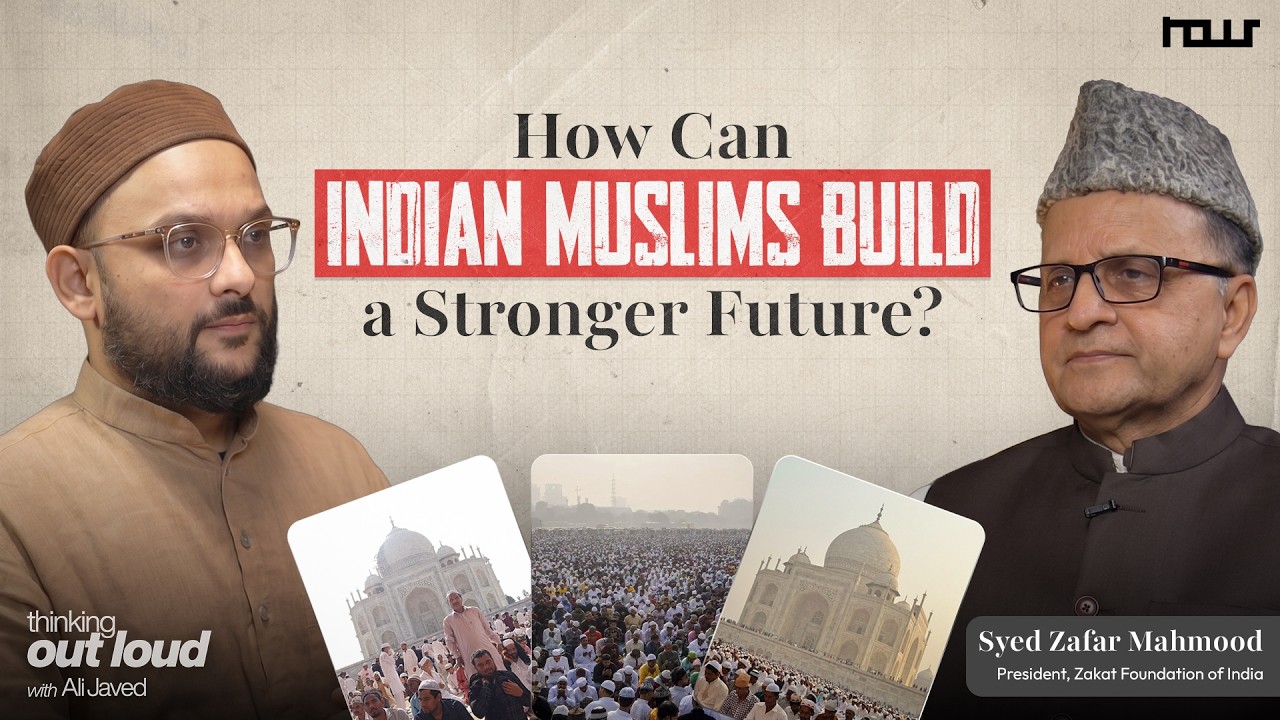
Dr Syed Zafar Mahmood, a retired IAS officer who went on to found the Zakat Foundation of India and helped shape the Sachar Committee's landmark 2006 report on Indian Muslims, opens his conversation with Nous by rejecting a common framing: that the deterioration in the position of Indian Muslims is a purely post-2014 phenomenon. The unease and structural neglect Muslims face today, he argues, existed well before, even if it was less visible. He traces it to three historical layers — roughly 800 years of Muslim political rule before colonialism, two centuries of British divide-and-rule in which Muslims were consistently cast as villains, and finally Partition, which took a portion of the country away with them. "If a non-Muslim in India today isn't prejudiced against Muslims," he said, "given a thousand years of baggage, that would almost be unnatural." He recalls a Hindu law-school friend telling him, decades before the BJP or RSS held any power in Delhi, that his own family had always jokingly called the bathroom "Pakistan" — a small, throwaway example, he says, of how deep-rooted the association runs, independent of any particular government.
Mahmood is nonetheless careful to distinguish degree from kind: in the decades between 1947 and 2014, he says, Muslims could largely live without a constant, active sense of being under scrutiny; posts of some visibility were occupied by a few community members, and society, if imperfect, was not organised around targeting them specifically. What changed after 2014, in his account, is not the presence of prejudice but its licence to operate openly.
A household built around a mandate
Mahmood's own path to public life began in a house in Bahraich, Uttar Pradesh, where his father — a successful lawyer educated at Aligarh Muslim University in the 1920s, later president of the local bar association — personally home-schooled his children for eight to ten hours a day alongside formal school, hiring separate tutors for English, Hindi, Urdu, science and mathematics, insisting on daily newspaper reading with a dictionary at hand to look up difficult words, and requiring five daily prayers performed together at the mosque. Mahmood credits this upbringing directly with his own success: entering the IAS in the 1977 batch ranked 27th, he was later moved to first place after five years of uniformly "outstanding officer" ratings from ten different reporting and reviewing officers, superseding 26 colleagues. He attributes it to total dedication to the work combined with strong interpersonal relationships up and down the hierarchy — the same values, he says, his father modelled through a private charity fund whose beneficiaries he never publicised. "Nowadays," Mahmood said, "people give to charity and photograph themselves doing it."
Reforming the Haj from inside the bureaucracy
Posted to the Indian consulate in Jeddah in 1988 as director overseeing Haj arrangements, Mahmood describes a series of changes he and colleagues pushed through against resistance from vested interests. The Haj ship — long justified as serving poorer pilgrims — was shown, on his analysis, to cost travellers more overall than flying, once a mandatory twenty-day extra stay in the Kingdom was factored in; opposition came chiefly from Bombay dockworkers running side businesses through the shipping route. He helped negotiate a pre-arranged accommodation scheme with Saudi Arabia's Haj ministry guaranteeing every pilgrim a minimum two-by-one-metre air-conditioned space with an attached bathroom, replacing an unregulated system in which local operators had been known to rouse sleeping pilgrims from paid-for beds. He also centralised the payment of a compulsory Saudi pilgrimage due through the Haj Committee of India rather than individual bank drafts, after seeing planes held on the tarmac while pilgrims searched for drafts lost in transit — many of them elderly, rural and on their first journey abroad. Separately, as director of schools, he pushed through the construction of new Indian embassy schools in five Saudi cities, including one in Jeddah that had been built for 1,600 students but was, by the time he arrived, serving 5,000 across shift schedules.
Zakat as an economic mandate, not a minimum
Mahmood founded the Zakat Foundation of India in 1997 on what he frames as a specifically economic reading of Islamic obligation. Zakat, in his account, is only "a very small segment" of a much larger Quranic mandate that wealth should keep circulating through society rather than pooling in a few hands — comparing it to blood circulation in a body. He distinguishes between adl (justice) — the roughly 2.5 percent zakat obligation, which merely keeps a believer out of hell — and ihsan (compassion), the far larger, uncapped obligation to give beyond the minimum, which he argues most Indian Muslims neither understand nor practise. He has built this into a framework he calls "TRAIL 33": Time, Resources, Assets, Income and Love, each of which should be allocated roughly one-third beyond one's immediate household, drawing on a specific verse of the Quran (2:219) on the scope of proper giving.
A coaching centre named after 1883
The organisation's flagship initiative, the Sir Syed Coaching and Guidance Centre for Competitive Examination, is named not for Sir Syed Ahmad Khan's role founding Aligarh Muslim University, Mahmood clarifies, but for a lesser-known 1883 precedent: the Mohammedan Civil Services Fund Association, which he says collected small annual dues from 500 members to send fifteen young Muslim men a year to England by ship to sit the Indian Civil Service exam. He pairs this with an anecdote drawn from a Maharashtra district gazetteer: in 1887, in a district where Muslims made up only 10 percent of the population, a coach named Syed Ahmed arrived months ahead of a major recruitment exam and prepared local candidates so effectively that more than half the vacancies went to Muslims. His own centre, he says, provides free hostel accommodation, food and coaching sourced from established professional institutes, and recounts a student from a village twenty kilometres outside Bahraich — one of India's most backward districts — who, after just six months of preparation there, became a jail warden in Kanpur straight out of class twelve.
The Sachar Committee, and getting Waqf onto its agenda
Mahmood situates the origins of the Sachar Committee in the surprise 2004 general election result, which returned the Congress-led UPA to power against most predictions; he recalls being in New York at the time and assuming, along with most observers, that the BJP would return. With Manmohan Singh as prime minister — a figure Mahmood calls personally sincere — the new government moved to commission a study of Muslims' social, economic and educational status, believing the community had contributed meaningfully to its win. Mahmood, by then closely tied to Muslim community institution-building, says he successfully pushed to have Waqf included as a chapter in the committee's report, though it wasn't originally part of its mandate — drafting a note that senior committee member Syed Hamid endorsed and passed on to Justice Rajinder Sachar himself for approval.
The committee's central finding, in Mahmood's summary, was that Muslims lagged across social, economic and educational indicators primarily because of chronic underrepresentation in governance — a gap he says has held steady since the first Lok Sabha in 1952: proportional representation would put roughly 77 Muslim MPs in a 542-seat house, but the actual average has stayed at or below 25.
Delimitation: naming the mechanism, then intervening in it
Mahmood's most concrete institutional legacy may be the Zakat Foundation's "Delimitation Cell," running for roughly twelve to thirteen years, built on the Sachar Committee's specific diagnosis that underrepresentation flows from "faulty delimitation" — the periodic, constitutionally mandated redrawing of constituency boundaries after each census — rather than overt political exclusion alone. He describes two interventions in detail. In Saharanpur, when the Election Commission proposed reserving a constituency for Scheduled Castes despite it having a lower SC population share than neighbouring constituencies, the Foundation filed objections backed by its own demographic data; the full commission travelled to Saharanpur for a public hearing and reversed its proposed notification. In Greater Mumbai, after a year-long campaign — built on a ten-page notice documenting specific violations of Maharashtra's own delimitation rules across 30 municipal wards, filed via RTI a year ahead of elections — the state election commission redrew all 30 wards according to the Foundation's submissions; in the election that followed, the number of Muslim corporators elected rose by roughly a third. He says only two or three organisations have ever approached the Foundation to collaborate on this work, and that he has actively discouraged turning it into a large public rally, preferring quiet, document-driven intervention that stays strictly within constitutional and legal channels.
Fighting a Waqf bill from a family holiday
As administrator of the Combined Wakf Board covering Punjab, Haryana, Himachal Pradesh and Chandigarh from 1999, Mahmood found more than half of 33,000 Waqf properties tied up in litigation, no systematic audit of income and expenditure, and no digitisation of records — deficiencies he began correcting locally, including raising imams' salaries through an order that was later cited in Supreme Court litigation seeking to implement the same standard nationally. When a Waqf Amendment Bill was introduced in 2010 that Mahmood judged to have abandoned the Sachar Committee's and a subsequent Joint Parliamentary Committee's recommendations, he spent 45 consecutive days — during what was meant to be a family holiday in Boston — building a detailed, colour-coded comparison chart between the bill and those official recommendations, issue by issue. Released to the press on his return, it became, in his telling, enough of a national talking point that Parliament sent the already Lok Sabha-passed bill back to the ministry for reconsideration; when it was reintroduced in 2013, he calls the result the best Waqf law "in the whole world at the time" — a status he notes has since been altered by subsequent legislative changes.
Self-sufficiency as doctrine, and the next generation
Running through the conversation is Mahmood's repeated insistence that India's roughly 200 million Muslims constitute, in his words, "a nation in itself" — economically and institutionally capable of far more self-reliance than the community currently practises, a shortfall he attributes not to external obstruction but to inadequate religious literacy: "we are not good enough Muslims." He frames this as a call to organise, borrowing the term kimiyagar (alchemist) from the poet Muhammad Iqbal for local political and administrative volunteer groups that would map their own constituency's Muslim population share, coordinate voting to avoid vote-splitting, identify eligible beneficiaries for existing government welfare schemes, and staff modest neighbourhood reading rooms — a spare mosque room or a family's front room — aimed particularly at the large number of students who drop out after class twelve, whom he sees as an untapped pool for stenographer, court clerk and personal-assistant posts that state governments routinely struggle to fill for want of applicants. He also urges wider use of the National Institute of Open Schooling to formally credential madrasa students and connect them to university bridge courses, and flags a growing gap in the community's engagement with artificial intelligence and data literacy.
He extends the same logic to interfaith relations through the Interfaith Coalition for Peace, which he founded in 2005 and which operates across roughly two dozen Indian states, organising joint events — including an interfaith iftar at Delhi's Jama Masjid — built around practices common across Hinduism, Islam, Sikhism and Christianity, from fasting to comparisons between namaz and yoga. And he reframes the basic unit of Muslim social obligation away from the nuclear family toward the extended family — by his estimate, roughly 80 to 85 people connected to any married individual by blood or marriage — arguing that lifting the least well-off members of one's own extended network is itself a concrete, achievable mandate independent of any state programme.
Asked what message he would leave for a younger generation navigating a far less confident version of India than the one he grew up in, Mahmood returns to a theme he traces through Iqbal: that self-knowledge of one's own purpose and capacity must come before any contribution to society is possible. He closes by recalling his father, on the eve of his own departure for Hajj in 1975, quoting a line of Ghalib to the assembled family — asking, in effect, who would carry the household's responsibilities forward after he was gone. Mahmood, then a young student, was the one who answered.


Discussion
0Readers only · Comments are reviewed by the desk before they appear
The journalism is free for everyone — create a free account to join the discussion.