

Terrorism Has No Definition. That's the Point, Says This Scholar.
Anthropologist Irfan Ahmad argues that the word "terrorism" was never meant to be defined — it was built to be deployed, first against communism, then against Islam, while state violence that dwarfs it goes unnamed.
Contents · 9 sections
- A Word Built for Religion, and for One Religion
- Before Islam, Communism
- A State Born of the Violence It Now Condemns
- The Word India Made Dirty
- Reading Myanmar, Sri Lanka and India Side by Side
- The Numbers Nobody Puts on Screen
- Law, Media and Judiciary, Working in Sync
- The ‘Ditto Theory’
- What He Thinks Comes Next
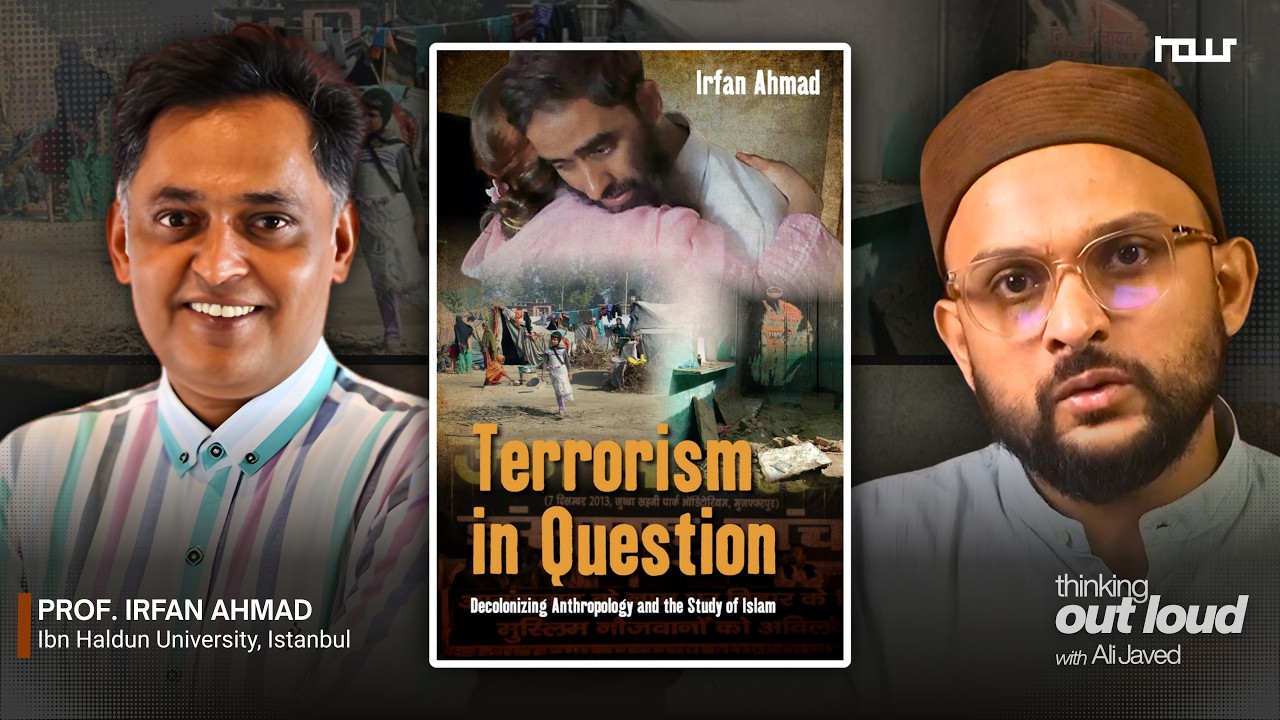
Irfan Ahmad opens his new book by refusing to answer the question everyone expects him to answer. Speaking with Nous founder Ali Javed, the anthropologist and author of Deconstructing Terrorism said the United Nations' own 2015 documentation admits there is no agreed global definition of terrorism — the same documents, he noted, often use “terrorism” and “radicalisation” interchangeably. The terrorism scholar Alex Schmid catalogued over 200 competing definitions in 1985 and, revisiting the question two decades later, concluded the search for consensus was still unresolved. Even within a single government, Ahmad said, the US State Department, the Department of Defense and the CIA each work from their own definition. Rather than asking who is a terrorist, he said, his method is to ask a different question: who needs the category of terrorist in the first place? That reframing, he argued, opens up a genealogy the standard question forecloses.
A Word Built for Religion, and for One Religion
Ahmad's focus is what he calls “post-9/11 terrorism,” which he says departed from how the concept had functioned through most of modern history. Historically, terrorism was treated as a tactic — a means to an end, used by various actors. After 2001, he argued, it was redefined as an ideology, and specifically a religious one. The asymmetry is telling, in his account: violent acts by Muslims are routinely labelled Islamic terrorism, but comparable violence by Hindus, Buddhists, Jews or Christians rarely earns a matching label — there is no everyday term for “Jewish terrorism” or “Hindu terrorism” in mainstream usage, whatever the facts of a given case. State violence, meanwhile, has been written out of the picture almost entirely, even though the term's own history begins there: the French Revolution's Jacobin “Reign of Terror” gave the word its origin, and after the failed uprising of 1857, Ahmad said, British forces in Delhi hung the bodies of the dead from trees — a tactic recorded in British sources as intended to strike terror into the city's residents.
Before Islam, Communism
Ahmad complicated the popular narrative that the West simply swapped enemies after the Cold War, communism for Islam. He pointed to the historian Bernard Lewis, who was already drawing a direct comparison between communism and Islam as early as the late 1950s or early 1960s — decades before 9/11 made the substitution explicit. Samuel Huntington's “clash of civilisations” thesis, Ahmad added, wasn't original either; the idea traces to Lewis, and, in an account few in India acknowledge, to Girilal Jain, the former Times of India editor whose book The Hindu Phenomenon made a strikingly similar argument.
The deeper structural point, in Ahmad's account, is the nation-state system built after the Second World War — a genuinely novel arrangement that much of the world, including most Muslim-majority regions, never asked for. After the Ottoman Empire's dissolution, the territory was carved into roughly thirty-two separate nation-states by British and French design, not popular demand; Ahmad noted that when Iraq's independence was proclaimed, the country had no national anthem of its own, so the ceremony played “God Save the King.” Resistance to this imposed order, he argued, has come disproportionately from Muslim-majority populations — which he offers as one reason Islam, rather than any other tradition, became the system's designated adversary.
A State Born of the Violence It Now Condemns
India, Ahmad said, absorbed this framework in its own way. When the country's anti-terror law was first drafted as the Prevention of Terrorism Act, a precursor to the current UAPA, the parliamentary subcommittee that shaped it explicitly framed terrorism as something that had emerged from the Middle East — importing a geography of blame even into domestic legislation. Unlike France, he noted, where a conversation about terrorism doesn't require mentioning Pakistan, an Indian conversation about terrorism almost never omits it, and increasingly folds in Bangladesh as well; the domestic debate is deliberately tied to a wider international one. Underlying all of it, in Ahmad's account, is a conceptual sleight of hand he calls “state nation” rather than “nation state”: no country, he argued — not even small, seemingly homogeneous ones like Switzerland or the Netherlands, which each contain multiple language communities — actually corresponds to the single, unified people a nation-state claims to represent. What exists instead is a state that asserts nationhood, then organises a hierarchy in which one culture is treated as core and the rest are expected to subordinate themselves to it.
Israel featured prominently in the conversation as, in Ahmad's telling, indispensable to how the post-9/11 terrorism discourse took global shape. He cited a book edited by Israel's current prime minister, written while he held a diplomatic post, whose central argument was that Arabs are terrorists and terrorists are Arab — a framing Ahmad said depends on treating Israel as part of the West, itself a contested claim. He pointed to a deeper irony: two organisations later folded directly into the Israeli Defense Force were, before 1948, designated terrorist organisations, and one prominent Israeli politician who later became prime minister is on record saying that no reading of Jewish ethics forbade the use of terrorism to found the state. Ahmad drew a straight line from that founding violence to the present, describing Israel's campaign in Gaza as a nationalist project — not simply religious or ethnic conflict, but an attempt to secure a homeland by force, with the Palestinian population treated as an obstacle to be removed.
The Word India Made Dirty
Turning to language, Ahmad traced the trope of “fanaticism” back to W.W. Hunter's 1871 book The Indian Musalmans: Are They Bound in Conscience to Rebel Against the Queen?, and noted that Rupa, a major Indian publisher, reissued the book after 9/11 with its subtitle quietly deleted. He traced the same trope's use in the United States, where Black abolitionists demanding full equality were dismissed by slavery's defenders as “fanatics” unwilling to stop at partial concessions. Against that dominant, external view — what he called the etic reading — Ahmad said his book works to recover the emic one: how people branded terrorists understand themselves, drawing on interviews with jailed Indian prisoners and on an Aligarh Muslim University student pamphlet, from the early 1990s, that described its own campaign for democracy and freedom as a jihad. He offered his own experience as an illustration, describing the year-long fight to resume his PhD at the University of Amsterdam after Dutch authorities demanded a birth certificate he did not have, which he still refers to, half seriously, as his “legal jihad.” Today, he said, the word has been stripped of that meaning entirely in India, proliferating instead as “love jihad,” “land jihad,” “corona jihad” and more — a deliberate, sustained campaign, in his view, to make the word mean only violence and regression, against the self-understanding of the Muslims who actually use it.
Reading Myanmar, Sri Lanka and India Side by Side
Ahmad's case for foregrounding nationalism rather than religion rests on three comparisons. In Sri Lanka, violence by the LTTE is described as Tamil terrorism, not Hindu terrorism, even though most Tamils involved were Hindu — evidence, he argued, that the underlying grievance was a Sinhala-Buddhist nationalist project that excluded Tamil speakers from language, jobs and political standing, not religion as such. In Myanmar, violence against the Rohingya rests on a claim that the Buddha once visited land they occupy, making it sacred and, in the logic he described, incompatible with a Muslim presence — a nationalist claim dressed in religious terms. In India, he traced the radicalisation of groups like SIMI to the campaign to demolish the Babri Masjid, itself driven by the unsubstantiated claim that a temple lay beneath the mosque — a claim, he argued, inseparable from the broader idea that India belongs to Hindus first. In each case, he said, nationalism supplies the underlying grammar; religion supplies only the label attached afterward.
The Numbers Nobody Puts on Screen
Ahmad used a comparison to illustrate what he called narrative asymmetry: by his account, roughly 800 people die from terrorism annually according to figures he cites in the book, while some 34,000 people die each year on Indian roads from potholes alone — deaths that draw no equivalent media coverage. He pointed to the actor Ajay Devgn, who fronts a popular gutka advertisement despite the product's role in thousands of deaths annually, as an example of harms that never enter the same rolling news cycle terrorism commands. The point, he said, is not that terrorism doesn't kill people, but that a capitalist media economy profits from spectacular violence tied to a specific enemy while routine, larger-scale harms are structurally invisible.
Law, Media and Judiciary, Working in Sync
Ahmad argued that no single institution sustains the terrorism discourse; it depends on what he called a synergy between law, media and the judiciary. Quoting a Russian proverb — that law is a spider's web in which the weak are trapped while the powerful simply break through — he described law as a tool of the powerful rather than a neutral arbiter. In India, he said, the idea that Muslims are outsiders to the national story is not confined to the BJP or RSS but has long been shared by the Congress as well, which allowed the Vishva Hindu Parishad's Babri Masjid campaign to draw on an ideology broader than any one party; newspapers including Amar Ujala, Dainik Jagran and the Times of India helped consolidate it, and the judiciary, he said, ultimately put its own seal of approval on the outcome. He pointed to the continued imprisonment of activists including Umar Khalid and Safoora Zargar as evidence of how far the space for alternative narratives has since narrowed.
The ‘Ditto Theory’
Ahmad's closing conceptual tool was what he called the “ditto theory” — the claim that violence came “from both sides,” used to flatten unequal conflicts into symmetry. He traced its use beyond India, citing Aung San Suu Kyi's own description of violence against the Rohingya as coming from both communities, and its recurring use in framing Israeli violence against Palestinians as a two-sided conflict. In India, he said, the same framing was applied to the 2020 Delhi riots and, earlier, to the Bhagalpur violence — language that obscures which side held disproportionate power and inflicted disproportionate harm.
What He Thinks Comes Next
Asked what Indian Muslims and their allies should actually do, Ahmad resisted offering a prescriptive list, saying readers in different fields — media, law, education, activism — would find different uses for the book's arguments. But he insisted that conceptual clarity has to come first: without a clear understanding of how the category of terrorism was built and deployed, he said, even tireless activism risks reproducing the very framework it means to resist. His broader positive project, only sketched in the conversation, draws on the Islamic scholarly tradition of huriyya, or freedom, and the practice of muharrar — writing as an act of liberation — which he contrasted with scholars like Bernard Lewis and Fareed Zakaria, whose writing on the Muslim world, he argued, has functioned to legitimise domination rather than challenge it.


Discussion
0Readers only · Comments are reviewed by the desk before they appear
The journalism is free for everyone — create a free account to join the discussion.