

"Parties Have Become Private Limited Companies": Qurban Ali on India's Defection Epidemic
Veteran journalist Qurban Ali tells Nous that the collapse of ideological commitment inside India's opposition parties, not just the ruling party's Hindutva project, is what has left minorities without a political address.
Contents · 4 sections
When Parties Stopped Believing in Anything
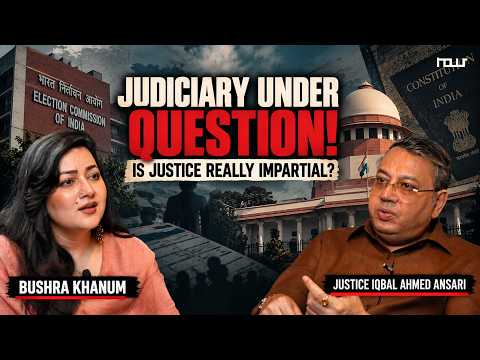
Qurban Ali, a journalist of more than four decades who has worked at the BBC and edited several television newsrooms, opened his conversation with Nous by locating today's political turmoil in a longer decline rather than a single election cycle. Looking back over roughly the last four to five decades, and especially since 1980, Ali argued that Indian politics once ran on ideology: parties and their workers held convictions, however imperfectly, and even when politicians switched sides they felt some need to dress the switch up as a change of belief. That residual shame, he said, is gone. What began with the phrase "aaya ram, gaya ram" in Haryana decades ago, describing legislators who crossed the floor for convenience, has become routine horse-trading, conducted, in his words, like the buying and selling of cattle at a fair.
Ali pointed to West Bengal as the freshest example: Mamata Banerjee's Trinamool Congress won three consecutive state elections, seeing off the Left Front and then twice fending off the BJP with more than 41 percent of the vote, yet MPs and MLAs who voiced no complaints about her leadership before results day have since abandoned the party for the BJP within weeks. He noted the same pattern in Karnataka and Madhya Pradesh, where elected Congress governments were toppled after MLAs were bought out, and argued that what was once an accusation levelled only at Congress over dynastic politics and defections now applies equally to the BJP and even Left parties.
A Ruling Party That Never Accepted the Constitution
Ali argued that the party currently in power, and the organisation behind it, has spent a century working toward a Hindu Rashtra, and has now achieved that outcome in practice even without formally amending the Constitution to say so. He noted that the words "socialist" and "secular" were added to the Constitution's preamble by Indira Gandhi during the Emergency, a fact the current ruling establishment has long treated as illegitimate, arguing the terms were inserted without proper mandate. Yet Ali argued the deeper problem is not the vocabulary but the practice: representation for minorities inside the ruling party's own benches has steadily shrunk, to the point, he said, that among more than 240 BJP Lok Sabha MPs and roughly 100 Rajya Sabha MPs, not one is Muslim, not one is Christian, and perhaps one is Sikh.
He was careful to distinguish this from the Emergency itself, arguing that whatever Indira Gandhi did in 1975 was at least declared openly, and she paid a political price for it in the 1977 elections when Congress was wiped out across north India. What is different now, in his account, is that the very people who once condemned that period for undemocratic conduct show no comparable discomfort with subpoenaing enforcement agencies, quashing opposition candidacies on technical grounds, or engineering defections, because, he said, people become "insult-proof" once the practice becomes normal enough.
Documentation as a Form of Justice
Pressed on why some communities, such as Sikhs after the 1984 Delhi violence, or the victims of the Gujarat riots, have secured convictions and compensation decades later while other episodes have not, Ali placed real responsibility on the affected communities and their institutions, not only on the state. He cited the case of the Hashimpura massacre, where lawyers Vrinda Grover and Rebecca John pursued the case for years and eventually secured convictions and compensation for the families of the fifty young Muslim men killed by policemen and dumped in a canal. By contrast, he said, a similar massacre in nearby Maliana the following day, in which around seventy Muslims were killed, went undocumented, with no case filed and no compensation paid, simply because no equivalent record-keeping or legal pursuit took place. The same was true, he argued, of the Bhagalpur riots and the Nellie massacre in Assam, both involving thousands of deaths that were never properly pursued through the courts. "Documentation is never wasted," Ali told Nous, arguing it eventually pays off even when there is no visible result.
The Only Weapon Left Is the Constitution
Ali's central prescription was blunt: minorities should stop waiting for political parties, human rights organisations or religious bodies to fight their battles for them, and instead use the courts and constitutional rights directly, as citizens. He cited his own case, Qurban Ali versus Union of India, in which the Supreme Court ruled that police and administration must act on hate speech suo motu rather than waiting for a complaint to be filed. He acknowledged this path is slow and frequently unsuccessful, but argued that repeated appeals, even when dismissed, at least create a public record that something happened, which itself has value.
Asked whether Rahul Gandhi represents a genuine ideological alternative, Ali offered qualified praise, noting that Congress under Nehru, Gandhi and Sardar Patel never compromised on communal issues in the way it later did, most visibly when Rajiv Gandhi ordered the disputed Ayodhya site's locks opened and campaigned on "Ram Rajya" language, a strategy that won Congress neither Hindu nor Muslim votes and helped the BJP claim the temple issue as its own. As an individual, Ali said, Gandhi is doing what he can and it is his duty to do so, given Congress's history and size, but Ali stressed that Muslim votes alone rarely decide an Uttar Pradesh election; they matter only in coalition with other social blocs, and become irrelevant wherever a party's entire strategy is to isolate and outvote that twenty percent rather than include it.


Discussion
0Readers only · Comments are reviewed by the desk before they appear
The journalism is free for everyone — create a free account to join the discussion.