

“Is Being Muslim My Biggest Crime?”: Two Delhi Journalists on the Night the Police Turned on Them
Shaheen Khan and Nafeesa Khan say they were dragged into a room at Saket police station, beaten, and asked again and again whether they were Muslim — and that days later, no one had been held responsible.
Contents · 7 sections
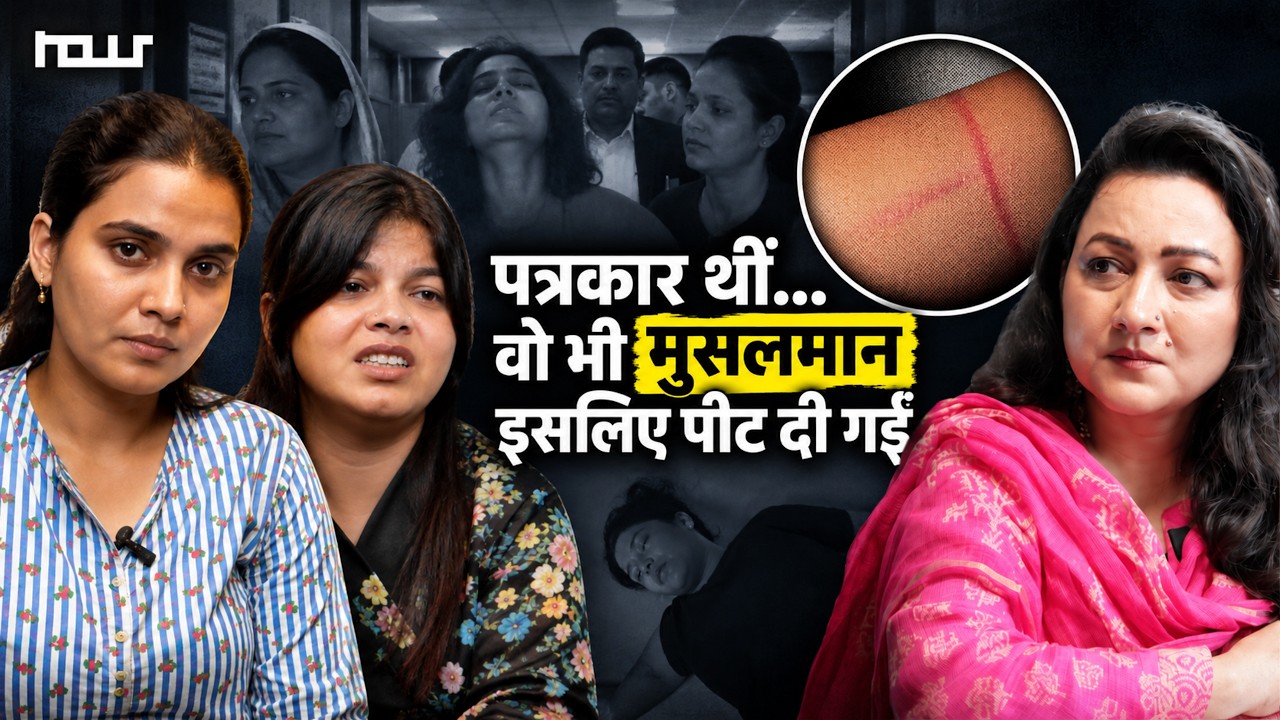
A shoot near a VIP visit
The interview opens without preamble: two young women, one visibly favouring an injured leg, sitting across from a host who tells viewers this is the fullest account either of them has given since the assault. Shaheen Khan and Nafeesa Khan were, by their own account, doing an ordinary day's work when it happened: riding a scooter through Malviya Nagar in south Delhi, filming a piece about a road the two journalist sisters knew well from having grown up and worked in the area. It was the days after India's Independence Day, and the neighbourhood had a strange gloss on it — encroachments cleared, garbage carted away, a private hospital suddenly spruced up. The reason, they explain in the interview, was a VIP visit: the Union Home Minister was coming to inaugurate the hospital, and Delhi's chief minister was expected too. Khan and Nafeesa wanted to ask, on camera, why a road that was “hard to even walk on” most days had been fixed only for a ministerial ribbon-cutting, and why government hospitals nearby went unmentioned while a private one got the red-carpet treatment.
They say traffic police they encountered near the site were cooperative once the sisters identified themselves as local journalists, even advising them on where they could safely stand to film. The trouble began closer to the hospital gate, where they stopped to film a roadside cutout — a promotional hoarding for the event — for a short piece to camera, the kind of quick stand-up the sisters say they had filed dozens of times before without incident. Security personnel objected almost immediately, treating a hoarding on a public road as if it were a restricted zone. The sisters say they explained repeatedly that they were only filming a public hoarding from a public footpath, were not on hospital premises, and were not obstructing anyone. They packed up and rode off toward home, and for a few minutes, Shaheen says, it seemed like the matter had ended there.
Stopped, then taken away
According to Khan and Nafeesa, they had barely left the area when police stopped them again. A female officer tried to take Nafeesa's phone; when she refused to hand it over without being told under what authority, more officers were called. What followed, they say, was not an arrest in any formal sense but something closer to an abduction: officers held their arms and legs, put them in a police vehicle, and told them they were only being “dropped home.” Instead, the sisters say, they were driven past their own street, first toward one police post and then another, before ending up at Saket police station — some distance from where they had been stopped.
They say they stayed calm through this, assuming a misunderstanding would be cleared up once they reached a station officer. “We are journalists, we told you, we are cooperating,” is how Shaheen recalls their end of the exchange. It didn't work that way. Even at this early stage, the sisters say, one detail stood out: a female officer had grabbed at Nafeesa in a way that felt deliberately intrusive rather than procedural, and when Nafeesa objected, she was told, in effect, that she had no standing to refuse.
Inside the station
At the reception desk, the sisters say an officer again demanded their phone, and they again asked what law required them to hand it over. They were told to wait in a “lockup room” and refused, saying they had committed no crime. A senior officer — named in the interview as the station's SHO, Dinesh Kumar — was sent for. Khan says the hope going in was that a superior officer would defuse the situation; instead, she says, he stared them down and effectively threatened them before other constables took over, telling the sisters they didn't understand what journalism was and mocking them for making a fuss over a formality.
The confrontation escalated near a reception-area CCTV camera, where the sisters had deliberately positioned themselves, hoping visibility would keep them safe. Several officers, they say, moved in to seize the phone anyway. In the scramble, Nafeesa says she was slapped hard enough to stagger her. “That slap hit me so hard,” Shaheen says, describing the moment she saw her sister struck. The two were then pulled and dragged — by their clothes and hair, they say — down a corridor and up a staircase into a closed room, out of view of the camera they had been standing under.
“Are you Muslim?”
It was inside that room, the sisters say, that the confrontation turned into something else. Officers had confiscated Nafeesa's phone, and when a call came in, the caller ID displayed a contact saved under the name Mohammad Khan. Khan and Nafeesa say that was the moment the tone in the room changed — a female officer, they say, stood up and effectively confirmed what she had begun to suspect: that they were Muslim. “Well, he is a Muslim,” Shaheen recalls being told, “then I will beat you more.”
What followed, by their account, was close to an hour of sustained assault: slaps, kicks, hair-pulling, and blows from a police baton, including strikes to the leg that Shaheen says left her “writhing like a fish.” They say officers repeated the word “Muslim” as they hit them, and that Nafeesa, rather than deny her faith, answered every blow by affirming it. “I am a Muslim,” she remembers telling them. “Hit me, hit me.” The sisters say they asked for water and were refused for a long stretch, with one officer telling them she would “make them thirsty.”
Throughout, the sisters insist they were never told what law they had broken. Their questions in the room, as they recount them, kept returning to the same point: that a police station, of all places, is supposed to be the safest place for a citizen, and that no FIR, no formal charge and no due process had been placed against them at any point — only, they say, a beating that intensified once their religion became known. At one point, Shaheen says, an unfamiliar officer opened the door, looked in, and left without intervening; she read it, in hindsight, as evidence that more than one person in the building knew what was happening in that room while it was happening.
Nafeesa, weaker from the beating by this point, says she has only fragments of memory from the worst of it — the word “Muslim” repeated back to her, an officer's hand in her hair, being pulled upright and pushed down again. What stayed with her afterward, she says, was less the physical pain than the sound of her own voice repeating a single word for what felt like hours: Muslim. She contrasts it with another sound she says she could hear faintly through the walls — the call to prayer from a nearby mosque — which she describes as the thing that kept her from going numb.
Cold drinks after the fact
The sisters say the atmosphere shifted only once officers realised that family members — alerted after Shaheen managed to make a brief call home — were mobilising outside and that word of the incident was travelling. The same SHO who had allegedly threatened them earlier, they say, returned to the room calling them “children,” ordering tea and cold drinks, and suggesting the matter be settled quietly without a formal complaint. Khan and Nafeesa refused the drinks and refused the offer. “Whatever crime we committed,” Shaheen says she told him, “let it come on paper.”
By their account, they were eventually able to leave the station under their own strength — Nafeesa unable to walk properly, needing to be half-carried down the stairs — rather than wait for any formal release. Nafeesa says she does not remember much of the final stretch; she fainted at the reception desk and needed medical attention. Speaking three days after the incident, on September 5, the sisters said no FIR had yet been registered against any officer, and that the department's only public acknowledgement had come in the form of a social media post that was later deleted — which they read, pointedly, as an admission.
Not their first run-in
Neither sister is new to being targeted for her reporting. Both previously worked for roughly two years at 4PM News, an independent Hindi-language YouTube channel run by Sanjay Sharma known for reporting critical of the state government, before going independent. Shaheen recounts an earlier incident, while still with 4PM, in which she was surrounded while reporting and told to “go to Pakistan” after being identified as Muslim — an exchange that also went viral, with her employer publicly backing her at the time. The sisters say they now run their own YouTube channel, Aman Sandesh — a name that translates to “message of peace.”
Asked where their composure came from, both credit their parents. Their father, they say, never treated them as any less capable for being daughters, calling them “son” and telling them not to be afraid when they stood on the side of the truth. Their mother, they say, has little formal education but has never let them lose their nerve. A brother, they say, stayed by their side throughout the ordeal even as their father was away from Delhi.
A demand, and a silence
The sisters' central demand, repeated through the interview, is narrow and specific: an FIR against the officers involved, and the suspension of the SHO and the female constable they hold most responsible for the assault. They say they have secured verbal assurances from opposition figures, citing past comments from Congress leader Rahul Gandhi about accountability for the police, and appealing directly to Priyanka Gandhi Vadra for support. They also singled out women in public life — including BJP leader Smriti Irani and actor-turned-politician Kangana Ranaut, as well as television anchors they accused of covering similar incidents involving journalists from other backgrounds far more aggressively — for their silence on the assault.
They place their own case alongside a list of other Muslims they say have faced prolonged legal ordeals in police or judicial custody — naming Siddique Kappan, Umar Khalid, Sharjeel Imam and Gulfisha Fatima — arguing that what happened to them in a Delhi police station over a few hours is part of a pattern rather than an aberration. “Whose shoulders,” Shaheen asks in the interview, does the responsibility fall on “to protect the honour of Muslims,” if the police themselves identify people by religion before deciding how to treat them.
Both sisters, visibly still in pain during the recording — Nafeesa repeatedly stretches and favours an injured leg through the interview — say the physical injuries matter less to them now than the unanswered questions: why an FIR had not been filed three days on, why the officers named remained on duty, and why the incident had not prompted a single comment from the Prime Minister or the Delhi chief minister whose visit set the day's events in motion. They say they do not intend to stop identifying themselves as Muslim, or as journalists, because of what happened to them at Saket police station. “We are not afraid,” Shaheen says. “We have proved that.”



Discussion
0Readers only · Comments are reviewed by the desk before they appear
The journalism is free for everyone — create a free account to join the discussion.