

In West Bengal, a Voter Rolls Purge Casts a Long Shadow Over a Record Election
As West Bengal recorded its highest-ever voter turnout, researcher Sabir Ahmed argues the Special Intensive Revision that preceded it disproportionately erased Muslim voters from the rolls, and warns that the fight for their restoration is only beginning.
Contents · 6 sections
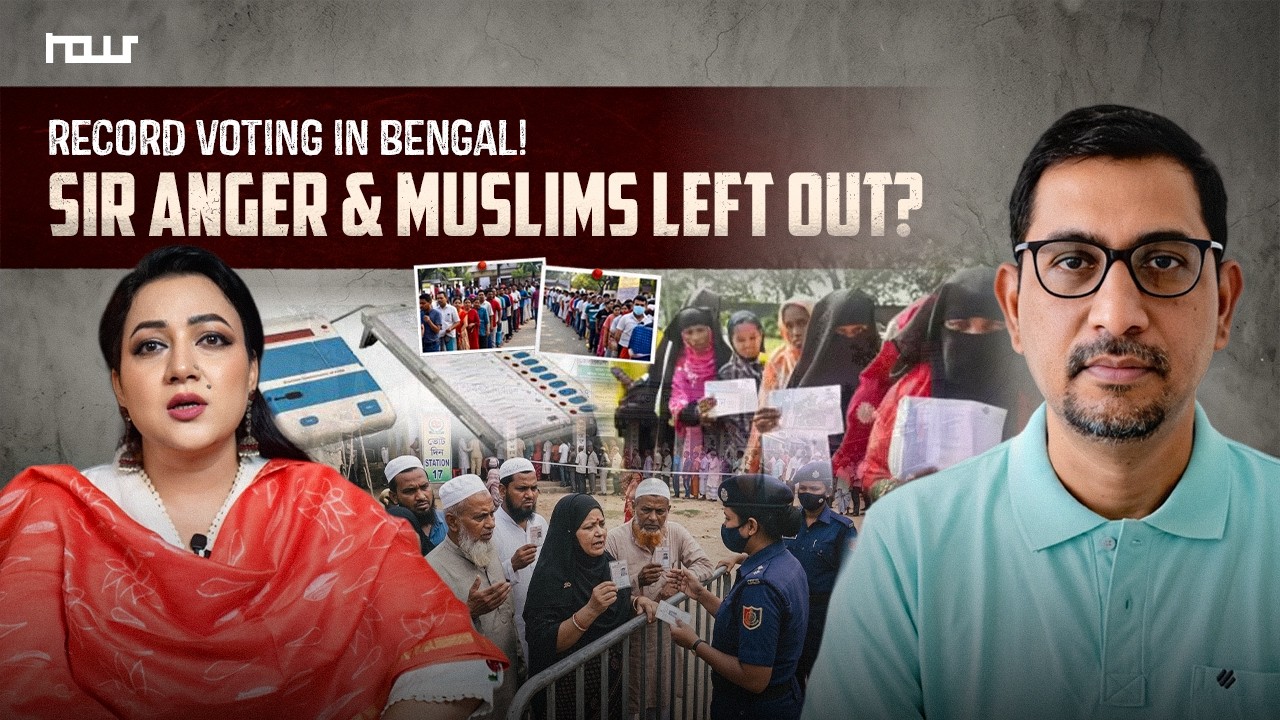
A Record Turnout, and a Reckoning Underway
On the day host Bushra Khanam Fahad recorded this conversation for Nous Podcast, West Bengal had just completed the first phase of voting in its assembly election, with turnout crossing 92 percent — by most accounts the highest the state has ever recorded. The number has become a Rorschach test. The Trinamool Congress reads it as a mass protest against the Special Intensive Revision, or SIR, the Election Commission's roll-cleaning exercise that preceded the vote. The Bharatiya Janata Party reads the opposite into it, arguing the surge reflects anger at Mamata Banerjee's fifteen-year government rather than support for it.
Fahad situated the moment within Bengal's longer political arc: decades of Congress rule, then nearly thirty years of Left Front dominance, and now a decade and a half of Banerjee. Turnout of this scale, she noted, echoed patterns seen recently in Bihar, where women voters and pro-incumbency sentiment both drove numbers up. Migrant laborers reportedly abandoned city jobs in Delhi, Mumbai, Pune and Kerala to travel home and vote, driving up flight fares as trains filled. Queues were still forming at some booths past 7 p.m.
To make sense of what sits beneath the turnout figures, Fahad turned to Sabir Ahmed, founder, director and lead of the Sabir Institute, a Kolkata-based public policy research organisation whose data-driven work on the SIR process has drawn national attention over the past six months.
How "Logical Discrepancy" Became a Weapon
Ahmed's account begins with the first SIR list, published in December, and a pattern his team says was visible from the outset. In districts with large Muslim populations — Farakka, Bhagawangola and Shamsherganj in Murshidabad among them — the share of voters whose records could be freshly linked to the 2002 electoral roll (what the exercise called "mapped population") was unusually high, with unmapped populations below 2 percent. In the Matua belt, settled by families who migrated from East Bengal, unmapped populations ran closer to 10 to 15 percent. That contrast, Ahmed said, appears to have shaped what came next: an artificial-intelligence-driven document check that surfaced a category found nowhere in the SIR manual — "logical discrepancy."
He illustrates the term with his own name. Sabir Ahmed should be spelled cleanly, he says, but a headmaster once inserted an extra letter decades ago — enough, under the new scrutiny, to flag a discrepancy. Multiple transliterations of the same name (Mohammed, Md., Shabbir, Shabbir), or families with six or more children in an era before any two-child norm existed, were treated the same way. "If you use AI, you can probe them to identify a Muslim name," Ahmed said, describing how flags clustered around Muslim names specifically.
The institute's own numbers make the case starkest through comparison. In Bhabanipur, Banerjee's own constituency, where Muslims make up roughly a fifth of the population, the share of "logical discrepancy" flags among Muslim voters roughly doubled to more than 40 percent once the category was applied — while the equivalent figure among other communities stayed flat. In Metiabruz, roughly 60 percent Muslim, some 90 percent of the flags fell on Muslim names.
Nandigram and the Pattern in the Numbers
Those flagged were pushed into a second, harsher category — "under-education" — requiring a hearing before a judicial officer, often someone unfamiliar with Bengali script, tasked with clearing more than a crore cases within roughly fifteen days. Ahmed calls this "humanly not possible." His own family was not spared: his father's passport-backed documents were approved, his brother's, filed the same day with the same proof, were deleted.
A further 27 lakh names were removed in a later round, bringing total deletions to roughly 91 lakh, a figure Ahmed says includes some genuinely deceased voters but is dominated by wrongful removals. Nandigram — the constituency Suvendu Adhikari won by a margin of only a few thousand votes — became a flashpoint after the institute presented data at a Delhi press conference showing that although Muslims make up about a quarter of the seat's population, they accounted for roughly 95 percent of deletions there. When Ahmed asked journalists searching for non-Muslim deletions to find comparable cases, the entire constituency yielded only 219 non-Muslim names cut from the rolls.
Compounding the problem, electoral rolls outside Kolkata are published in Bengali, and names of Urdu, Arabic or Persian origin often garble badly in transliteration — Abdul Jabbar rendered simply as Jabbar, or Santu Pal appearing as something unrecognisable. Ahmed's institute has published the raw, district-by-district breakdown of deletions by community on its own website. As of the recording, he said, the appellate process — run through a tribunal informally referred to by the name Shyama Prasad Mukherjee — had restored just under 200 names in total, despite the scale of the exclusions.
The Cost of Proving You Belong
For those swept into adjudication, the consequences extend well past the ballot. Deletion from the rolls, Ahmed said, suspends access to welfare schemes and even halts land transactions, since so many entitlements are now tied to the voter card. His institute's separate research into the exercise's toll found substantial economic costs — photocopying, travel between offices, lost daily wages for laborers earning a few hundred rupees a day — compounding into a heavy burden across the state, alongside more than a crore hours of lost school and work time as teachers and other officials were pulled in as booth-level officers.
Ahmed described calls to the institute's legal-aid centre from people across the social spectrum — senior bureaucrats to domestic workers — in visible distress, some in tears, some unable to sleep for fear of deportation to a detention camp. He said he has no confirmed information but would not rule out the possibility that sites for detention facilities are already being scouted in Bengal, given what he described as the pattern in Assam. "They will very soon prepare a detention camp even in Bengal," he said.
The asymmetry sharpens around the Matua community, migrants from East Pakistan and Bangladesh who remain eligible for citizenship under the Citizenship Amendment Act even if struck from the rolls. Muslims facing the same process, Ahmed noted, have no equivalent legal provision to fall back on — despite generations of documented residence, cemetery records dating to the early 1900s, and family members who served in the judiciary and the army.
Bengal's Political Undercurrents
Both Fahad and Ahmed situated the SIR fallout within a broader BJP push to polarise the state along communal lines, with mixed results. Uttar Pradesh chief minister Yogi Adityanath campaigned with the claim, "this is not the land of Kaaba, it is the land of Kali," while Adhikari suggested the SIR process would itself deliver the BJP to power. Ahmed and Fahad agreed the party's attempt to install a rival Muslim face, Humayun Kabir, was rejected outright by Muslim voters, while promoting Adhikari as an alternative to Banerjee gained little traction given his own party-switching history and communal rhetoric.
Meanwhile, Banerjee's campaign leaned on Bengali cultural identity — warning that BJP rule would threaten access to fish and meat, gesturing at rumours of meat-free weekdays — a message Fahad and Ahmed suggested resonated more than the BJP's polarisation strategy, though Ahmed cautioned that a narrative blaming Muslims for job losses and linking them to Rohingya and Bangladeshi migration had been built quietly by the BJP over roughly a decade and could still move some votes, particularly in urban areas insulated from the SIR's direct impact.
Both described the security posture around the vote as extraordinary: large deployments of CRPF and other central forces, visuals of what were described as tanks circulating on social media, and comparisons to militarised zones like Kashmir and the Northeast. Ahmed, delayed reaching the interview by the deployment's effect on Kolkata traffic, called it unprecedented in his lifetime and in India's electoral history.
What Happens After May 4
Ahmed repeatedly drew a parallel to Assam's National Register of Citizens exercise, whose tribunal system he says offers a preview of what Bengal may face — including instances where families reportedly had to produce a relative's dead body before a tribunal to prove a death. He noted that Assam's NRC ultimately excluded more Hindus than Muslims from its final list, undermining its own stated rationale, and expressed hope that Bengal's outcome could similarly discredit the exercise, while cautioning against assuming the same forces would stop there.
He was sharply critical of the appeals process itself: no published standard operating procedure despite a Supreme Court directive, an online application capped at roughly 1,000 words in a country with wide digital gaps, and no receipt given for offline submissions. "They will very soon prepare a detention camp even in Bengal," Ahmed repeated of his broader fear, while stressing that a categorical statement from the Election Commission itself had found no verified instance of Rohingya or Bangladeshi nationals among the flagged voters — undercutting the premise used to justify the exercise.
Asked what should happen after results arrive on May 4, Ahmed argued that whichever government forms should make restoring wrongfully deleted voters within 90 days its top priority — a fight, he said, that belongs in Delhi as much as in Kolkata, and one civil society groups intend to keep pushing regardless of the outcome. He invoked a phrase Fahad recalled from a separate interview with commentator Parakala Prabhakar, who described the SIR process as a "political bloodless genocide," creating, in effect, two classes of Indian: those with documents and full rights intact, and those left to prove, indefinitely, that they belong.
For Ahmed, the stakes extend past Bengal. "A direct blow to the constitutional value, a direct blow to democratic practice," he said of the exercise, adding that a party willing to use such methods once could use them anywhere. His closing appeal was for Bengali intellectuals and concerned citizens nationally to keep the issue alive well past election day, and for the judiciary — which he said has historically played an active role protecting minority rights — to treat the plight of the deleted voters with the urgency he says it deserves. "The Election Commission is a party to this," he said, arguing that whatever the vote count on May 4 shows, the fight over who counts as a citizen in West Bengal will not end with it.


Discussion
0Readers only · Comments are reviewed by the desk before they appear
The journalism is free for everyone — create a free account to join the discussion.