

Illusive Citizenship: Tanweer Fazal on Indian Muslims, Denationalisation and the Politics of Belonging
Political sociologist Tanweer Fazal argues that the gap between constitutional promise and lived reality has widened into a deliberate project of othering, tracing it from Partition-era debates through CAA, NRC and SIR.
Contents · 9 sections
Citizenship on paper and in practice
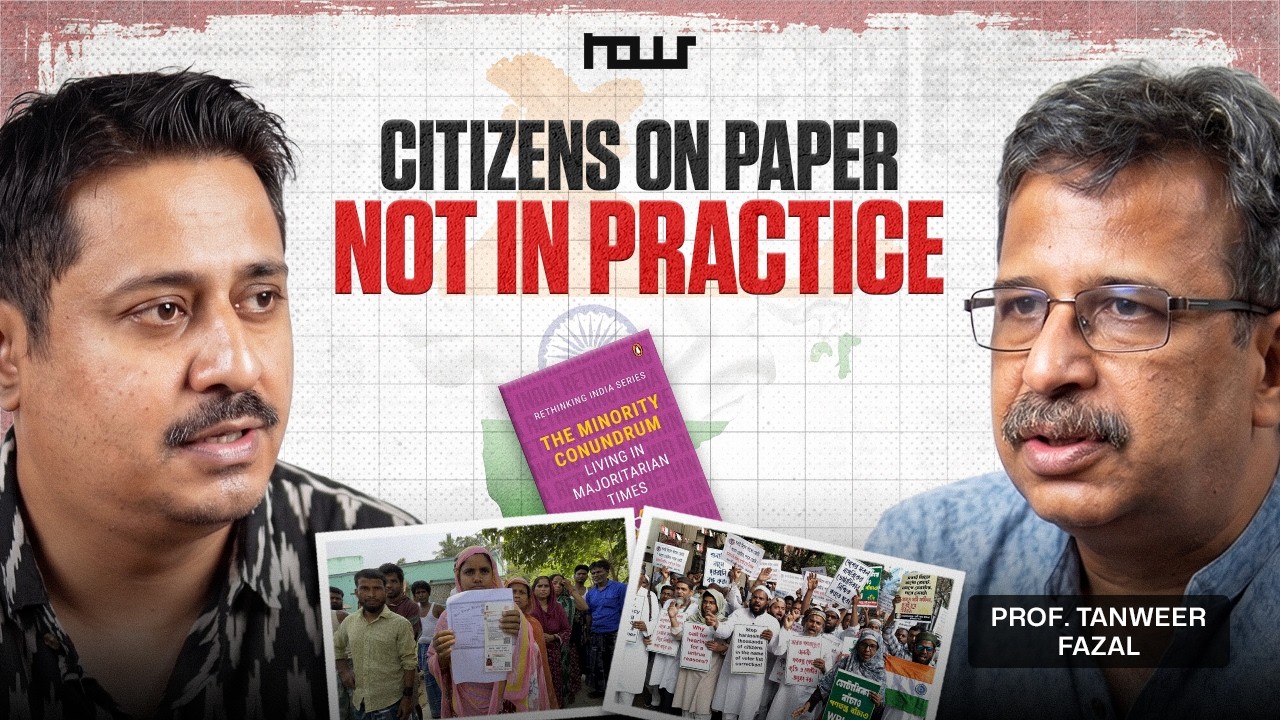
Prof. Tanweer Fazal, a political sociologist who has written extensively on minority rights, exclusion and citizenship, uses the phrase "illusive citizenship" for the gap between what the Constitution promises and what Muslims in India experience. In a conversation with the host Asad Ashraf, he explained that citizenship in principle means legal membership of a state with equal rights. In practice, he argued, that promise has always been thin for the marginalised, and it has thinned further as social inequalities have been reinforced instead of narrowed and as the state has stopped acting as an instrument for delivering constitutional rights.
Fazal traced the sharpest deterioration to the establishment of what he called a Hindutva regime at the centre and in many states. As an example, he pointed to what is celebrated as the Yogi model, or bulldozer justice, which he described as a complete denial of constitutional process: accusation and punishment collapsed into a single act, with bureaucracy, police and even the judiciary in his view failing to stop it. He was careful to say that Muslims are not the only ones affected by fragile citizenship, but he argued that in their case there is a concentrated attempt at what he called denationalisation: questioning their claim to belong at all, through labels such as outsider and traitor, constant doubts about their patriotism, and the denial of their history.
Solidarity, and an alternative from within
Asked what a community facing this should do, Fazal's first answer was organisation and solidarity, among Muslims and across other marginalised communities. Such efforts have been attempted before but have not lasted, he said, partly because there is no consensus on what marginality means: whether economic deprivation counts, how to understand caste discrimination inside Muslim communities as well as outside them, and how to address gender-based violence. A politics of solidarity, he said, cannot be produced in a seminar room; it comes from sustained practice, from people engaging seriously with one another's questions while respecting each community's autonomy.
The host suggested that Muslim communities also face internal questions of sect, caste-like biradari divisions and gender. Fazal agreed and argued that progressive thinking need not be imported from Western modernity, because Indian and Islamic history and practice can themselves generate progressive alternatives. He said the answer is to engage with those traditions and with the progressive movements that have grown up around them.
Qaum, millat, ummah and the idea of darul aman
Fazal's 2014 book distinguishes three ideas of collective belonging among Muslim thinkers: qaum, millat and ummah. He described the debate as an old one, alive in the late colonial period when figures as different as Maududi, Hussain Ahmad Madani, Iqbal and Maulana Azad argued about nationhood, a concept that had itself arrived from Europe after its wars of religion. Islamic theology, he noted, is often quoted selectively today, with the concepts of darul harb and darul Islam pulled out to raise doubts about Muslim loyalty. What is forgotten, he said, is that Indian Muslim thinkers, going back to Sir Syed, developed the idea of darul aman or darul ahd, a land where communities coexist and Muslims share power, and pointed to the Prophet's covenant in Medina with people of other faiths as a precedent.
On the ummah, he argued that in the Indian context it has always been understood as a spiritual idea, not a territorial or political claim. One can be a good Muslim in India and feel spiritual kinship with Muslims elsewhere without that becoming a political contest over loyalty.
What the Sikh comparison shows
Fazal compared Muslim and Sikh experience because both communities once developed distinct ideas of nationhood, and neither, he argued, out of theological necessity. In his account, the dominant Hindutva discourse, and to some degree Indian nationalism more broadly, has distinguished religions of Indian origin from those of "non-Indian" origin, a distinction he traces to Savarkar's writing on Hindutva, whose influence spread widely. Those whose holy land lies outside India were therefore not to be trusted, and some thinkers, he said, went as far as suggesting they be made second-class citizens.
The rise of Muslim and Sikh nationalisms, he argued, should be understood as responses to anxiety about whether Indian nationalism could accommodate their concerns, in the run-up to Partition and after it. Pakistan, he noted, did not settle the national question for its own people, given the 1971 split over language. Sikh nationalism, in his account, grew out of the demographic shift Partition produced in Punjab, the Punjabi Suba movement, and the mishandling that ended in Operation Blue Star; separatism proved short-lived and costly, though the idea of a distinct Sikh identity persists. Fazal said he does not advocate religious nationalism, which he considers unsustainable, and preferred the framework of multinationalism associated with his own supervisor, T. K. Oommen, in which many identities can be accommodated inside one state.
He also cited reservation policy as a sign of the same distinction. Under Article 341, Muslim and Christian Dalits were excluded from Scheduled Caste status while Sikhs were included in 1956 and Buddhists in 1990. Communities that do similar work and suffer similar humiliation, he said, have seen upward mobility among those covered by reservation and almost none among those left out.
Why composite nationalism fell short
The host asked why composite nationalism, which many assumed had succeeded, allowed Hindutva to become as dominant as it is. Fazal said history must be examined without turning it into a weapon. In his view, composite nationalism served more as a slogan than as a conviction even among its proponents, and a majoritarian tendency was present from the start. He pointed to the language question, where the idea of a shared Hindustani gave way to a Sanskritised Hindi and a 1955 Sanskrit Commission was asked to consider Sanskrit as a national language, and to state-level laws on conversion and cow slaughter that accommodated majoritarian concerns. He also argued that understanding why leaders such as Iqbal and Jinnah, both once nationalists, turned to separatism is necessary for understanding how Hindutva rose.
Yet Fazal was not pessimistic about India's diversity. Diversity, he argued, has historically given the state stability, and homogenising ideas of one language, one nation and one culture are counterproductive. He suggested that the sort of upheaval seen in Bangladesh, Nepal or Sri Lanka would be harder to organise in so varied a country.
Muslim politics and its limits
Asked about attempts at Muslim political mobilisation, such as the one associated with Hyderabad's MP, Fazal said democracy allows many kinds of politics, and that treating Muslim political assertion with suspicion, as if it might revive the pre-1947 situation, is unacceptable. But he noted that Muslim experiences differ by region: relatively prosperous and professional in parts of the south, largely poor and in urban poverty in much of the north and east. A model that suits Hyderabad may not suit Bihar or Bengal.
He was equally sober about the record of secular parties. Bihar has had decades of socialist politics and Bengal long Left rule, yet Muslim indicators in both remain poor, and Bihar's caste survey showed OBCs still among the poorest despite three decades of OBC politics. Politics can improve representation, he said, but social and economic transformation requires a sustained, concentrated effort, and where polarisation is intense it is hard for Muslim candidates to win at all. The first task, in his view, is a politics that can defeat polarisation.
The anti-CAA protests and what followed
Fazal saw the 2019-20 protests against the CAA and NRC as a significant sign of change. They were led largely by women, students and young people, they were notable for the near-absence of religious orthodoxy, and they were, in his description, a citizenship protest conducted under the national flag that also reached out to others. He argued that the state's response, including the deaths of around 20 to 22 people in Uttar Pradesh and police action inside Jamia, resembled a war against the protesters, and that the Covid lockdown then completed the demobilisation. He nonetheless saw the movement's legacy in a new Muslim middle class and a new civil society, more rooted and less dependent on donor agendas, working in places such as Mewat and Kashmir.
Othering as a project
When the host asked whether othering is deliberate, Fazal said it is, and that it works through several channels at once. He pointed to Assam's chief minister and to population and land policies aimed at Bengali Muslims; to Hindutva-inflected popular culture, films and songs; to the renaming of places, which he called symbolic but a denial of a community's presence in history; and to the labour market. Ask for a service call, he said, and eight in ten times the person will be a Muslim doing the lowest-paid work, while employers now fear hiring Muslims. He cited the prime minister's remark about puncture repairers as an example of language read as stigmatising. Boycott calls over halal labels and shop names, he said, show even the market being polarised.
On SIR, the special intensive revision of electoral rolls, Fazal said CAA, NRC and SIR should be seen as one continuum. In his reading, the anti-CAA protests were effective in one respect: a nationwide NRC did not happen, and the aim has shifted to other instruments. He noted the scale of deletions in Bengal, about 90 lakh names by the figures he cited, and the introduction of an undefined category of logical inconsistency, under which minor spelling differences in parents' names were enough to lose the vote. He cited reports that around 65 percent of the roughly 35 to 36 lakh people removed under that category were Muslim, a share far above their proportion of the population, and said the data has not been fully disclosed. He also argued that SIR works as a polarising tool, since the anger over deletions did not become cross-sectional: those not affected, he said, may even welcome it.
He said the CAA itself was hard to implement because applicants must first declare themselves immigrants, which people who already hold documents have little reason to do. And he pointed to a newly announced demographic commission whose terms of reference, he said, include looking into the unnatural growth of population in certain communities, without naming them.
Impunity and hope
Fazal argued that impunity is what makes Muslim experience distinct even though it is not unique to Muslims. Drawing on his research, he cited the Laxmanpur-Bathe killings in Bihar, where lower courts convicted but higher courts acquitted everyone, and the Bhagalpur violence of 1989, where he said most cases never produced usable FIRs or were undermined by delays and misspelled names. What is different now, he said, is that perpetrators are celebrated, citing the release of the Bilkis Bano convicts and a garlanding in Jharkhand.
On the possibility of a Rohingya-like fate, he said Indian Muslims number around 200 million and live across a diverse country, which makes a uniform project of that kind implausible. What he expects instead is a continuous operation of othering, because Hindutva politics depends on the Muslim as its adversary. He compared Indian Hindutva with German fascism in its methods and ideology, though not in expansionism, and said he finds hope in history: fascism in Europe was defeated, colonialism collapsed, long-standing dictatorships fell, and human energy does not rest indefinitely under constant repression.


Discussion
0Readers only · Comments are reviewed by the desk before they appear
The journalism is free for everyone — create a free account to join the discussion.