

How the World Learned to Call Only Muslims Terrorists
Anthropologist Irfan Ahmad argues that "terrorism" was never a neutral description of violence — it was built, definition by definition, to mean Islam.
Contents · 7 sections
A word with no agreed meaning
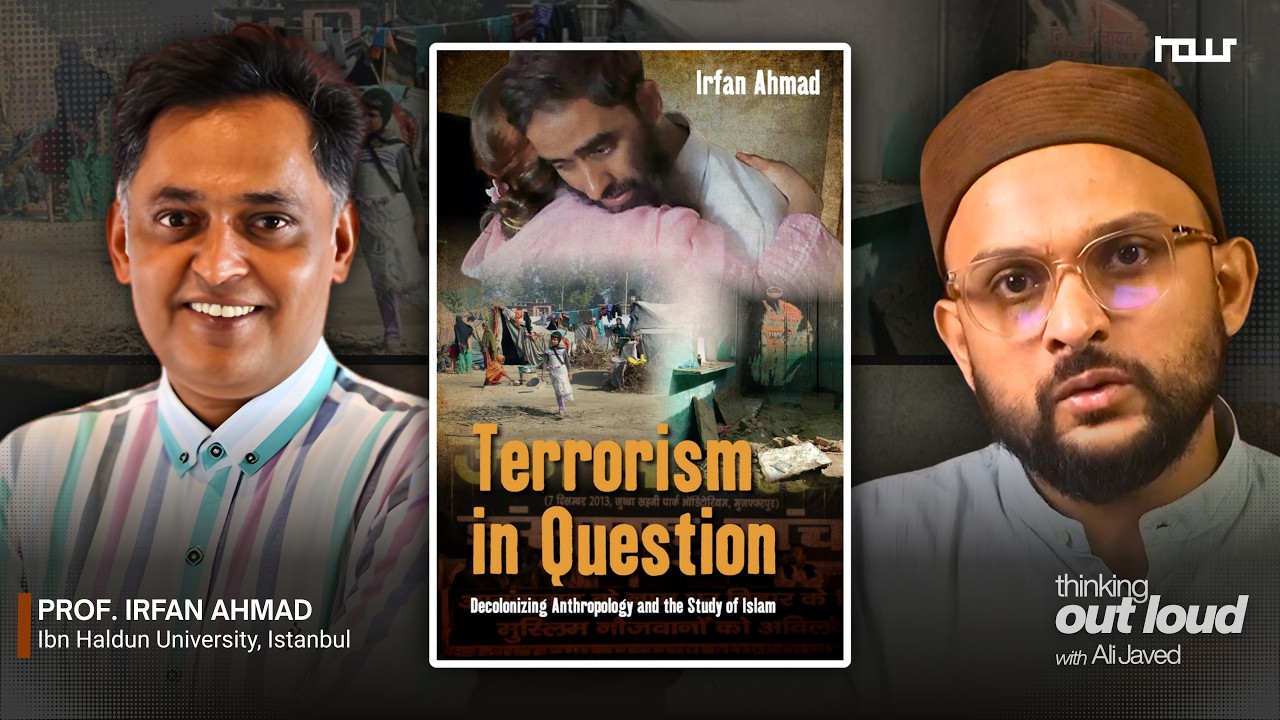
Irfan Ahmad, an anthropologist and sociologist trained at Jawaharlal Nehru University and the University of Amsterdam, opens from an unusual place: terrorism, he says, has no agreed definition. A 2015 United Nations document concedes as much, even as it uses "terrorism" and "radicalization" interchangeably. The scholar Alex Schmid catalogued more than 200 competing definitions in 1985 and, revisiting the question in 2005, found the search for consensus still unresolved. Even within a single government, Ahmad notes, agencies disagree: the US State Department, the Department of Defense and the CIA each work from their own definition, shaped by their own institutional histories.
Rather than search for a cleaner definition, Ahmad poses a different question in his new book: not "who is a terrorist," but "who needs the label." That inversion, he argues, opens a genealogy — why a category with no scholarly consensus became, after the September 11 attacks, functionally synonymous with one religion.
Two features mark what Ahmad calls "new terrorism" in the post-9/11 frame. First, it is defined as a religious phenomenon — and once religious, by implication, Islamic. No equivalent term exists for the other faiths: there is no currency for "Hindu terrorism," "Christian terrorism," "Buddhist terrorism" or "Jewish terrorism" in mainstream discourse, though violence carried out in the name of each has occurred. Second, terrorism was reclassified from a tactic — a means any group might use — into an ideology, and specifically a religious one. A third, quieter shift accompanied these two: the historical association between terrorism and the state itself was largely erased. Ahmad points to the Jacobins' Reign of Terror after the French Revolution, and closer to home, to British forces hanging bodies from trees in Delhi after the failed 1857 rebellion "to strike terror" in residents — an account drawn, he says, from British sources themselves. Post-9/11 terrorism discourse, by contrast, speaks almost exclusively of non-state actors.
From communism to Islam
Ahmad situates the post-9/11 shift within a longer story about the world order built after 1945. Popular narrative holds that the West's principal enemy moved cleanly from communism, defeated with the Soviet collapse, to Islam and terrorism after 9/11. Ahmad complicates this: the historian Bernard Lewis, he notes, was already drawing an explicit parallel between communism and Islam as early as the late 1950s or early 1960s — well before the Cold War ended. The idea of Islam as the West's civilizational other, in other words, predates its supposed trigger.
He locates the deeper cause in the nation-state system itself, which he calls a genuinely "novel experiment" imposed on much of the world after World War I, particularly across the former Ottoman territories. The 32 nation-states carved from the Ottoman Empire's collapse were not, in his account, born of popular demand the way independence movements arose in colonized India. He offers a pointed illustration: at the ceremony announcing Iraq's creation as a state, no Iraqi national anthem existed, so the British national anthem was played instead. Populations across the region continued to identify with older, pre-national forms of community — religious, linguistic, cultural — that the imposed borders never fully replaced. Resistance to the nation-state model, Ahmad argues, has therefore been disproportionately associated with Muslim-majority regions, feeding a narrative that treats that resistance itself as suspect.
Israel, in his reading, was central to internationalizing the terrorism discourse. He cites a book edited in the 1980s by a future Israeli prime minister whose central argument, stripped down, was that Arabs — and only Arabs — are terrorists, a claim made while folding Israel into "the Western world" it claims to defend. Ahmad juxtaposes this with the historical record of Israel's founding: organizations that carried out attacks before 1948, he notes, were later absorbed directly into the Israeli Defence Force, and prominent Israeli politicians — one who later became prime minister — are on record saying no reading of Jewish ethics prevented the use of terrorism at that founding moment.
In India, Ahmad traces the discourse to committee reports behind the country's early anti-terror legislation, which explicitly located terrorism's origin in the Middle East. Because India's own Muslim minority is large and its geopolitics entangle Pakistan and Bangladesh, he argues the domestic conversation about terrorism could never be insulated from this international framing — unlike, say, France, where discussing terrorism domestically does not require invoking a neighboring state.
Fanaticism, jihad, and narrative asymmetry
Much of Ahmad's method traces how specific words were built to carry stigma across very different contexts. He follows "fanaticism" from W.W. Hunter's 1871 book on Bengal's Muslims — whose full title, "The Indian Musalmans: Are They Bound in Conscience to Rebel Against the Queen?", was published by an Indian house after 9/11 with the subtitle quietly dropped — to the American civil rights movement, where Black activists demanding full equality were similarly branded "fanatics" by segregationist officials.
His treatment of "jihad" follows a similar arc, moving from an anti-colonial Aligarh Muslim University pamphlet of the early 1990s — written in Urdu, framing student activism as "jihad for democracy and freedom" — to Ahmad's own account of what he calls his "legal jihad": a bureaucratic battle with Dutch immigration authorities during his PhD, when officials demanded a birth certificate he had never possessed, forcing him to travel from his home village in Bihar to Dutch embassy offices to establish, retroactively, that he had been born. He contrasts this self-understanding of jihad as a struggle for fairness with its contemporary Indian deployment in phrases like "land jihad," "corona jihad" and "love jihad" — a proliferation, he argues, engineered to make the word connote only violence, erasing its interior meaning for the people who actually use it.
This is where Ahmad introduces what he calls "narrative asymmetry": when media, intelligence agencies, police, judiciary and scholarship converge on a single dominant account of a community, he argues, political equality becomes impossible until that narrative imbalance is corrected first. Much of his book, he says, is devoted to demonstrating this asymmetry with evidence — including listening, without prejudgment, to people imprisoned in India as alleged terrorists, to recover what he calls the "emic" view: how people understand their own actions, as against the "etic" view imposed from outside.
Nationalism as the "underbelly of terrorism"
Ahmad's central methodological claim is that no serious account of terrorism is possible without interrogating nationalism itself. He develops this through three case studies: Sri Lanka's Tamil Tigers, Myanmar's persecution of the Rohingya, and India. In each case, he argues, what gets labeled terrorism is inseparable from a majority group imposing its language, religion or national narrative on a minority — Sinhala Buddhist nationalism excluding Tamil speakers in Sri Lanka, Buddhist nationalism in Myanmar treating Rohingya land as sacred and its Muslim residents as trespassers, and in India, the destruction of the Babri Masjid feeding both Hindu-nationalist ideology and the subsequent radicalization narratives applied to Indian Muslims.
He extends the same logic to Israel, arguing that Israeli state violence against Palestinians cannot be fully explained without treating it as a nationalist project — the establishment of an ethnically Jewish state in which Palestinian presence is framed as a demographic and territorial "disturbance," tracing back to the Balfour Declaration.
Ahmad also questions why this connection to nationalism goes largely undiscussed at forums like the Oslo terrorism conference he attended and describes ethnographically in the book. His explanation: nationalism is the very foundation on which the postwar Western order rests, and foundational assumptions are structurally resistant to their own scrutiny. The discomfort is therefore displaced onto an external enemy — a dynamic he also finds in how selectively violence is reported. He cites a comparison from the book: in a year when roughly 800 deaths in India were attributed to terrorism, some 34,000 people died in road accidents — deaths that receive none of the sustained media attention terrorism does.
A discipline built to study "the other"
Ahmad is also candid about the limits of his own discipline. Anthropology, he explains, historically developed alongside sociology as a study of "the other" — originally the "primitive" or "preliterate" societies without written traditions, as distinct from orientalism's study of literate non-Western civilizations. He argues this origin has consequences: even celebrated anthropologists were complicit in producing the very stigmatization his book examines. He singles out Irawati Karve, often credited as India's first woman anthropologist, and Claude Lévi-Strauss, the French father of structuralism, both of whom wrote about Islam as a "destructive force" and a form of "fanaticism" in the 1940s — years before Samuel Huntington's "clash of civilizations" thesis, which Ahmad notes was itself preceded by similar arguments from Bernard Lewis.
Where classical ethnography insists on deep, localized fieldwork — living with a community, learning its language, avoiding snap judgment (a method Ahmad likens to a prophetic hadith counseling against judging someone without having traveled or dealt with them) — he argues terrorism cannot be understood at the local level alone. The same slogan, "not all Muslims are terrorists, but all terrorists are Muslims," recurs identically across the United States, Canada, Norway, Australia and India — geographically disconnected contexts that, in his view, demand what he calls "ethnography on an awkward scale": fieldwork that stays rooted in local specificity while tracing how national, regional and global forces converge on it, rather than treating any single neighborhood as a self-contained unit of analysis.
"A good Muslim is basically an anti-Muslim"
Building on the political scientist Mahmood Mamdani's well-known "good Muslim, bad Muslim" framework, Ahmad proposes a sharper formulation of his own: in contemporary Western, Indian and Zionist discourse, he argues, a "good Muslim" has effectively come to mean an anti-Muslim — someone who actively denigrates or mocks Islam. He cites the platforming of critics such as Taslima Nasrin in India, and internationally, figures like Irshad Manji and Ayaan Hirsi Ali, several of whom eventually renounced Islam altogether, as evidence of a discourse that rewards public repudiation of the faith rather than mere moderation within it.
Asked about the risk that decolonial and anti-colonial frameworks can themselves be weaponized, Ahmad is sharply critical of Hindu-nationalist figures who invoke "decolonization" rhetoric — naming the commentator J. Sai Deepak specifically as, in his assessment, "pseudo-scholarship" that misunderstands colonialism in order to recast Islam and Muslims as India's original colonizers. He argues that decoloniality, as a framework, remains a "negative reference" — useful for identifying what to reject, but insufficiently developed on what should replace it. Drawing on the Arabic root of hurriyat (freedom), he calls for scholarship oriented toward that positive, constructive project rather than critique alone.
Law, media and the "ditto theory"
In the book's final movement, Ahmad turns to how state institutions sustain the terrorism discourse in concert rather than in isolation — law, media, judiciary and political parties acting together, he argues, using the example of the Babri Masjid movement, which drew support across the Congress–BJP divide and was ultimately endorsed by India's Supreme Court. He names activists including Umar Khalid and Safoora Zargar, discussed in the book, as examples of people who have spent years in prison for what he characterizes as thinking against prevailing power.
He closes with what he calls "ditto theory" — the practice, deployed from Myanmar to Israel to Delhi, of describing communal or state violence as coming symmetrically "from both sides," flattening clear power imbalances into false equivalence. He points to Aung San Suu Kyi's own framing of violence against the Rohingya in these terms as a case in point. Asked what readers should do with this analysis, Ahmad resists prescribing a single course of action, arguing instead that effective activism — in media, law, education or elsewhere — depends first on conceptual clarity, without which sustained effort risks working hard without working toward anything coherent.


Discussion
0Readers only · Comments are reviewed by the desk before they appear
The journalism is free for everyone — create a free account to join the discussion.