

How India's Political Parties Became "Private Limited Companies"
Veteran journalist Qurban Ali argues that the real crisis in Indian politics is not only Hindu nationalism's rise but the collapse of ideological commitment across every party, secular and communal alike, leaving Muslims and other minorities without a reliable political home.
Contents · 6 sections
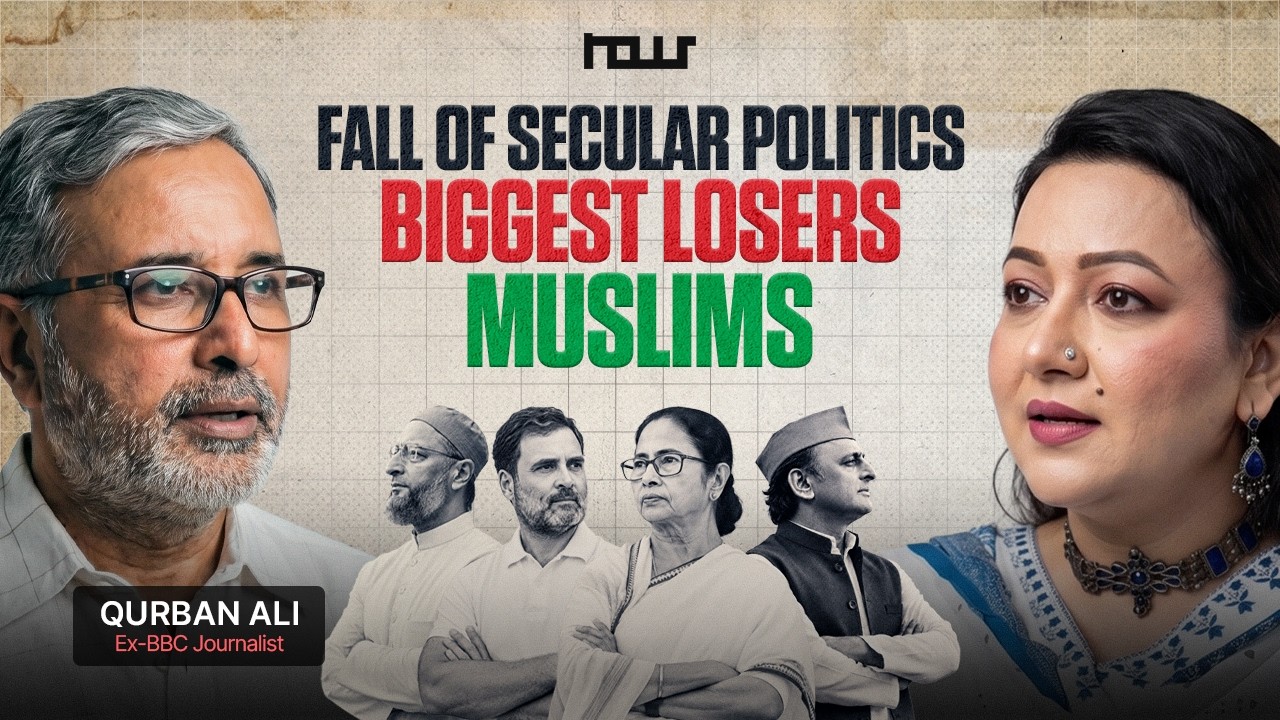
The interview opens on a scene from West Bengal. Weeks after Mamata Banerjee's Trinamool Congress won a third straight state election against the BJP, a clutch of its own MPs and MLAs abandoned the party and are widely understood to be headed into the BJP-led NDA. Among them, journalist and Nous Podcast host Bushra Khanam Fahad notes, is the actor-politician Sayoni Ghosh, once celebrated for a viral line about carrying "Mecca and Medina" in her heart, and Yusuf Pathan, the cricketer whose father served as a mosque muezzin. Both, within weeks of an election Trinamool did not so much lose as have taken from it, are aligning with the very political forces that built their campaigns on hostility to India's Muslim minority.
For Qurban Ali, a journalist with more than four decades of experience across the BBC and several national news channels, this is not an aberration but the logic of a political system that has hollowed itself out from within.
A Marketplace, Not a Movement
Ali traces the decay back roughly four to five decades, to the point when Indian politics still ran, however imperfectly, on ideological commitment inherited from the freedom movement and encoded in the Constitution. Defections happened even then — the phrase "Aaya Ram Gaya Ram" was coined in Haryana precisely to describe them — but they came with at least a pretence of principle. "Now it is like a cattle market where people are bought and sold," he said.
The evidence, in his telling, is not confined to one party or one state. Elected Congress governments in Karnataka and Madhya Pradesh were toppled after their MLAs were bought out. In Himachal Pradesh, Congress's own Rajya Sabha candidate lost after BJP engineered defections within his party. In Madhya Pradesh, a Congress candidate's nomination was disqualified on technical grounds while a ruling-party rival's flawed papers were quietly cleared. What was once an accusation levelled only at the Congress — dynastic capture, a politics of personal loyalty over ideology — now describes the BJP, the Left parties, and the regional formations built by figures like Lalu Prasad, Mulayam Singh Yadav and Biju Patnaik alike. "Every party has become a private limited company," Ali said, "and the only slogan left is: love me, love my last."
Whose Emergency Is It
Fahad pressed Ali on whether the current climate — bulldozed homes, demolished mosques, lynchings, and what she called the criminalisation of being Muslim in public space — constitutes an undeclared Emergency worse than the one Indira Gandhi imposed in 1975. Ali agreed substantially, but located the deeper danger in the ruling party's relationship to the Constitution itself. He pointed to the 2024 election slogan "400 paar" — an ambition, made explicit by several BJP leaders, to secure the two-thirds majority needed to rewrite the Constitution's basic structure, a doctrine the Supreme Court fixed in the Kesavananda Bharati case as unamendable regardless of numbers in Parliament.
Unlike Indira Gandhi's Emergency, which was declared and eventually punished at the ballot box in 1977, Ali argued that today's erosion proceeds undeclared: media captured, courts slow to act, civil society intimidated by the threat of prosecution, and investigative agencies deployed selectively. Of the more than 240 BJP MPs in the Lok Sabha and over 100 in the Rajya Sabha, he noted, not one is Muslim, not one is Christian, and perhaps one, by his estimate, is Sikh. "That is not an accident," he said. "It is the design."
Congress's Own Reckoning
Fahad's line of questioning kept returning to whether opposition parties bear responsibility for the vacuum Ali describes, given how readily they abandon secular commitments once elected. Ali did not exempt the Congress. He walked through the party's own history of communal compromise: the reopening of the locked Babri Masjid site under Rajiv Gandhi's government, the shilanyas ceremony at the disputed site, and Rajiv Gandhi's own promise to deliver "Ram Rajya" — a strategy that won Congress neither Hindu nor Muslim votes and cost it power in Uttar Pradesh and Bihar for the subsequent thirty-six years. Having conceded that religious symbolism could win elections, Ali argued, Congress effectively handed the BJP a justification to compete more aggressively on the same terrain, culminating in the Ayodhya movement becoming an official manifesto commitment.
He drew a sharper contrast with the Congress-led government of Manmohan Singh, under which, he said, communal temperatures were at "an all-time low," the Sachar Committee produced the first rigorous official accounting of Muslim socio-economic conditions, and a Ministry of Minority Affairs was created — one that survives, if underpowered, even under the current government.
The "B-Team" Charge, and Its Double Standard
Much of the conversation turned on the political fate of Muslim-interest parties like Asaduddin Owaisi's AIMIM, routinely branded a BJP "B-team" for splitting the anti-BJP vote. Ali resisted the label while declining to endorse AIMIM's politics personally. His argument was one of consistency: AIMIM contests elections independently and has never allied with or joined the BJP, unlike the Trinamool defectors under discussion. Owaisi, he pointed out, has been recognised repeatedly as an outstanding parliamentarian and was among the most vocal defenders of the Indian state during the recent military confrontation invoked as "Operation Sindoor" — a record, Ali argued, that sits uneasily with the communal label attached to him.
He also noted an asymmetry: caste-based parties — Mayawati's politics for Dalits, the Akali Dal for Sikhs, historically even Shiv Sena's explicitly Hindu appeal — are rarely stigmatised the way a Muslim-interest party is, even though caste and religion are, in his account, comparably foundational to Indian social organisation. At the same time, Ali maintained that religion-based politics is neither constitutionally sustainable nor strategically wise for Muslims, since it hands the BJP a rhetorical justification for its own project. What has scaled successfully, he argued, is the Indian Union Muslim League in Kerala, which has governed within secular coalitions — under the Left, under the Congress-led UDF, and in Manmohan Singh's central government — precisely because it built a "secular character" rather than campaigning on emotive religious appeals.
Documentation as a Weapon
One of the interview's more concrete arguments concerned the uneven historical record of anti-Muslim violence. Ali, who reported on the Maliana and Hashimpura massacres and the Bhagalpur riots as a young journalist, contrasted two cases from the same 1987 period. The Hashimpura massacre — in which security personnel abducted and killed Muslim youths, dumping bodies in a canal — was pursued for decades by lawyers Vrinda Grover and Rebecca John, ultimately securing convictions of the accused policemen and compensation for victims' families. The Maliana massacre, in which around seventy Muslims were killed roughly a day later, produced no comparable prosecution, because it was never adequately documented or litigated. The same gap, he said, applies to Bhagalpur, where thousands were killed, and to the 1983 Nellie massacre in Assam.
Ali's point was not to absolve the state of responsibility but to insist that documentation, litigation and organised civil-society pressure are not optional extras — they are what converts injustice into a legal and historical record capable of eventually producing accountability, as his own petition before the Supreme Court did, resulting in a ruling that police and administration must take suo motu cognisance of hate crimes rather than waiting for complaints to be filed.
What Is Left to Do
Toward the close, Fahad asked whether India's Muslims have simply resigned themselves to their circumstances. Ali's answer combined sympathy with challenge. He invoked Faiz Ahmed Faiz's line that a "night of tyranny is still just a night" — implying a dawn will come — while cautioning that resistance requires sustained self-preparation, pointing to Iran's decades of endurance as an example, without endorsing Iran's politics.
Practically, his prescription centred on the courts and the Constitution as the only instruments actually available: pursuing cases up to the Supreme Court regardless of repeated setbacks, building NGOs and human-rights documentation infrastructure, and using social media where mainstream and "godi" (pliant) media will not carry the story. On the coming Uttar Pradesh election, Ali was specific: given that Muslims form roughly 20 percent of the state's electorate and cannot deliver a government alone, their vote becomes relevant only in coalition with a party carrying a substantial additional vote bank — pointing to Akhilesh Yadav's Samajwadi Party rather than Congress contesting alone. He credited Rahul Gandhi personally for standing on constitutional and pluralist ground during what Ali called "the era of hatred," while noting this was an individual judgment rather than confidence in Congress as an institution, given the party had, at a recent internal meeting, congratulated itself simply for deciding to use the word "Muslim" rather than the euphemism "minority."
His closing point returned to the interview's opening theme: Muslims, Dalits and other secular-minded voters cannot outsource their political future entirely to parties that have shown themselves willing to defect the moment power beckons. A durable secular front, built on issues rather than sentiment, remains — in his account — the only viable path back from what he calls this "long, dark tunnel."


Discussion
0Readers only · Comments are reviewed by the desk before they appear
The journalism is free for everyone — create a free account to join the discussion.