

Has Every Party Failed India’s Muslims? Raju Parulekar’s Unsparing Answer
The Mumbai commentator indicts the BJP for weaponising anti-Muslim hatred that was already there, and “secular” parties for decades of looking away — calling the Babri Masjid’s demolition one of the biggest stains in India’s modern history.
Contents · 6 sections
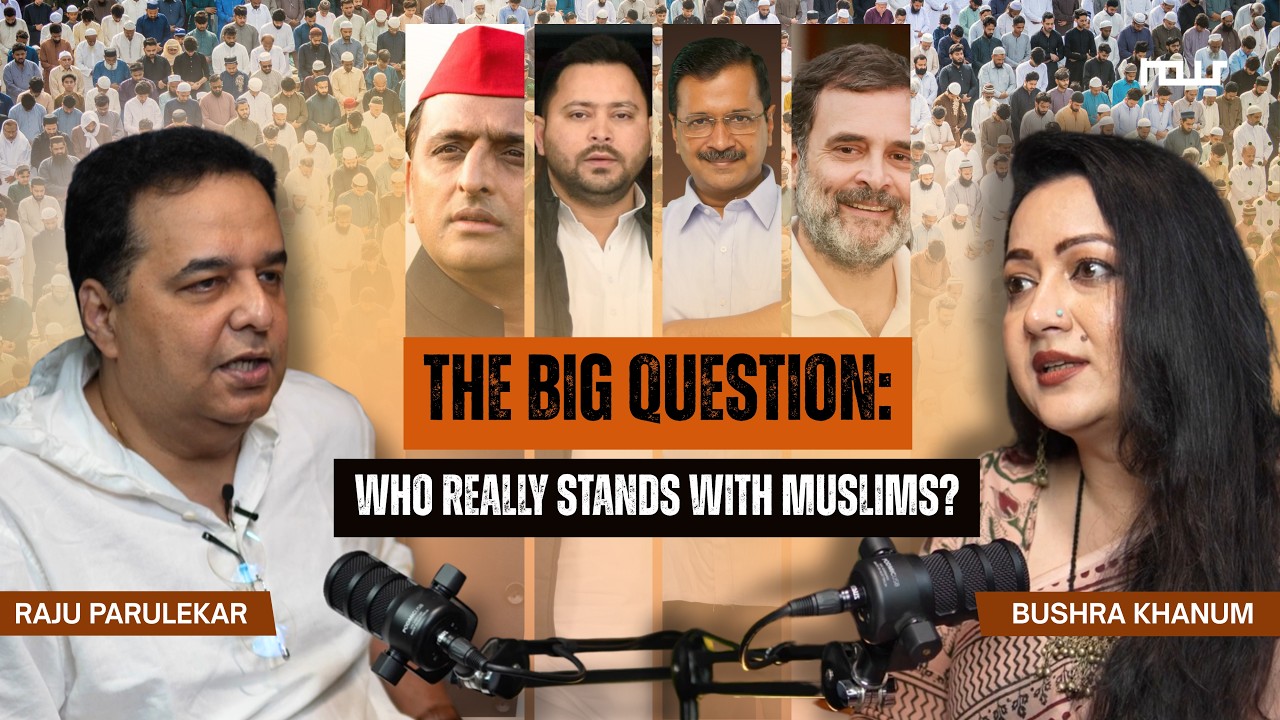
A wave of street protest had just forced the resignation of a Union minister, and ordinary Indians were, for the first time in years, asking pointed questions of the people in power. Senior journalist Bushra Khanum opened her conversation with commentator Raju Parulekar by posing the question underneath all of it: amid this sudden willingness to hold the government accountable, where exactly do Muslims stand?
Parulekar’s answer, across a wide-ranging and often combative exchange, refuses to let anyone off easily — not the BJP and the RSS, whom he holds chiefly responsible, but not the Congress and the socialist parties either, whom he accuses of decades of convenient silence.
A Hatred That Was Already There
Parulekar’s starting claim is blunt: the communal violence of the past decade did not appear from nowhere. “This hatred was already festering in society,” he said. “All the BJP did was give it power.” As evidence, he points to the 1992-93 riots, where he says police in Mumbai were “proactively involved” against Muslims — citing the Sri Krishna Commission’s findings on the Suleman Bakery firing — and to the repeated, unimplemented recommendations of police reform commissions under Congress governments. “Commission after commission kept coming,” he said. “Not a single police reform was implemented.”
He treats the 1992 demolition of the Babri Masjid as the hinge point, calling it “a sign that India had turned communal” and a “red warning bell” that should have stopped everything that followed. Later in the conversation, pressed by Khanum, he goes further, calling it one of the biggest stains left by his generation’s own choices — and admitting, with evident discomfort, that the demolition “pleased the majority of Hindus” at the time. “This is the most dangerous thing,” he said. The fall of the mosque and the making of the Muslim villain, in his reading, “are the same thing.”
Not Only the BJP
Khanum pushed back on the frame that hatred was simply dormant until 2014. People do not start hating overnight, she argued; something had to have been building for far longer. Parulekar agreed, but located the deeper failure in what came before: a political class, Congress included, that never built the institutions that might have contained it. “No government taught us the difference between being religious and being communal,” he said. Police and bureaucrats, in his account, were never trained to see the Constitution — not a minister’s order — as their actual chain of command. “Your uniform represents the Constitution, which is supreme,” he said. “Listening to Amit Shah comes later.”
He is equally unsparing about the socialist tradition that likes to present itself as Muslims’ natural ally. The Jayaprakash Narayan movement of the 1970s, he points out, drew crucial support from the Jana Sangh — the forerunner of the BJP — and the leaders it produced, from Mulayam Singh Yadav to Nitish Kumar, mostly went on to ally with the BJP when it suited them, Lalu Prasad Yadav being the exception he names. Muslims, he said, kept supporting these parties regardless. “Don’t you think that was the biggest betrayal of the Muslims?”
Four Names, and a Different Verdict on the Rest
Asked whom, if anyone, he credits with real commitment to Muslim welfare, Parulekar names four leaders, all from a single family: Jawaharlal Nehru, Vallabhbhai Patel, Indira Gandhi and Rajiv Gandhi. The inclusion of Rajiv Gandhi is qualified — Parulekar frames his decision, under pressure from Arun Nehru and V.P. Singh, to overturn the Supreme Court’s Shah Bano ruling as a costly political bet taken under duress, not a clean example. His harsher verdict is reserved for P.V. Narasimha Rao, whom he otherwise admires, for failing to treat the demolition of the Babri Masjid with the seriousness it demanded. “A Muslim man feels a sense of fear being in India,” he said. “That fear began to set in after the tenure of Narasimha Rao.”
The Silence of the Stars
Some of Parulekar’s sharpest words are for Hindi cinema’s biggest Muslim stars. He singles out Shah Rukh Khan, Aamir Khan and Salman Khan for staying silent through incidents of lynching and communal targeting over the past decade, despite their cultural standing. “These people turned out to be such cowards that they don’t deserve hero status,” he said, arguing that a star who will not stand by his own community can hardly be expected to stand by his country. He contrasts this with the ordinary Muslims he describes meeting — among them a Jaipur-based cardiac surgeon in his late sixties who, despite holding medical licenses in Britain and the United States, chose to stay in India and continues to treat mostly Hindu patients, some for free, even as he describes being shunned socially because of his faith.
What Parulekar Is Asking For
Rather than closing on grievance, Parulekar sets out a concrete, if provocative, list of demands. He wants political reservation for Muslims — seats reserved in Parliament and state assemblies in regions of the north where Muslims are numerically weak and have borne the brunt of violence, with half of those reserved seats going specifically to Muslim women. He wants caste-based reservation recognised within the Muslim community itself, for its own backward castes. And he wants a law modelled on protections already available to Scheduled Castes: a non-bailable offence, prosecuted on a fast-track basis, for the use of communal slurs against Muslims in public life.
He is careful to frame this as a demand for protection, not favour. “We have failed to protect them,” he said of the political system as a whole. “So let them protect themselves. They need at least this much constitutional shield.” Asked what an ideal situation for Indian Muslims would actually look like, he lists markers that are notable for their ordinariness: the ability to pursue an education and run a business without fear, to travel freely, to wear a hijab by choice, and for a Muslim to be as plausible a candidate for chief minister, prime minister or president as anyone else.
A Promise, and a Debt
Parulekar frames the coming years in the language of a ledger that India owes Muslims, rather than one Muslims owe the country. He draws an explicit comparison to Jewish communities negotiating with postwar Germany: the point, he argues, is not reconciliation on easy terms but making the state confront what it allowed to happen. “You must make this government feel guilty,” he said, pointing to a generation of children who “kept dying in our homes” while the state did nothing — and arguing that what is owed back, in return, is the full set of political, social, economic and educational rights the Constitution already promises.
He closes with a promise he immediately complicates. Give it three years, he tells Khanum, and the architects of the last decade’s politics will be in the courts and the public mood will have turned. But when she asks whether the wounds of the past twelve years will heal by then, he corrects the metaphor rather than the timeline: “Wounds do heal,” he said. “The marks will remain.”
Khanum does not let the optimism go unexamined. She presses him on whether a changed public mood will actually translate into solidarity the next time a Muslim is lynched, jailed under an anti-terror law, or bulldozed out of a home — pointing to Assam, to the Goonda Act arrests in West Bengal, to UAPA cases still moving through the courts. Parulekar does not dispute the pattern. His case, instead, is that the fear which kept both perpetrators and the silent majority quiet for over a decade is finally breaking down, and that this shift, more than any single reform, is the precondition for everything else he is asking for.


Discussion
0Readers only · Comments are reviewed by the desk before they appear
The journalism is free for everyone — create a free account to join the discussion.