

‘Give Me Three Years’: A Commentator's Reckoning With Who Failed India's Muslims
As protests reshape Indian politics after twelve years of BJP dominance, commentator Raju Parulekar tells Nous that Muslims are only just beginning to shed a fear built up over a decade — and argues the blame for it extends far beyond the BJP.
Contents · 4 sections
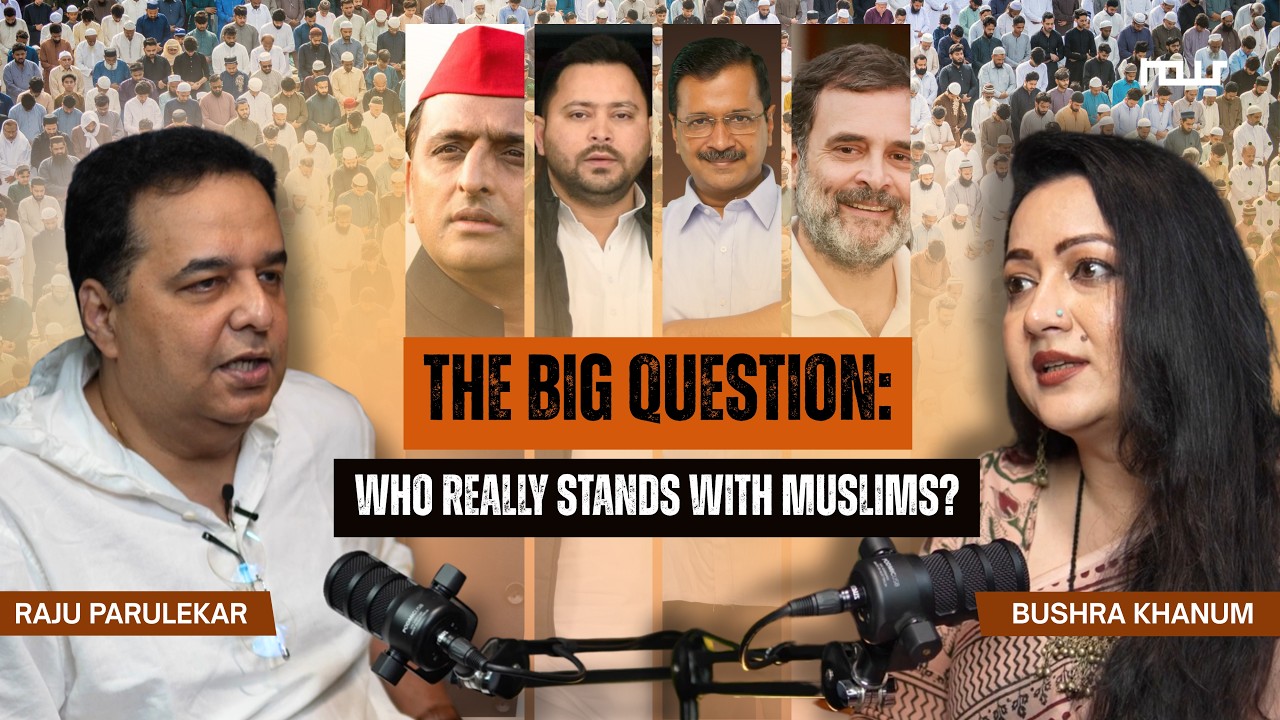
Host Bushra Khanam opened the conversation with a question hanging over India's recent wave of protest: as young people confront power and demand accountability from the prime minister and home minister directly, where do Muslims stand in all this? Has the same fear that gripped the country for twelve years lifted from them too? Her guest, the Mumbai-based political commentator Raju Parulekar, answered with a medical metaphor: recovering from a long fever doesn't mean you're strong the next morning — you're out of danger, but still weak. Muslims, he argued, have reached that stage: no longer at existential risk, but far from empowered. That shift unsettles the ruling establishment, he said, because its entire political project rests on treating Muslims as the enemy — a claim he rejected outright, arguing that the RSS, Modi and the BJP do not represent authentic Hinduism, and that ordinary Hindu society is increasingly seeing through the propaganda, especially as reports of financial irregularities have touched even the Ram temple project the movement was built around.
A Fear That Cuts Both Ways
Parulekar's broader claim was that Hindus, too, have been victims of twelve years of governance failures — leaked exam papers, collapsing roads and bridges, deteriorating healthcare — and that repeated disappointment eventually breaks even a well-propagandised trust. He argued that communal hostility was never really about religion but a tool serving a narrower set of interests: RSS leadership, groups he did not hesitate to call “terrorist organisations,” and a ruling party keen to protect its own power and its patrons. Khanam pressed him hard on whether the shift he described was real: are Muslims emboldened enough to protest publicly when a lynching happens, when young men are booked under the UAPA, when Bengal's Gunda Act sweeps up mostly Muslim students, when Assam singles out Muslim residents for targeting? Parulekar's answer was a promise rather than a defence: “Give me three years,” he said, predicting swift accountability once the current leadership falls, and describing a friend in Solapur, Sarfaraz Ahmed, who has kept a private, ongoing documentation of lynchings that Parulekar said would eventually be reckoned with, case by case.
He reserved particular scorn for Bollywood's biggest Muslim stars — Shah Rukh Khan, Aamir Khan, Salman Khan — arguing that men with genuine public standing and reach chose silence through the worst of the lynching years, and that history should record it starkly. He balanced this, when pushed, by acknowledging Hindu silence too, breaking it into three groups: a large number who stayed quiet out of the same fear gripping everyone, including many who watched the state move against dissenting Hindus — opposition leaders hit with Enforcement Directorate cases, or protesters, in his account, met with lathi charges and pellet guns; a smaller, opportunistic group that had always harboured hostility and simply seized the licence Modi's rise gave it; and a hardcore ideological base within the RSS and BJP that he said deserves formal constitutional trial for what he considers terrorism.
The Missed Red Line
Asked how the country arrived here, Parulekar located the real turning point decades earlier: the demolition of the Babri Masjid in December 1992, and the Mumbai riots of 1992–93 that followed. He cited the Srikrishna Commission's findings on the Suleman Bakery case as evidence that police in Mumbai had acted proactively against Muslims during the riots — findings, he said, that a subsequent Shiv Sena-BJP government simply discarded. He argued that despite repeated commissions during Congress rule recommending police reforms, not one of roughly ten specific recommendations was ever implemented, leaving a police force that, seventy-five years after independence, has never been formally trained to place its constitutional oath above a minister's order. That failure, in his account, is what let a pre-existing social prejudice calcify into policy. The conversation turned personal here: Khanam disclosed that she was herself a survivor of communal violence, forced to flee her home as a child, and that her father was arrested and beaten so severely he never fully recovered his ability to walk — grounding, for her, a broader argument that the hatred she and Parulekar were describing did not appear only after 2014, but was already present and simply handed power.
Who Actually Gets the Blame
Pressed on responsibility beyond the BJP, Parulekar named names. He argued that only four Indian leaders held genuine ideological commitment to Muslim welfare, and noted pointedly that all four came from the same family: Jawaharlal Nehru, Sardar Patel — who banned the RSS after Gandhi's assassination — Indira Gandhi, and Rajiv Gandhi. Every other party, he argued, including the socialist lineage running from Ram Manohar Lohia and Jayaprakash Narayan through Mulayam Singh Yadav, Lalu Prasad Yadav and Nitish Kumar, took Muslim votes for decades without ever risking a real break with Hindu nationalism — he noted that the Jana Sangh itself backed the JP movement in the 1970s. He offered a complicated verdict on Rajiv Gandhi, who ordered the Babri Masjid's locks reopened for Hindu worship, seemingly to offset the political cost of reversing a Supreme Court ruling in the Shah Bano case under pressure from conservative Muslim opinion — a decision Parulekar said reflected fear of alienating the Hindu majority more than any coherent principle, and one Rajiv Gandhi did not live long enough to be judged on further. He was harder on P.V. Narasimha Rao, saying that whatever his other qualities, he failed to treat the Babri demolition with the gravity it demanded — and that a specific, ordinary fear of simply being Muslim in India, as distinct from the general injustice the poor face everywhere, set in only after his tenure.
What He Wants Instead
Parulekar's proposals for the future were concrete and, by his own admission, likely to provoke controversy: 50 percent of India's existing women's political reservation quota set aside specifically for Muslim women; reserved constituencies for Muslims in parts of northern India, where he argued communal violence has been concentrated and where Kerala, by contrast, has seen none — invoking the 1916 Lucknow Pact, in which even Lokmanya Tilak accepted electoral reservation for Muslims; and reservation within the Muslim community for its own oppressed, Pasmanda castes. He also floated rigorous, fast-tracked life imprisonment for public use of anti-Muslim slurs, a proposal Khanam pushed back on as extreme. More than legal fixes, though, he argued Muslims need to build education, organisation and wealth deliberately, pointing — not entirely approvingly — to how India's Jain community, though smaller than India's Muslim population, wields outsized influence through accumulated wealth, including, he said, excluding Mumbai's original Koli fishing community from housing in some areas.
Parulekar's larger historical claim, offered near the end, was that Hindu-Muslim conflict in India is not organic but a colonial graft, comparable to Britain's role in the Balfour Declaration: princely states that were Muslim-ruled, he argued, sacrificed the most resisting the British in 1857, while many Hindu ruling houses secured their fortunes through collaboration — contrasting the wealth retained by houses like Scindia's with the destruction of Tipu Sultan's and Wajid Ali Shah's kingdoms. “Muslims sacrificed more for this soil,” he said, “but it takes a historian willing to say so.” On what Muslims should now demand, he argued bargaining power must sit with an organised community rather than individual leaders, whom he accused of selling out their communities for personal power on both sides of the divide, and pointed to a stronger Iran, historically supportive of India on international platforms, as a geopolitical factor that could strengthen Indian Muslims' hand. His closing formulation was blunt: India owes its Muslims an accounting for what was allowed to happen to them, comparable to Germany's postwar reckoning with its Jewish community, and correcting it — he said — is not a favour to Muslims but a condition for protecting India itself.


Discussion
0Readers only · Comments are reviewed by the desk before they appear
The journalism is free for everyone — create a free account to join the discussion.