

Erased Before the Vote: Parkala Prabhakar on Bengal's Electoral Roll Purge
As West Bengal votes on rolls that have shed nearly a crore names, economist and election-reform campaigner Parkala Prabhakar argues the Special Intensive Revision is less a cleanup of voter lists than a slow redrawing of who counts as an Indian citizen.
Contents · 8 sections
- What the SIR Actually Is, and Why No One Will Explain It
- Ninety Lakh Names, Twenty-Seven Lakh Left in Limbo
- A Reversed Burden of Proof
- Two Indias: From No Vote to No Aadhaar, No Ration, No Land
- Why He Calls It "Bloodless Political Genocide"
- A Reluctant Umpire and an Indecisive Court
- The Opposition's Contradiction
- Civil Society as the Last Resort
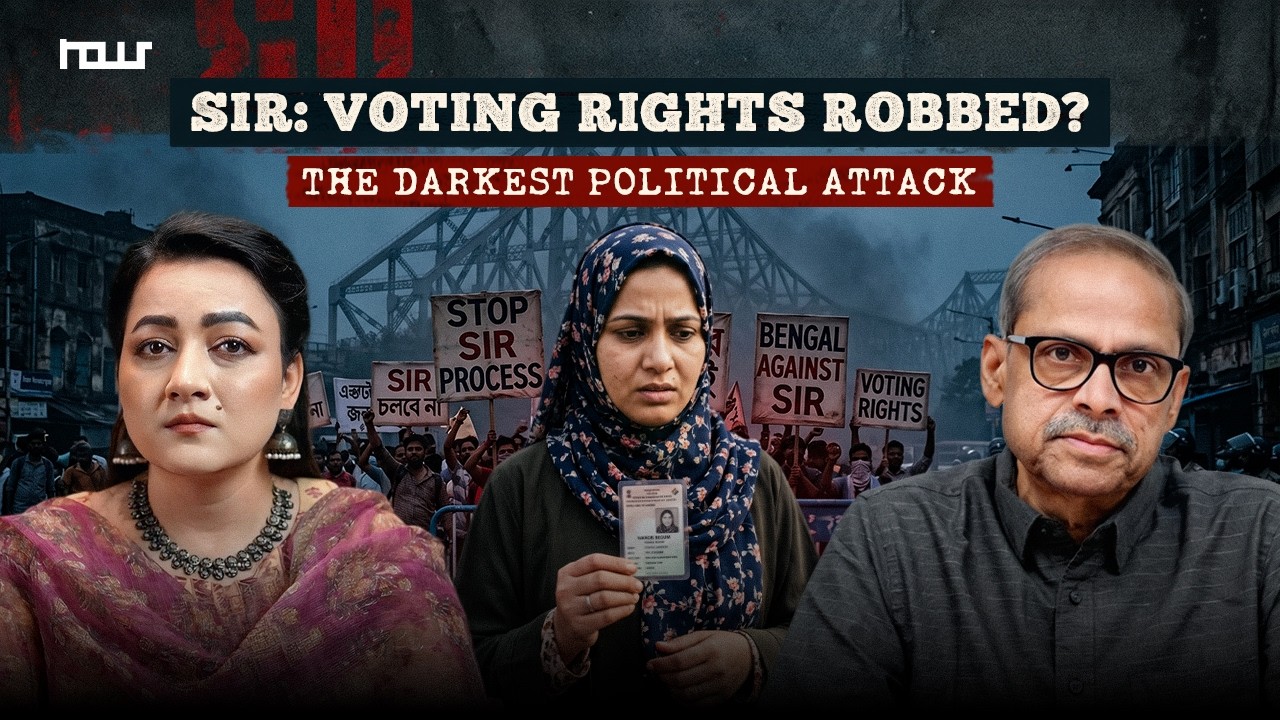
West Bengal is going to the polls this month on an electoral roll that has been quietly emptied of tens of lakhs of names. In conversation with Nous, the economist and long-time election-reform campaigner Parkala Prabhakar argued that the Special Intensive Revision, or SIR, carried out ahead of the vote is not the routine housekeeping the Election Commission of India describes, but what he called a "bloodless political genocide" — a phrase, he said, he does not use lightly.
What the SIR Actually Is, and Why No One Will Explain It
Every year, between October and February, the Election Commission conducts a Summary Revision of electoral rolls — adding new voters, removing the dead, correcting errors. What happened in Bihar earlier this year, and has now been repeated in West Bengal, was different: a Special Intensive Revision, justified in official notifications on the grounds that an unspecified internal study had found the ordinary revision process unsatisfactory, riddled with dead voters, duplicates and people who had shifted address. Prabhakar said he does not dispute that such errors exist. What troubles him is the opacity around the decision itself. Right to Information queries filed by activists, including the transparency campaigner Anjali Bhardwaj, sought the study that justified the SIR, the name of the authority that ordered it, and any file noting or concept paper behind it. The Election Commission's response, he said, was that no such record exists — no study has been made public, no single official is named as having taken the decision, and a separate RTI after the Bihar exercise established that no review of that rollout was ever conducted before the same process was extended to Bengal and other states.
Ninety Lakh Names, Twenty-Seven Lakh Left in Limbo
In West Bengal, Prabhakar said, close to ninety to ninety-four lakh voters have either been deleted from the rolls outright or referred to a slower process called adjudication, where a tribunal decides case by case whether a flagged name is genuine. He was careful to say that not every deletion is illegitimate — pointing to cases from Bihar where a Brazilian actress's photograph was used to register duplicate voters at fifteen to twenty different locations, and where investigators found a single address registered to eighty-nine people of different castes, regions and religions, at a location that on inspection turned out to have no house at all. But he argued the same clean-up exercise has doubled as cover for what he called targeted deletions, noting that those referred to adjudication in Bengal are overwhelmingly — by his account, ninety to ninety-five percent — Muslim. Of the roughly ninety lakh names in question, around twenty-seven lakh remained undecided at the time of the interview: neither confirmed as eligible nor formally struck off, even as the state's old electoral roll, which he stressed has not been legally extinguished, continues to exist in parallel. His argument is procedural as much as political: a voter who has not been ruled ineligible cannot lawfully be denied a ballot, yet the adjudication tribunals are moving so slowly — by his estimate, clearing only a handful of names a week — that most of the twenty-seven lakh will remain unresolved by the time both phases of voting are over.
A Reversed Burden of Proof
A recurring theme in Prabhakar's argument is that the documentary burden now placed on ordinary voters has no precedent. When the Election Commission points to a similar special revision conducted in 2002-03 to argue that nothing unusual is underway, he counters that no Indian voter in that exercise was asked to produce a paper trail proving their parents' citizenship or their own eligibility document by document, in the way SIR now demands. That burden, he said, falls hardest on people who can least carry it — daily-wage labourers, the illiterate, residents of flood-prone villages without stable paperwork — and disproportionately on Muslims, Dalits and Adivasis, the groups he says are being made to prove, again and again, that they belong.
Two Indias: From No Vote to No Aadhaar, No Ration, No Land
Prabhakar's central warning is that SIR does not simply subtract names from a list; it splits citizens into two tiers. One tier retains full rights and recognition. The other loses the vote first, and with it the political attention of every party, since, as he put it, parties will only campaign for and act on behalf of "those people who have votes." He sketched what he sees as the logical next steps once someone is off the voter rolls: if a person is not a voter, why should they need an Aadhaar card; if they have no Aadhaar, why should they receive a ration card; if they have no ration card, what basis do they have to hold farmland at all. He was careful to frame this as a foreseeable trajectory rather than a settled fact, but insisted the sequence is not far-fetched once disenfranchisement is normalised. In his account, the relationship between voters and the state has been inverted: previously, voters decided who would hold power; after SIR, those already in power are deciding who gets to be a voter.
Why He Calls It "Bloodless Political Genocide"
Asked to explain the phrase, Prabhakar said genocide historically meant expelling or killing populations distinguished by religion, caste, region, language or civilisation. A modern Indian state, he argued, can no longer expel or physically eliminate its own citizens — but it can extinguish their citizenship instead, achieving a comparable erasure by bureaucratic rather than violent means. He invoked a remark by Assam's chief minister about the state's "Miya" Muslim population, that the state need not physically expel them because conditions could be engineered to make them leave on their own, as an illustration of the same underlying logic. He was emphatic that his objection is not about which party wins or loses a given election — he said explicitly that a Trinamool Congress victory would not, by his standard, make the process legitimate either — but about whether the process itself preserves what he called the basic democratic principle of "one person, one vote, one value."
A Reluctant Umpire and an Indecisive Court
Prabhakar was equally critical of the institutions meant to check this process. He said the Election Commission's credibility has fallen so low that it is popularly seen as functioning like another wing of the ruling party — comparable, he said sardonically, to the BJP's youth, women's, farmers' and minority wings, except this one organises elections. On the judiciary, he described a pattern of adjournment after adjournment on the constitutional validity of SIR — "tareekh pe tareekh," in his words — even as elections proceed on the results of the very process whose legality remains undecided. The Supreme Court did invoke Article 142 to grant some relief on the adjudication timeline, which he welcomed, but he argued that courts should not be taking their time on a process that is actively running its course; a decision deferred, he said, is functionally a decision to let the process complete unchallenged. He added, pointedly, that he is uneasy about how much the country has come to depend on the judiciary to resolve what is fundamentally a political and administrative failure.
The Opposition's Contradiction
Prabhakar reserved some of his sharpest criticism for opposition parties. He noted that parties which raised the slogan "vote chor, gaddi chor" — vote thief, throne thief — and held large rallies alleging stolen mandates have nonetheless continued to take their seats in the very assemblies and Parliament they say were elected on stolen votes. If a party genuinely believes an election's outcome rests on theft, he argued, boycotting the resulting house rather than legitimising it by sitting in it would be the consistent response. He also pointed to a pattern of short memory: a yatra against voter deletions in Bihar drew unexpectedly strong public support but was not sustained into a durable national movement, and crises in Manipur, Bihar and now Bengal are each set aside once the news cycle, and the election, moves on. He warned that if the BJP wins West Bengal on rolls reshaped by this SIR, it would hand the party a repeatable template — a "trump card" the party could deploy in state after state — and, in his words, would fulfil what may be the single most consequential ambition the Rashtriya Swayamsevak Sangh has pursued in a century.
Civil Society as the Last Resort
Asked what remains to be done, Prabhakar said he places little faith in either the courts or political parties to carry this fight to its conclusion, based on what he has observed so far. His prescription is sustained, peaceful satyagraha — organised civil society agitation with, in his phrase, "feet on the ground," rather than sporadic press conferences or one-off yatras. He argued that political parties tend to follow public mobilisation rather than lead it, and that only a broad, non-partisan citizens' movement, one that keeps attention on Bihar, Manipur, Bengal and Tamil Nadu alike rather than moving on after each election, can force the issue to remain a national priority. He closed by framing the stakes in terms of India's own self-image: a country that has long presented its elections as a model of free and fair democracy to the rest of the world, he said, cannot ignore what its own Election Commission is now seen to be doing at home.


Discussion
0Readers only · Comments are reviewed by the desk before they appear
The journalism is free for everyone — create a free account to join the discussion.