On November 9, 2019, India's Supreme Court delivered its verdict on a 1,500-square-yard plot in Ayodhya, ending a decades-long dispute with a 1,400-page ruling from a five-judge bench. A mosque, the Babri Masjid, had stood there for nearly five centuries before a mobilised crowd demolished it on December 6, 1992. The Court called that demolition "a serious violation of the rule of law" — and in the same judgment awarded the land to the Hindu parties. That contradiction, a legal wrong acknowledged and its consequence rewarded anyway, sits at the centre of a critical 107-page report examined on the Nous Podcast: "A Critical Analysis of the Babri Masjid Judgment and the Case of the Places of Worship Act, 1991," published in 2026 by JEM — Justice and Empowerment of Minorities, an initiative of Jamiat Ulama-e-Hind.
Discussed alongside legal commentator Nasir Aziz, the report's central claim is precise: the 2019 verdict was not an isolated ruling but the culmination of a thirty-year process in which the Supreme Court gradually absorbed the logic of Hindu majoritarianism into its own constitutional reasoning, steadily weakening the secular protections built around Muslim places of worship.
The Law Built to Prevent Another Ayodhya
In 1991, amid the Ram Janmabhoomi agitation, Parliament passed the Places of Worship (Special Provisions) Act, freezing every place of worship's religious character as it stood on August 15, 1947 — no new claims, no reopening of history, on the theory that reviving medieval-era disputes could fracture society further. The Act carved out exactly one exception: the Babri Masjid–Ram Janmabhoomi dispute, to be resolved separately. Every other place of worship was meant to be protected by it. The 2019 verdict praised this law extensively, calling it a "non-derogable obligation" underwriting India's secularism — and then, through its one carved-out exception, gave the disputed land to the Hindu side anyway, leaving open exactly how similar historical claims might be framed and adjudicated in the future.
A Foundation Laid Twenty-Five Years Earlier
The report traces the verdict's roots to 1994's Dr. M. Ismail Faruqui v. Union of India, in which the Court upheld a law acquiring the disputed site but, in doing so, ruled that a mosque is not an essential part of Islamic practice, since prayer can be offered anywhere. This became the "mosque essentiality" doctrine — stripping mosques of special constitutional protection against acquisition, and transferring the authority to decide what is religiously essential from believers to judges, despite the mosque's deep historical role, from the Prophet Muhammad's earliest migration to Medina onward, as the social and administrative centre of Muslim community life, not merely a place of prayer.
A year later, in 1995, the Court ruled that Hindutva is not a religious appeal but can be understood as "a way of life" — which the report reads as a de facto clearance for Hindu nationalism in electoral politics. Justice A.M. Ahmadi, who dissented in Faruqui, reportedly refused to sign a draft implicitly justifying the 1992 demolition, saying, "I don't care about becoming Chief Justice. I won't do it." Twenty-five years later, the reasoning he refused to sign became the foundation of the 2019 verdict.
Four Flaws in the 2019 Verdict
The 2019 case was framed as a property dispute in which neither side could produce title documents — a fact the Court itself acknowledged — yet the land went to the Hindu parties on possessory title. The report identifies four flaws: an asymmetric evidentiary standard, with Muslim claims scrutinised rigorously and Hindu claims tested far less; idols placed unlawfully inside the mosque in 1949 later treated as grounds for a religious-presence claim; an ASI excavation report that never concluded a temple had been demolished to build the mosque, and which archaeologists Supriya Verma and Jaya Menon, observing on behalf of the Waqf Board, argued resembled confirmation of a predetermined conclusion rather than neutral inquiry; and a remedy — five acres of alternative land, rather than restoration — that the report calls "the formalisation of a faith accomplished."
Former Chief Justice D.Y. Chandrachud, who co-authored the verdict, told an interviewer in 2025 that the mosque's 1528 construction was "a fundamental act of desecration" — a claim the judgment he co-authored never actually made, since it explicitly found the ASI had not established that a temple was demolished. When the inconsistency was raised, Chandrachud said his remark had been taken out of context. The report calls this pattern the "Ayodhya logic": reasoning shaped less by evidence than by the weight of civilisational memory.
The Reanimation of Ayodhya
The report's more consequential claim concerns what it calls the "reanimation of Ayodhya" — the same template repeating across sites since 2019. In Sambhal, a court ordered a mosque survey within hours of the petition in November 2024; when the survey team returned, violence killed five people, all Muslim. In Haldwani, a February 2024 demolition order for a mosque and madrasa triggered protests that police firing put down, killing six. In Gyanvapi, a Varanasi court permitted Hindu prayers to resume in the mosque's long-sealed cellar in January 2024, and the Supreme Court declined to stay the order. In Rajasthan's Barmer district in June 2026, eviction notices dated June 11 were delivered only on June 17, giving residents a single day to respond, against roughly fifteen days the Supreme Court's own guidance treats as a minimum; days later, six mosques and madrasas in border villages were demolished under a "zero tolerance" security policy. Similar drives have hit Uttar Pradesh, Assam, Gujarat, Madhya Pradesh and Uttarakhand.
The most consequential case may be Dhar's Bhojshala–Kamal Maula Mosque dispute. On the same day the JEM report was released in May 2026, the Madhya Pradesh High Court ruled that the eleventh-century structure — a functioning mosque for centuries, run under a shared-use arrangement since 2003 — is in fact a Hindu temple, barring Muslim prayer there, and explicitly invoked the 2019 Ayodhya judgment's principles to reach that conclusion. Where Ayodhya at least ordered five acres of alternative land, the Dhar ruling says only that the state "may consider" providing land elsewhere.
The JEM report identifies five recurring patterns: framing title disputes as survey petitions to bypass the Places of Worship Act; demanding documents from one side while accepting faith-based claims from the other; flexible procedure for majority claims, strict procedure for minority ones; judicial passivity as conditions shift on the ground; and legal reasoning used to legitimise historical revisionism. What was presented in 2019 as a one-time exception now looks like a repeatable strategy — and with some Hindutva groups extending historical claims to as many as four hundred mosques, the question stops being about any single site.
That pressure has moved beyond individual courtrooms. In 2025, Parliament passed the Waqf (Amendment) Act, repealing the long-standing doctrine of "waqf by user," under which mosques, graveyards and madrasas were historically recognised even without formal documentation — critics say the change exposes thousands of properties to dispute. The Places of Worship Act itself now faces its own constitutional challenge before the Supreme Court, which has stayed fresh surveys in pending cases but not dismissed the challenge to the law.
What the Act Was Built to Prevent
The Babri Masjid no longer exists; the case is formally closed. But the 2019 judgment, in the report's account, established a method rather than a settlement — and a method travels. The Places of Worship Act drew a line at 1947 specifically so that historical grievance could not be weaponised against the present; the Court itself called that a non-derogable obligation in the very judgment that carved an exception to it. That single exception now functions as a citable precedent, invoked by name in the Dhar ruling barely eighteen months after this report's authors began their work. As one discussant puts it, courts are not final because they are infallible; they are treated as infallible because they are final. The hope the episode closes on is modest: that no future judgment repeats the injustice this one is argued to have done.


 56:39
56:39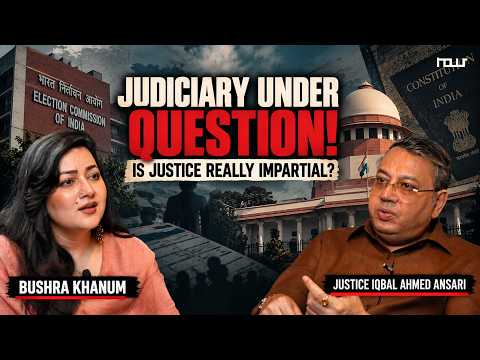

Discussion
0Readers only · Comments are reviewed by the desk before they appear
The journalism is free for everyone — create a free account to join the discussion.