

Do Muslims Really Avoid Education? What a Jamia Nagar Study Reveals
A 3,900-child study of one of Delhi's largest Muslim neighbourhoods finds enrollment near 94% — but shows that structural neglect, not culture, decides whether that ambition survives school.
Contents · 5 sections
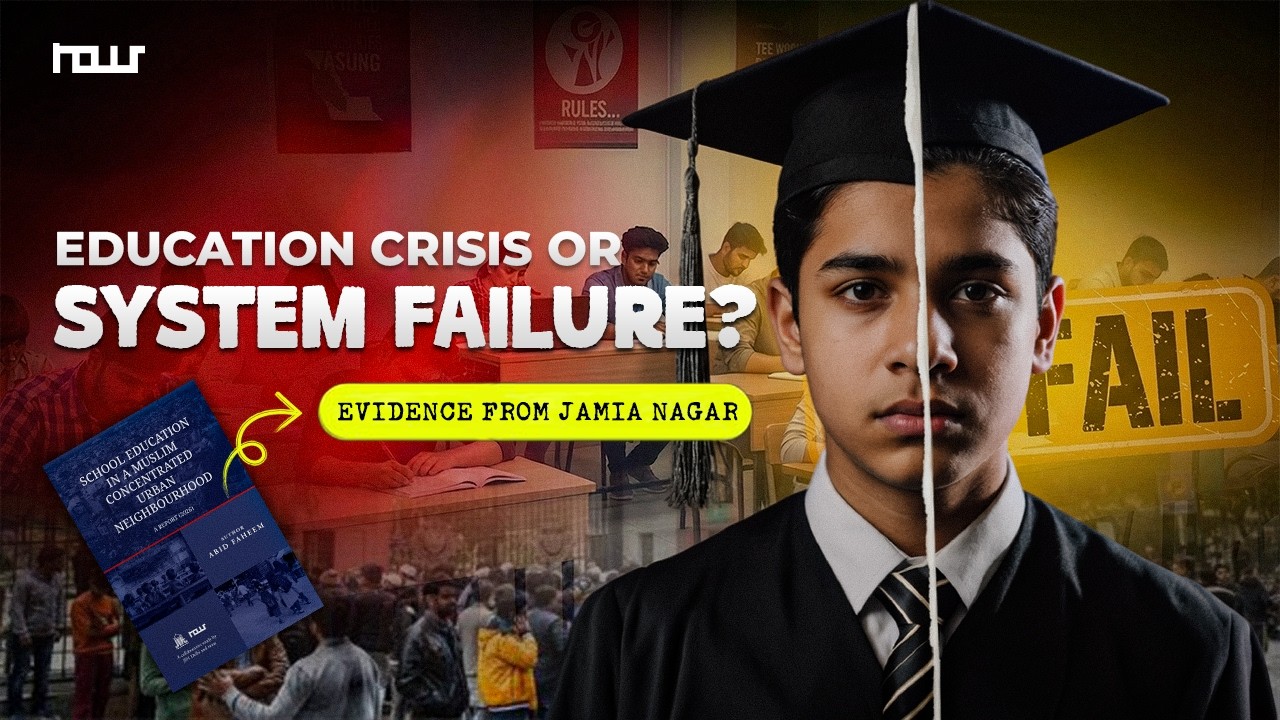
It is a common line, repeated often enough to sound like common sense: Muslims don't prioritize education, the assumption goes, or take schooling as seriously as other communities. A detailed household study of Jamia Nagar, in south-east Delhi, sets out to test that claim against actual data — and finds it does not hold up.
A study built to answer a real question
The research, School Education in a Muslim-Concentrated Urban Neighbourhood: A Case Study of Jamia Nagar, is a collaboration between Nous and the Delhi unit of Jamaat-e-Islami Hind. It surveyed 2,700 households across 12 localities and traced the schooling journeys of nearly 3,900 Muslim children aged 3 to 18 — not just whether they were enrolled, but the conditions of the households they came from, the schools actually available to them, and their foundational learning outcomes in language and maths. One of the study's organizers explained the motivation plainly: despite a concentration of influential Muslims and major institutions in the area, no shared, evidence-based picture existed to plan around. "We needed some basic information," he said, "on which we could build a long-term plan."
High aspiration, real constraints
Jamia Nagar's socioeconomic profile explains much of what the data goes on to show. Most households are nuclear; roughly half have migrant backgrounds, largely from Uttar Pradesh and Bihar. Many families fall into low or lower-middle income brackets, and a significant share lack basic amenities — a separate kitchen, digital access, or a space conducive to studying. About a quarter of parents never received formal schooling themselves, though the study found madrasa education makes up only a small share of that history; most parents who did study went through mainstream schools and colleges. The community, in other words, is not distant from education — it is managing education within limited resources.
On the surface, the numbers look strong: 94% of children in Jamia Nagar are enrolled in school, a clear sign that parents take education seriously. Roughly 3.7% of children have never been enrolled at all, and another 2.3% have dropped out — mostly at the secondary and senior secondary levels. Access to schooling, in other words, exists. Staying the course to the end is harder.
Wealth, caste and migration change the picture
When the study disaggregates by wealth, caste and migration status, the picture shifts. Dropout is not explained by a lack of interest — the leading causes are economic pressure, academic pressure, rising education costs and household responsibilities. Migrant families show a higher dropout risk despite comparably strong enrollment, pointing to economic stress and settlement instability rather than motivation as the driver.
A private-school system built on public absence
At the school level, Jamia Nagar is becoming steadily more dependent on private education: about 57% of children attend private schools against roughly 40% in government schools — a pattern the study attributes to a shortage of public options rather than preference. Densely populated areas like Shaheen Bagh have no government school at all, forcing families to absorb private fees, transport and coaching costs directly. The bottleneck sharpens at the secondary and senior secondary levels: primary schools are relatively available, but government options thin out as children get older, pushing families toward private schools, longer commutes and coaching to compensate — all adding to household expense.
The study's clearer contribution is showing that education pathways are not even within the same neighbourhood. Wealthier and general-category households get children into private schools, English-medium instruction and coaching; poorer and OBC families depend more heavily on under-resourced government schools. And despite high enrollment and real household investment, learning outcomes remain weak: ASER-style assessments found fewer than 4% of Class 3 children could read at grade level in Urdu, with sentence-level English reading almost nonexistent; by Class 8, many children still fall short of expected levels in language and maths. Schooling is happening. Learning is not reliably following it.
Coaching as a shadow curriculum
Government schools, the study notes, are burdened by procedural overload that leaves little room for anything beyond maintaining the school itself, while most private schools in the area operate well below any recognized quality standard. Despite that, over 97% of children said they want higher education — an aspiration that holds steady across gender, caste and income group, making clear the shortfall is not one of ambition but of the widening gap between that ambition and what the institutions around it can support.
That gap has a price tag. Private school costs rise sharply at the secondary level, and coaching — taken by most children, especially in private schools — has become less an enrichment than a necessity, filling in for material children aren't grasping from classroom instruction alone. For low-income households, that expense makes sustained schooling harder to afford, and it is precisely where dropout risk climbs. Jamia Nagar, the study concludes, is not an exception. It is a case study in what happens when high aspiration meets a weak system: poor public provisioning, rapid privatization, economic pressure and uneven learning quality combine to keep inequality intact, no matter how many children walk through a school door each morning.



Discussion
0Readers only · Comments are reviewed by the desk before they appear
The journalism is free for everyone — create a free account to join the discussion.