

Can Muslim Institutions Engineer Their Own Progress? A Bureaucrat's Blueprint for Self-Reliance
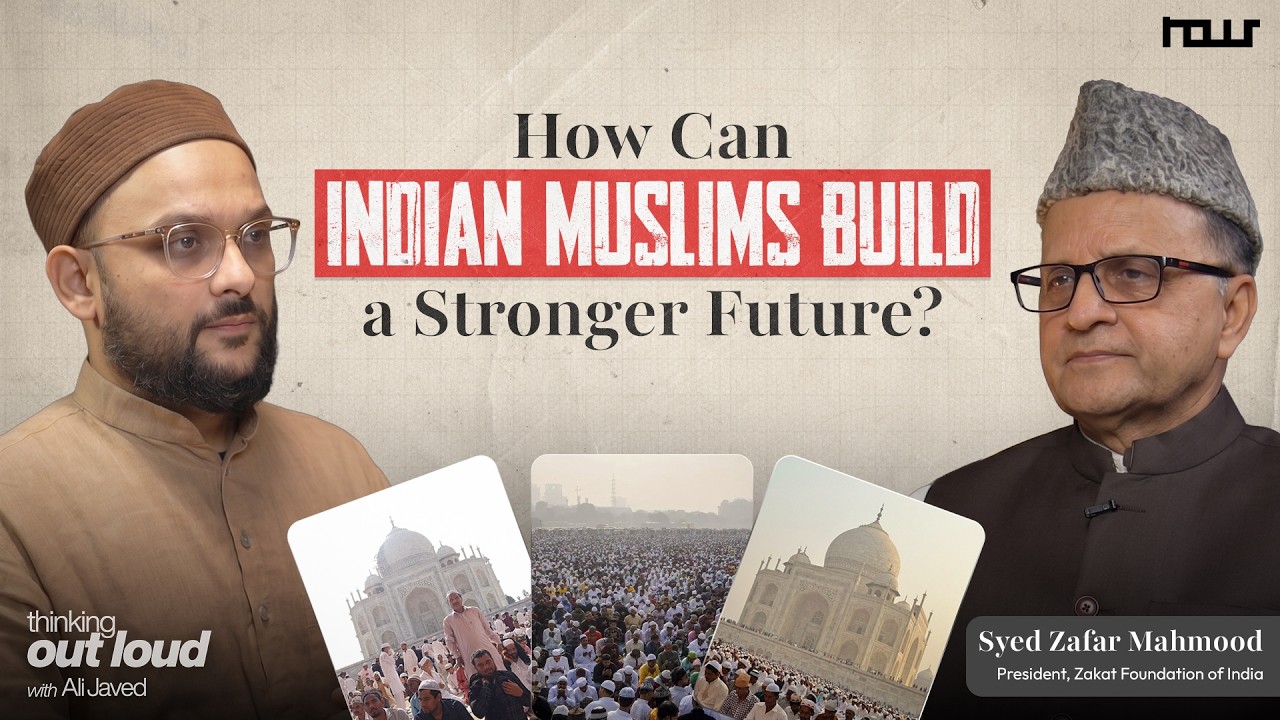
Dr Syed Zafar Mahmood, a retired IAS officer who overhauled Hajj logistics and Waqf administration from inside government before founding the Zakat Foundation of India, argues that Indian Muslims already hold the institutions, data and resources to lift themselves, if only they organised them.
Contents · 9 sections
- A household built for public life
- Learning institution-building from inside government
- The committee that almost left out Waqf
- Forty-five days in Boston, fighting a bad bill
- The Zakat Foundation and a theology of circulation
- Redrawing the map, constituency by constituency
- An alchemist's roadmap
- Faith in common: interfaith work and inherited obligation
- A letter to the next generation
A household built for public life
Syed Zafar Mahmood's account of his own life begins not with the civil service but with a household in Bahraich, in eastern Uttar Pradesh, where his father, a successful lawyer and president of the local bar association, ran what amounted to a private curriculum alongside his legal practice. Separate tutors were kept for English, Hindi, Urdu, science and mathematics, and Mahmood recalls his father reading the newspaper aloud every morning, stopping to explain difficult words with a dictionary, and continuing the discussion over breakfast, lunch and dinner. Five newspapers arrived at the house daily, in English and Urdu, alongside Jamaat-e-Islami's weekly Radiance and a lesser-known journal edited by Maulana Abdul Majid Daryabadi.
His father also quietly ran a personal charity, keeping accounts only between himself and God, and built a guest house attached to the family home specifically to host visiting scholars and community leaders passing through Bahraich. Mahmood's mother died when he was three; his father died when Mahmood was twenty-five, five days after completing Hajj in 1975, having lain down after the dawn prayer and not woken again. Before leaving for Hajj, his father had recited a line of Ghalib asking who would take responsibility for the family's affairs in his absence; Mahmood, then a student, answered that he would.
Mahmood studied physics with honours at Aligarh Muslim University before switching to political science for his master's degree in preparation for the civil services, later completing a PhD in public administration. He joined the Indian Administrative Service in the 1977 batch and was unexpectedly placed first on the seniority list for promotion, ahead of twenty-six officers senior to him, a result he attributes to what a review of ten reporting and reviewing officers over five years had rated as outstanding performance.
Learning institution-building from inside government
Mahmood's account of his career functions as a case study in what a single official can do inside existing structures. Posted to Jeddah as First Secretary at the Indian consulate in 1988, with responsibility for Hajj affairs, he found a system in which pilgrims travelling by the government-run Hajj ship were compelled to stay twenty extra days in Saudi Arabia after the pilgrimage, ostensibly for the benefit of poorer pilgrims but in practice benefiting Bombay-based agents who used the ship's hold for their own cargo. Mahmood's team discontinued the ship service entirely, added new air pick-up points, and negotiated a pre-arranged accommodation scheme with the Saudi Hajj ministry that guaranteed every pilgrim a minimum air-conditioned space with an attached bathroom.
He also built a centralised payment mechanism through the Indian consulate so that pilgrims no longer needed to carry individual bank drafts, which were frequently lost in transit and could strand an entire flight at the airport for hours while payments were reconciled. As director of the embassy's schools, he established five new Indian schools in Saudi cities and expanded the Jeddah school, built in 1964 for 1,600 students but serving 5,000 by the time he arrived, into what later became a 10,000-student campus.
In 1999, as Additional Commissioner in Delhi, Mahmood was given charge of the combined Wakf Board covering Punjab, Haryana, Himachal Pradesh and Chandigarh, overseeing roughly 33,000 properties, more than half of them tied up in litigation with around 300 lawyers engaged on the board's behalf. He introduced systematic digitisation of property records, began regular financial audits where none had previously existed, and raised the fixed salaries of imams, arguing that an underpaid imam could not be expected to lead a community. That salary order was later cited in the Supreme Court and recommended for implementation nationwide. Mahmood also spent a decade helping rebuild the India Islamic Cultural Centre in Delhi, started by a retired government scientist who had personally solicited donations outside the Parliament Street mosque, turning what was then a stalled, near-derelict structure with about forty lakh rupees in the bank into a completed three-storey building.
The committee that almost left out Waqf
The Prime Minister's High Level Committee on the Social, Economic and Educational Status of the Muslim Community of India, popularly known as the Sachar Committee after its chairman, Justice Rajinder Sachar, was constituted in 2005 after the ruling coalition, led by Manmohan Singh, concluded that its unexpected 2004 election victory owed a debt to Muslim voters that had not been matched by any systematic assessment of the community's condition. Mahmood recalls being consulted informally while posted as Commissioner in Agra, though he says no single, organised push for the committee existed beforehand; it emerged from an accumulation of individual concerns rather than a coordinated demand.
As Zakat Foundation's founder, Mahmood contributed research to the committee and says the original mandate given to it contained no reference to Waqf property at all. He drafted a note arguing that Waqf, India's collective Muslim endowment holdings, deserved its own chapter, and passed it to Syed Hamid, the committee's most senior member, who endorsed it before Justice Sachar signed off. Mahmood credits this addition directly to his own intervention rather than to any pre-existing plan, describing the committee's working style as consensual, with little internal disagreement among members including the economists Abusaleh Shariff and Rakesh Basant of IIM Ahmedabad.
Forty-five days in Boston, fighting a bad bill
The Sachar Committee's findings and a subsequent Joint Parliamentary Committee, chaired by K. Rahman Khan, both recommended specific reforms to Waqf law. When a Waqf Amendment Bill was introduced in 2010, Mahmood says it ignored both sets of recommendations and had effectively been left to lower-level officials rather than shaped by political deliberation. The bill nonetheless passed the Lok Sabha.
Mahmood happened to be visiting his children in Boston when it passed. Over the following forty-five days, spending eight to ten hours a day away from what was meant to be a family holiday, he built a colour-coded chart-booklet comparing the bill clause by clause against the Sachar Committee, the JPC and the Committee of Secretaries' recommendations. On returning to India he printed and released it at a press conference, turning it into what he describes as a national issue, then lobbied JPC members directly. Parliament ultimately returned the bill to the ministry for reconsideration despite its Lok Sabha passage. Mahmood's chart-booklet work fed into the eventual Waqf Act of 2013, which he calls, without qualification, the best Waqf law in the world at the time.
The Zakat Foundation and a theology of circulation
Mahmood founded the Zakat Foundation of India in 1997 after a Delhi resident named Asrar Ahmed, who became the foundation's first vice-president, approached him seeking help with an official matter. The foundation's motto, taken from the Quran, is that God helps those who help themselves. Mahmood frames zakat, the annual 2.5 percent levy on savings, as only a small fraction of a much larger Quranic mandate: that wealth should keep circulating through society the way blood circulates through a body, rather than pooling in a few hands. He cites Surah Baqarah, verse 219, distinguishing between adl, or justice, which zakat's 2.5 percent minimum satisfies, and ihsan, or compassion, which covers everything beyond it and which he argues most Muslims neglect.
To make that surplus concrete, the foundation has proposed a framework it calls TRAIL 33, an acronym for Time, Resources, Assets, Income and Love, arguing that a Muslim should direct roughly a third of each toward people outside their immediate household rather than only their nuclear family. Mahmood extends this logic to the idea of the extended family, roughly 80 to 85 people connected to any married adult by blood or marriage, as the basic unit of Islamic social obligation rather than the nuclear family alone, with an expectation that better-off members lift up poorer relatives.
The foundation has also proposed a Hajj Fund of India, built on the observation that pilgrims often save money toward Hajj for five to eight years before travelling, leaving tens of billions of rupees sitting idle at any given time. Under the proposal, savers would deposit funds with the foundation in exchange for a guarantee of repayment when they actually travel, with the pooled money used in the interim for small, interest-free loans, similar to schemes that finance auto-rickshaw drivers who do not own their vehicles. Mahmood points to existing microfinance efforts run by community groups, which he says post repayment rates above 90 percent, as evidence the model can work at scale.
Redrawing the map, constituency by constituency
One of the Sachar Committee's core findings was that Muslim under-representation in legislatures stems less from active political exclusion than from what it called faulty delimitation, the periodic redrawing of constituency and ward boundaries mandated by the Constitution every ten years after each census. In response, the Zakat Foundation set up a Delimitation Cell roughly twelve to thirteen years ago, compiling constituency-level demographic data across the country, which Mahmood says has produced ground-level results with a 70 to 100 percent success rate.
In one instance, the Election Commission issued a notification proposing to reserve a Saharanpur constituency for Scheduled Castes despite the area having a lower Scheduled Caste population share than neighbouring constituencies that were not being reserved. The foundation filed a formal objection with supporting data; a full Election Commission bench travelled to Saharanpur for a public hearing and ultimately withdrew the notification in favour of an alternative the foundation had proposed. In Greater Bombay, the foundation identified specific violations of Maharashtra's own delimitation rules across the city's thirty municipal wards, filed a detailed notice with the state election commission a year before elections were due, and won a full redrawing of all thirty wards. Mahmood says the number of Muslim candidates elected rose by roughly a third in the election that followed.
An alchemist's roadmap
Mahmood describes a broader roadmap, published on the Zakat Foundation's website, built around a term borrowed from the poet Muhammad Iqbal: kimiyagar, or alchemist, someone who turns copper into gold. He proposes that community members organise into two kinds of local groups, KGP for political work and KGA for administrative work, each drawing up annual and five-year plans. KGP groups would study the demographic profile of their own constituency; Mahmood notes there are eleven Lok Sabha seats in India where the Muslim population share runs between 51 and 68 percent, yet a Muslim candidate frequently still fails to win them for want of coordinated voter organisation, rather than for want of numbers.
The foundation's Sir Syed Coaching and Guidance Centre for Competitive Examinations, meanwhile, takes its name deliberately from two historical episodes rather than from Sir Syed Ahmad Khan's founding of Aligarh's college. In 1883, Sir Syed established the Mohammedan Civil Service Fund Association, which collected annual dues from 500 members to send fifteen young men to England each year to sit the Indian Civil Service examination. Separately, an 1887 district gazetteer from Maharashtra records that a man named Syed Ahmad arrived months before a large recruitment drive in a district where Muslims made up only 10 percent of the population, and that Muslims won more than half the announced vacancies. Mahmood's coaching centre does not run its own classes; it identifies talented candidates nationally and pays for coaching at established professional institutes.
The roadmap also pushes beyond civil services and higher education toward roles Mahmood argues the community overlooks: stenographer and personal assistant positions in government offices, which he notes routinely go unfilled for want of applicants despite requiring only a twelfth-standard education and short-hand training; skill development and retraining, including exposure to artificial intelligence tools; and religious seminaries. On madrasas, Mahmood is emphatic that their existence has sustained the practice of the faith in India, but he argues madrasa students should also register with the National Institute of Open Schooling to earn recognised tenth and twelfth-standard certificates, which several universities already accept through bridge courses for further admission.
Faith in common: interfaith work and inherited obligation
In 2005, Mahmood helped establish the Interfaith Coalition for Peace, which he says maintains representation from Hindu, Muslim, Sikh and Christian communities across roughly two dozen states. Its work focuses on what he calls practical common ground rather than doctrinal comparison: pairing discussions of fasting across religious traditions, or of prayer and yoga, with joint events such as an interfaith iftar held at Delhi's Jama Masjid. He separately runs Iqbal Academy India, which publishes Iqbal's poetry, framed as an ethical code rather than literature, through a quarterly magazine and a coffee-table book, Jahan-e-Mukafat, alongside a second coffee-table volume, Taj Mahal: Spiritual Mystery, the product of a decade Mahmood spent studying the Quranic inscriptions on the monument, which he describes as a vehicle for conveying a religious message to visitors regardless of their faith.
A letter to the next generation
Asked what has changed for younger Muslims, Mahmood, born in the early 1950s, contrasts his own experience of confident, close relationships with Hindu and Sikh friends in Saharanpur with what he sees as a thinner, more anxious sense of belonging among today's college-age generation. His advice to them begins with self-knowledge: understanding why one has been placed in the world, identifying one's own capacities, and asking how those capacities can serve both oneself and society, a formulation he draws from Iqbal's poetry.
He closes with a wider frame borrowed from his own writing: of seven rough levels of human organisation, from village to continent, six broadly fulfil their purpose of making life liveable, while the nation-state, in his view, has strayed furthest from that mandate everywhere in the world, not only in India. He mentions having written to Joe Biden on his becoming the oldest person to assume the American presidency, urging him to weigh individual human dignity against narrower national interest, a tension Mahmood says he also poses to candidates in civil service mock interviews without offering his own answer. It is a question, he suggests, worth leaving open for a younger generation to sit with, rather than resolving for them.



Discussion
0Readers only · Comments are reviewed by the desk before they appear
The journalism is free for everyone — create a free account to join the discussion.