

Can Existing Muslim Institutions Become Engines of Progress? Dr. Syed Zafar Mahmood's Case for Self-Reliance
A retired civil servant who helped shape the Sachar Committee report argues that India's Muslims already have the resources they need, and that the real work now is building institutions patient enough to use them.
Contents · 10 sections
- A Bureaucrat Who Turned Diagnosis Into Institutions
- A Household Built on Text and Discipline
- Learning the State's Machinery from Inside Haj and Waqf
- Zakat as Instrument, Not the Whole Mandate
- How the Sachar Committee Came Together
- The Real Bottleneck: Faulty Delimitation
- The Kimiya Ghar Roadmap
- Untapped Money and Underused Schemes
- Interfaith Practice and the Extended Family
- A Message to the Next Generation
A Bureaucrat Who Turned Diagnosis Into Institutions
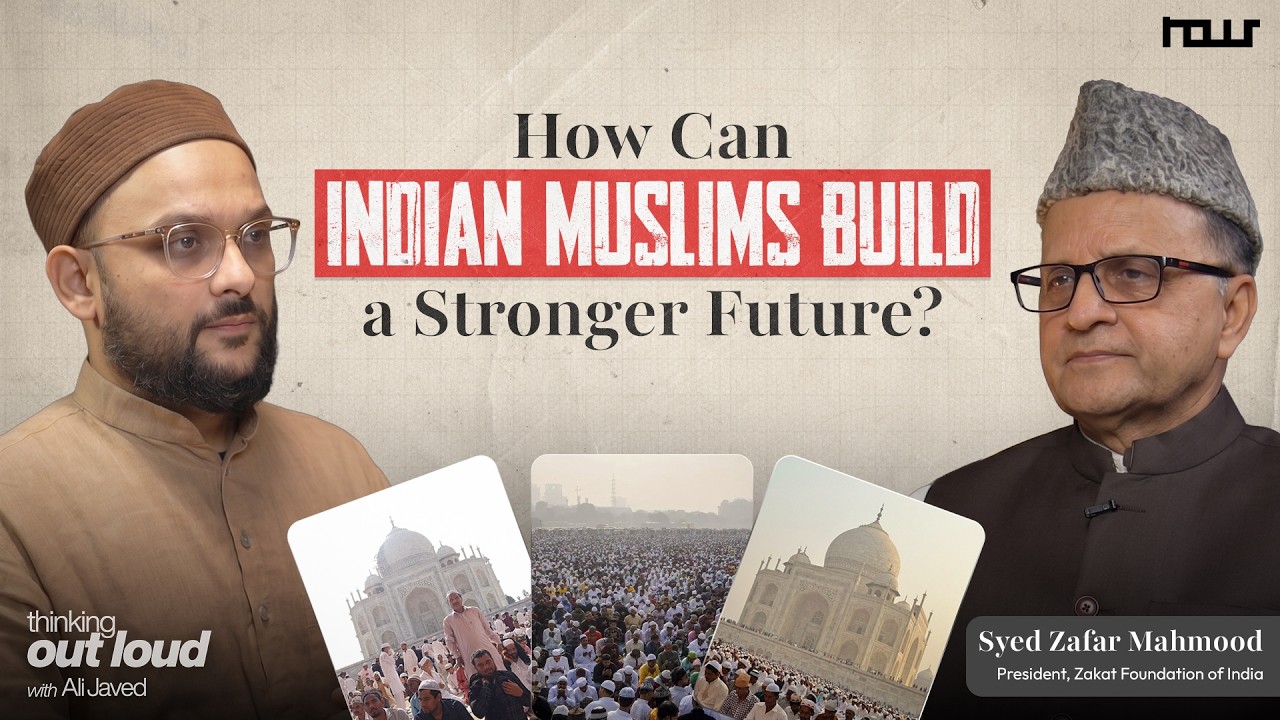
Dr. Syed Zafar Mahmood spent thirty years inside the Indian government before spending the next quarter-century building organisations meant to work around it. A 1977-batch Indian Administrative Service officer, he ran Haj operations for the Government of India in Saudi Arabia in the late 1980s, later administered the combined Wakf Board of Punjab, Haryana, Himachal Pradesh and Chandigarh, and served as an Officer on Special Duty during the drafting of the Prime Minister's High Level Committee report on the status of Indian Muslims, popularly known as the Sachar Committee report. Since 1997 he has run the Zakat Foundation of India, and since 2005 the Interfaith Coalition for Peace, alongside a coaching centre for competitive exams, an Iqbal studies academy, and a delimitation-monitoring cell that has quietly reshaped municipal wards in Mumbai.
In a follow-up conversation with Nous, after an earlier data-heavy episode on the Waqf Amendment Bill, Mahmood was asked a more personal question: what does his own career, inside and outside the state, reveal about where the real gaps lie for India's Muslims, and what can be done about them that does not depend on any government's goodwill. His answer combined a bureaucrat's granular knowledge of how delimitation, waqf administration and civil service recruitment actually function with a theologian's insistence that the community's deepest problem is internal — a failure, in his words, to be "good Muslims" in the fullest sense of living out the faith's economic and social mandate.
A Household Built on Text and Discipline
Mahmood's grounding in this worldview began at home in Bahraich, where his father, a lawyer trained at Aligarh Muslim University in the 1920s, built what amounted to a private curriculum around his children. Alongside formal schooling, the household ran daily sessions of eight to ten hours covering Arabic and Urdu texts, English and Hindi newspapers, Iqbal's poetry recited in chorus and explained line by line, and handwriting drills. English-language papers, Urdu papers, and the Jamaat-e-Islami's Radiance Views Weekly all arrived at the house; his father also ran a private charity and a school, and kept a guest house specifically to host visiting Islamic scholars and community leaders. Mahmood's mother died when he was three; his father died when he was twenty-five, by which point, he says, the habits of daily reading and communal responsibility had already been set.
He read Physics Honours at Aligarh Muslim University, topped his class, and then switched to a Master's in Political Science to prepare for the civil services — a decision his physics professor, on hearing it, greeted with amused resignation. He also completed a PhD in Public Administration. When the 1977 results came out, Mahmood had ranked 27th on the all-India list; four years later, at his first promotion review, he found his name placed first, ahead of the twenty-six officers who had outranked him at entry. He attributes it to what superiors told him was near-unanimous praise across ten reporting officers over five years — evidence, he suggests, that competence and interpersonal trust travel further in the bureaucracy than seniority alone.
Learning the State's Machinery from Inside Haj and Waqf
Two postings shaped Mahmood's sense of what organised, patient administration could achieve. Posted to the Indian Embassy in Jeddah in 1988 as First Secretary in charge of Haj affairs, he found a system riddled with quiet inefficiencies that had gone unquestioned for decades. Pilgrims travelling by the Haj ship — long justified as a service to the poor — were shown, once he examined the numbers, to be spending more than air travellers once mandatory extra stays in the Kingdom were counted; local moallim agents were extracting full payment from pilgrims while sometimes turning them out of promised lodgings mid-stay. Working with his superior, the diplomat Talmiz Ahmad, Mahmood's team discontinued the Haj ship, negotiated a pre-arranged accommodation scheme directly with Saudi Arabia's Haj Ministry, and centralised pilgrim payments through the Haj Committee of India and the embassy — cutting the hours pilgrims spent stranded at the airport and removing an entire layer of exploitation. His office also built five new Indian embassy schools in Saudi cities, expanding capacity for a student population that had outgrown its buildings several times over.
A decade later, an additional charge as administrator of the combined Wakf Board for Punjab, Haryana, Himachal Pradesh and Chandigarh gave him a close look at how badly a core Islamic institution was being run. Of roughly 33,000 waqf properties under the board, more than half were tied up in litigation, with some 300 lawyers permanently retained to fight cases — many of them disputes within the community itself rather than with outsiders. Documentation existed but had never been digitised; there was no systematic audit of income and expenditure. Mahmood introduced digitisation, instituted regular audits, and fixed and raised imams' salaries, reasoning that an underpaid, dissatisfied imam cannot be expected to lead a community. That salary order was later cited in a Supreme Court case and, he says, ordered implemented nationally — a rare instance of a state-level administrative fix becoming country-wide policy.
Zakat as Instrument, Not the Whole Mandate
Mahmood's signature institution, the Zakat Foundation of India, grew directly out of a theological observation he had been sitting with since his time overseeing Haj and mosque administration: of Islam's five pillars, zakat is the only one with an institutionalised third-party beneficiary built into its very origin. He traces this to the account of three companions of the Prophet who, having stayed back from an expedition, bound themselves to a pillar in penance; when Quranic revelation followed to address what should be done with the charity they then offered, it commanded the Prophet to "take from them" — establishing, in Mahmood's reading, that organisation and collection of zakat was mandated from the outset, not left to individual discretion. Founded in 1997 with the backing of Asrar Ahmed Khan as its first vice-president, the Foundation's motto is drawn from the Quran: "God helps those who help others."
But Mahmood is emphatic that zakat, at 2.5 percent of surplus wealth annually, is "a very small segment" of what he calls Islam's larger economic mandate: that wealth should circulate through society the way blood circulates through a body, rather than pooling in a few hands, per Surah al-Baqarah 2:219. He illustrates the point with arithmetic — a person with one lakh rupees who pays 2.5 percent zakat keeps 97 percent for themselves; a person with ten crores or a thousand crores who pays the same percentage keeps a vastly larger absolute sum, meaning the obligation to also observe ihsan, or voluntary compassion beyond the legal minimum, scales with wealth in a way zakat alone does not capture. Zakat, in his framework, satisfies the baseline of adl (justice); ihsan, the higher and effort-demanding orbit, is what philanthropic traditions elsewhere — he points to Christian charitable giving reaching well beyond 50 percent of income in some cases — have arguably practised more consistently than modern Muslim communities have.
How the Sachar Committee Came Together
The panel that produced what the press named the Sachar Committee report carried the formal title of the Prime Minister's High Level Committee to write a report on the social, economic and educational status of the Muslim community of India. Mahmood locates its origin in the shock of the 2004 general election: the Congress-led coalition, which had been widely expected to lose, won partly on the strength of Muslim votes, and Prime Minister Manmohan Singh's government concluded it owed the community a genuine accounting of its condition before designing any response. Before the committee's report, Mahmood argues, there had been no systematic, government-backed study of Muslim conditions in India since independence — only scattered individual and organisational efforts, including his own coaching centre and a study circle that had begun at Hamdard in 1991.
Mahmood describes a functioning, low-friction drafting process rather than a fractious one: he prepared notes that were reviewed first by the committee's senior-most member, Syed Hamid, and then placed before Justice Rajinder Sachar, both of whom he says were consistently persuaded. It was through this process that waqf entered the report at all — the original mandate given to the committee did not mention waqf, Mahmood says, and it was his note, endorsed first by Hamid and then approved by Sachar, that resulted in waqf receiving its own chapter. He also recalls being consulted informally before the committee was even constituted, while posted as Commissioner in Agra, though he says he was not told at the time what shape the effort would eventually take.
The Real Bottleneck: Faulty Delimitation
Asked to locate the single most consequential finding in the Sachar report, Mahmood points not to education or employment statistics but to political representation, and specifically to what the report called "faulty delimitation." India's Constitution requires a census every ten years and mandates that constituency and ward boundaries be redrawn periodically in light of new population data, a process intended to preserve what Mahmood calls "representational justice." The laws and rules governing this, he says, are sound; what fails is implementation. Since the first Lok Sabha in 1952, Muslim representation has averaged around 25 seats out of 543 — against a proportional expectation of roughly 77 — and Mahmood attributes the shortfall less to any single party's politics than to a bureaucratic machinery that redraws boundaries without adequate regard for demographic accuracy, producing outcomes he likens to gerrymandering.
The Zakat Foundation's Delimitation Cell, running for twelve to thirteen years, claims a 70 to 100 percent success rate on the ground-level interventions it has pursued, using Right to Information requests and legal objections rather than public campaigns. In Saharanpur, when the Election Commission proposed reserving a constituency for Scheduled Castes despite a neighbouring constituency having a higher SC population share — a violation of the law's own stated criterion — the Foundation filed objections backed by its own demographic data; a three-member bench travelled to hold a public hearing and reversed the notification. In Greater Mumbai, after the Foundation documented specific violations of Maharashtra's own ward-delimitation rules across all 30 wards under scrutiny and petitioned the state election commission a year ahead of elections, every one of the 30 wards was redrawn according to its submissions. In the election that followed, the number of Muslim corporators elected rose from 23 to over 30 — an increase Mahmood attributes entirely to that single administrative intervention.
The Kimiya Ghar Roadmap
Mahmood's prescription for the community draws its name and logic from Muhammad Iqbal's image of the kimiyagar, or alchemist — someone who transforms a heart of copper into one of gold through service to others. He has built this into a two-track organisational model published on the Zakat Foundation's website: Kimiya Ghar Political (KGP) groups and Kimiya Ghar Administrative (KGA) groups, meant to form in every locality. KGP groups are asked to study their own constituency's demography and electoral map — a step he says most communities skip entirely, mourning election results after the fact rather than organising to prevent vote-splitting beforehand — while KGA groups are asked to identify young people for careers beyond the Indian Administrative Service alone: the 29 state public service commissions, 25 High Courts and their subordinate courts, and the thousands of stenographer and personal-assistant posts that state and central governments advertise annually and frequently fail to fill for lack of applicants.
The infrastructure this requires, in Mahmood's telling, need not be elaborate: a spare room in a home, or the smallest room in a mosque, turned into a reading room and orientation centre, staffed initially by whoever in the neighbourhood already has the qualifications. He describes one student from a village near Bahraich, one of India's most backward districts, who reached Zakat Foundation's hostel and coaching facility after being unable to complete schooling locally, and became a jail warden in Kanpur within six months of intensive preparation — evidence, in Mahmood's account, that opportunity rather than aptitude is usually the scarce resource. He also urges attention to skill development and artificial intelligence literacy, arguing the community has been slow to adopt new technical tools even as they become more accessible, and suggests imams could deliver more effective sermons using screens and multimedia, citing a Friday sermon he once watched projected in a church in the United States as a model worth adapting.
Untapped Money and Underused Schemes
One of Mahmood's more striking proposals concerns the billions of rupees that sit dormant in Haj savings accounts. Because Saudi Arabia caps annual pilgrim numbers by country, many applicants to India's Haj Committee wait five to eight years for their turn, setting aside savings for a pilgrimage that will not happen for years. Mahmood's proposed Haj Fund of India would let savers deposit these idle sums with the Zakat Foundation, which would deploy the money productively — his example is financing rickshaws for drivers currently renting them from owners — and return the principal when a depositor's turn for Haj arrives. He points to microfinance programmes elsewhere in India recording repayment rates above 90 to 95 percent as evidence the model is viable, arguing that letting large sums of money sit static rather than circulating violates the same Quranic principle about wealth that underlies zakat itself.
He is similarly insistent that existing government provisions are underused rather than absent. A central government scheme to fund quality education components within madrasas has run continuously since 1996 across multiple changes of ruling party, he notes, yet remains little known and little claimed. He points madrasa students and their families toward the National Institute of Open Schooling as a route to formal class 10 and 12 certification alongside religious education, which several universities' bridge courses can then convert into undergraduate admission — a pathway, he argues, that requires no new government commitment, only better information reaching families who do not know it exists.
Interfaith Practice and the Extended Family
Since 2005, Mahmood has also run the Interfaith Coalition for Peace, active across some 24 states with representation from Hindu, Muslim, Sikh and Christian communities at multiple levels. Its guiding idea, borrowed explicitly from the Christian concept of "praxis," is that shared ethical ground between faiths is only meaningful once translated into joint action rather than left as a talking point — comparative study of practices such as fasting across religions, or events like a multi-faith Iftar gathering the coalition organised at Delhi's Jama Masjid, are offered as examples of theory "coming down to the ground."
Mahmood also argues that Islamic social ethics locate the basic unit of society not in the nuclear family, as is commonly assumed across faith traditions, but in the extended family — the roughly 80 to 85 people connected to any married adult by blood or marriage — with an obligation to lift up its less fortunate members, followed by an equivalent obligation toward neighbours. He has published extensively on both themes, in 111 languages, through the Zakat Foundation's website, alongside a parallel project, Iqbal Academy India, which produces a quarterly journal and a coffee-table book, Jahan-e-Mukafat, pairing individual verses of Iqbal with translations and illustrations meant for casual, repeated reading rather than sustained study. A separate ten-year study of the Quranic calligraphy inscribed on the Taj Mahal produced another coffee-table volume, arguing the monument functions not only as a mausoleum or symbol of love but as what he calls "a vehicle to carry God's message to humanity."
A Message to the Next Generation
Pressed on what younger Muslims, raised in a visibly less confident climate than the one he associates with his own early career, should actually do differently, Mahmood returned to a framework of self-recognition: understanding why one exists, identifying one's own capacities, and then deploying them for both individual and communal benefit. He invoked Iqbal's philosophy of khudi, or selfhood, summarised in the line urging a person who will not become God's to at least become fully themselves, as the starting point for any programme of communal improvement.
He widened the frame further, arguing that of seven levels of human social organisation, from village to continent, the nation-state is uniquely failing its basic mandate worldwide, not only in India — citing, without elaboration, the current politics of the United States as one example. He noted he had once written to Joe Biden, as the oldest person elected to the American presidency, urging him to consider the state's proper mandate of protecting individual dignity, consistent with the United Nations' founding purpose, a letter still posted on the Zakat Foundation's website. He left the harder version of that question, about how individuals should act when national and human interest collide, open for younger listeners to answer themselves, saying only that the reflection itself needed to begin.
He closed the conversation with a memory of his father's departure for Haj in 1975: on his last evening in Delhi, his father recited a line of Ghalib asking whose house calamity would visit once he was gone, and the young Mahmood, prompted by his sister, answered that it would come to his own. His father died in Mecca five days after completing the pilgrimage. Mahmood's own reading of that exchange, decades later, is direct: responsibility should be claimed the moment it presents itself, because the chance to claim it may not return.


Discussion
0Readers only · Comments are reviewed by the desk before they appear
The journalism is free for everyone — create a free account to join the discussion.