

Bengal Turns: How a Hindu Vote Consolidation Left Muslim Voters Without a Government
As the BJP wins power in West Bengal for the first time, political analyst Dr Mohammad Reyaz explains why a decade of quiet demographic and narrative shifts, not last-minute vote-roll revisions, decided the state's most consequential election in generations.
Contents · 9 sections
- A Historic Defeat, and a Question Left Hanging
- Not Overnight: The Making of a Hindu Vote Consolidation
- "Anti-Incumbency" as a Coded Word
- TMC's Own Alienation of Its Muslim Base
- A Fractured Vote: Humayun Kabir, ISF and a Diminished Bench
- The Machinery Behind the Result
- Roots Older Than This Election
- Fear on the Ground: What the Roll Revision Leaves Behind
- A Silver Lining, and an Open Question for the Opposition
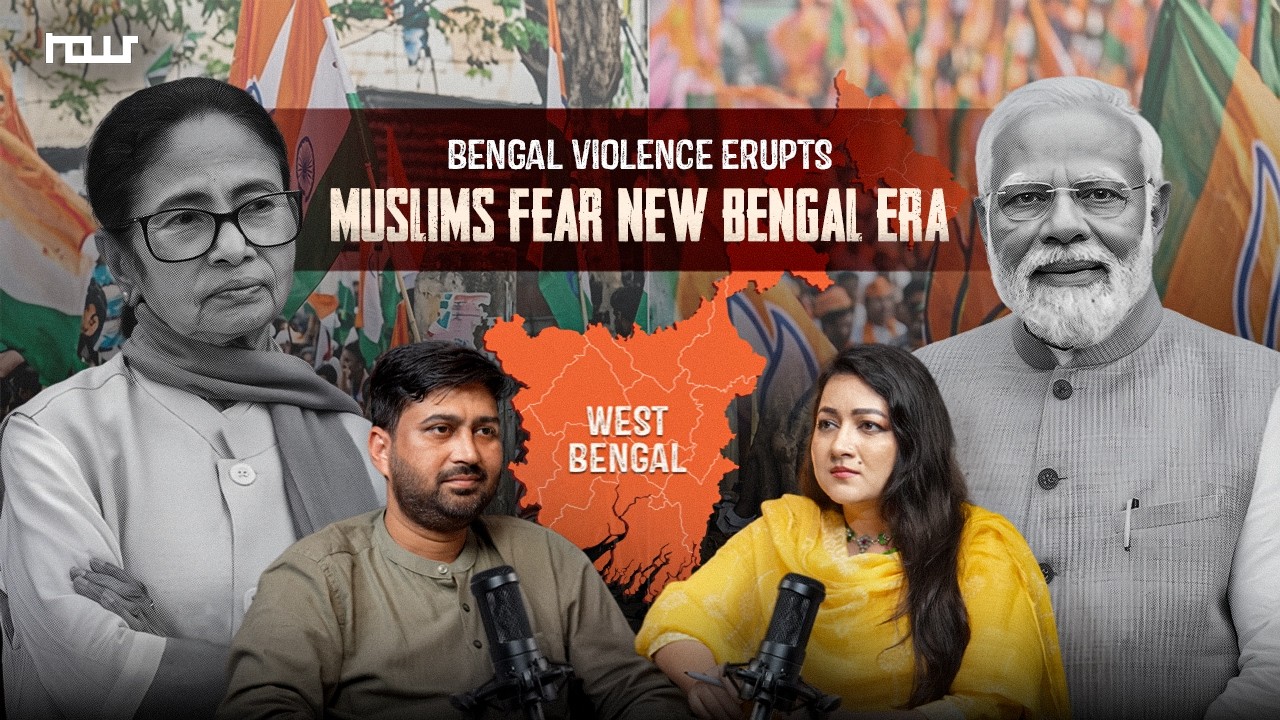
A Historic Defeat, and a Question Left Hanging
West Bengal's 2026 assembly election produced a result that even seasoned analysts had hedged against until the votes were counted: the Bharatiya Janata Party won power in the state for the first time, ending Mamata Banerjee's fifteen-year run as chief minister. In the days since, the state has been convulsed by the aftermath. Statues of Lenin have been pulled down, bulldozers have made public appearances, crowds have marched chanting "Jai Shri Ram" while brandishing swords, and multiple killings have been reported, including that of an aide to senior BJP leader Shubhendu Adhikari. Adhikari himself had said during the campaign that he considered himself an MLA "only of Hindus," because only Hindus had voted for him, and had separately suggested Muslims deserved the kind of treatment Israel meted out in Gaza.
Against this backdrop, journalist and host Bushra Khanam Fahad opened a conversation on the Nous Podcast with Dr Mohammad Reyaz, assistant professor at Kolkata's Aliah University, a former journalist and a long-time analyst of Bengal's politics, to unpack what the result means for the roughly 30 percent of Bengal's population that is Muslim. Some Muslim organisations, Fahad noted, had already circulated advisories urging community members to avoid stepping out of their homes unless absolutely necessary. For a community that had, under successive governments of different ideological stripes, always retained some seat at the table -- symbolic or otherwise -- the immediate reality now is that every Muslim legislator elected to the new assembly will sit in opposition. None will be part of the government.
Not Overnight: The Making of a Hindu Vote Consolidation
Reyaz's central argument is that the scale of the BJP's win, while startling to many, was not a sudden event triggered by any single cause. "We saw a large-scale Hindu vote consolidation," he said, pointing to the party's near-total sweep of Scheduled Caste and Scheduled Tribe-dominated seats -- Purulia, Bankura, Alipurduar, the Jangalmahal belt, Purba Medinipur and much of North Bengal all went overwhelmingly to the BJP, on top of a substantial consolidation among the urban, upper-caste Bengali middle class.
This, he stressed, was building well before this election. In 2021, the BJP had already won 77 seats and roughly 36-37 percent of the vote, making it in effect the principal opposition. Pollsters like Yashwant Deshmukh of C-Voter had framed the contest as a fight over a 30 percent Muslim vote bloc that was presumed unlikely to move toward the BJP, which is one reason so many analysts were cautious even as exit polls, in the end, undershot the BJP's actual tally. What surprised people, Reyaz said, was not that consolidation happened, but how complete it turned out to be -- and he was careful to add that it was not driven by communal sentiment alone. Anti-incumbency, he argued, was a real and significant factor layered on top of it.
"Anti-Incumbency" as a Coded Word
Pressed on why the same charge of corruption and non-performance produces "pro-incumbency" verdicts in BJP-ruled states like Bihar but "anti-incumbency" verdicts against non-BJP governments, Reyaz offered a theory he said he had been trying to articulate publicly for some time. Corruption and stagnation narratives, he argued, only seem to gain electoral traction against governments the BJP is trying to unseat -- Congress, Arvind Kejriwal's Aam Aadmi Party, or Mamata Banerjee's TMC -- and rarely stick to BJP-run states themselves, even where allegations exist, such as the Vyapam scandal in Madhya Pradesh. His explanation: the anti-incumbency narrative "stands" as a respectable public position precisely when a large-scale Hindu vote consolidation is already under way, because educated, liberal upper-caste voters are reluctant to say outright that they are voting on communal lines. Instead, he said, they frame it as concern over corruption or the absence of development.
He drew a direct parallel with the Bharatiya Janata Party's 2014 national campaign around "achhe din," pointing to strikingly similar ingredients this time: a narrative of rising unemployment and stagnation driving people out of the state for work, and a women's-safety narrative built around the RG Kar case that he compared to the aftermath of the 2012 Delhi gang-rape -- in both instances, he noted, a victim's mother went on to contest and win a seat. "They are masters at building narratives," he said of the BJP, adding that this was matched by a parallel failure of opposition parties, including the Congress, to construct a competing one even when they held power, as in 2014.
TMC's Own Alienation of Its Muslim Base
If Hindu consolidation explains one half of the result, Reyaz located the other half in a slow erosion of trust between the TMC and its Muslim voters. He traced it to roughly 2016, when, in his account, the flow of new welfare policies and schemes specifically benefiting Muslims -- expansion of Aliah University, English-medium madrasas, OBC reservation gains that had visibly created a new professional Muslim middle class in Kolkata -- began to slow after having been substantial in Banerjee's first term. Into that vacuum stepped the Indian Secular Front (ISF), formed ahead of the last election, whose pitch, as Reyaz summarised it, was pointed: "Security is fine, but what beyond security?"
Compounding this, he said, Banerjee spent the last five years pursuing what he called a form of "soft Hindutva" -- building four grand temples, including a Jagannath temple in Digha and others in Rajarhat and Siliguri -- even as her party publicised her attending Iftars, wearing a headscarf during Hajj send-offs, and paying monthly stipends to imams and muezzins. The effect, in Reyaz's telling, was to generate two contradictory narratives simultaneously: Hindu voters were told, and some came to believe, that she was engaged in Muslim "appeasement," while many Muslim voters concluded she was drifting toward what they, too, called "soft Hindutva." He pointed to the Waqf Act protests as a particular flashpoint, recalling that Banerjee had told protesters to take their agitation to Delhi rather than stage it in Bengal -- read by many Muslims, he said, as confirmation that they were being taken for granted.
A Fractured Vote: Humayun Kabir, ISF and a Diminished Bench
The consequence showed up starkly in the numbers. TMC strategists, Reyaz said, had been hoping for something close to total Muslim consolidation in their favour out of sheer fear of the electoral-roll revision process -- 99 or even 100 percent in some pockets. What they got instead was closer to 80-84 percent. The number of Muslim MLAs in the new assembly has fallen to roughly 36, well below the 2011 high of 59, even as they continue to make up around 40 percent of TMC's own winning legislators -- evidence, in Reyaz's reading, that TMC still holds a plurality of the Muslim vote, but not the near-monopoly it had counted on.
Some of that shortfall went to Congress, which picked up a handful of seats concentrated in Malda, Murshidabad and North Dinajpur, and to AIMIM, which Reyaz said had made only a "dent" rather than a breakthrough. The most striking case was Humayun Kabir, a sitting MLA who won from two seats after campaigning, in part, on a promise to build what he called a "Babri Masjid." Reyaz was unambiguous that he did not support the idea -- "if you wanted to build a mosque, just build one," he said, questioning the need to invoke that particular name -- and noted that Kabir had previously been associated with the BJP and was seen publicly congratulating the party after the results, raising questions about a possible understanding between them. But he cautioned against reading Kabir's win as an endorsement of that specific promise: Kabir was already a locally influential politician with his own base before he ran as an independent, and his victory reflected TMC's broader anti-incumbency problem as much as anything else.
Reyaz was equally insistent that the shift should not be overstated. Of the roughly 32 assembly seats where Muslims form more than half the electorate, TMC had swept all of them in 2021; this time it retained around 23. "That shows there is erosion, not collapse," he said, adding that without the BJP in the picture at all, the party would likely have won even fewer of the state's seats than it did -- the SIR-driven fear of disenfranchisement, he argued, actually held part of the Muslim vote together for TMC even as anti-incumbency pulled at it from another direction.
The Machinery Behind the Result
Much of the post-election commentary, Reyaz noted, has focused on the Special Intensive Revision (SIR) of electoral rolls, which TMC and civil society groups have blamed heavily for the defeat. He does not dismiss its effect -- in some of the closest Muslim-majority contests, deletions exceeded the eventual victory margin, and he estimated SIR could have directly swung perhaps 15 to 20 seats. But he was skeptical of treating it as the primary explanation, comparing it to parties reflexively blaming EVMs after a loss: no political party, he said, will readily blame its own voters. He also argued TMC had grown complacent once litigation began, having earlier promised aggressive resistance -- Abhishek Banerjee had spoken of surrounding Delhi with lakhs of protesters -- only to pursue a comparatively quieter legal route once the final SIR lists were published.
He also pointed to a parallel collapse in TMC's campaign infrastructure. Around mid-April, he said, he began noticing a marked weakening of the party's social media presence coinciding with an Enforcement Directorate raid connected to a director at IPAC, the election-management firm run for the party by Prashant Kishor's former outfit, with reports -- denied by TMC -- that its operations had effectively stalled. He cited a Hindustan Times field-reporting piece by journalist Nilanjan Sarkar describing how, since 2021, IPAC had become something close to a party extension under Abhishek Banerjee, deciding candidate selection to the point that tickets were reportedly denied to 73 to 77 sitting MLAs -- a decision Reyaz said Amit Shah moved to exploit directly, holding individual meetings with aggrieved, denied candidates.
That points to what Reyaz called the BJP's core strength: its capacity to "micro-manage" elections at a granular level. Amit Shah spent more than three weeks in Kolkata during the campaign, he noted, and the party dominated advertising space across websites, social media and newspapers simultaneously. He described BJP's "panna pramukh" (page in-charge) volunteers campaigning aggressively even inside high-rise apartment complexes that typically see low voter turnout, with reports of the party booking train and flight tickets to bring voters back to their constituencies to cast ballots -- a scale of resourcing, he said, that TMC simply could not match.
Roots Older Than This Election
Reyaz pushed back on the idea that Bengal's communal turn is a recent or sudden phenomenon, tracing it back to the Partition era and communal tensions that intensified in the state from around 1938 onward. Bengal and Punjab were the two states most affected by Partition, he noted, but unlike Punjab, which saw an almost total demographic separation along religious lines, Bengal retained a large Muslim population -- around 27-30 percent by the 2011 census -- alongside a substantial Hindu refugee population from East Bengal.
What kept communal politics from becoming electorally dominant for decades, in his account, was that successive governments -- B.C. Roy's Congress, more than three decades of Left Front rule under Jyoti Basu, and later the TMC -- gave the community enough symbolic and social accommodation that a distinct communal political identity did not need to assert itself. That, he argued, is why the BJP stayed confined to a handful of seats for decades even in the home state of its ideological forerunner, Shyama Prasad Mukherjee, despite the RSS steadily building grassroots networks there over that same period.
The shift, Reyaz said, is one he first argued in a 2017 research article: as a new, upwardly mobile Muslim middle class emerged in Bengal and began asserting its identity in public life, it produced what he called a "counter-polarisation" among Hindus. What is visible in 2026, in his framing, is roughly a decade's worth of that counter-polarisation reaching its peak. He was careful, though, to draw a distinction between this and North Indian-style communalism: Bengali Hindus who voted BJP, he suggested, are unlikely to march on mosques with swords or resort to lynching in the way seen elsewhere, but he agreed this is still a form of communal polarisation, simply expressed differently.
Fear on the Ground: What the Roll Revision Leaves Behind
Beyond the election result itself, Reyaz flagged the unresolved human toll of the SIR process as an immediate concern. Roughly 90 lakh names were deleted from Bengal's electoral rolls during the revision, a figure he cautioned should not be read at face value -- some proportion reflects genuinely deceased, duplicate or relocated voters. Based on tribunal disposal patterns so far, in which close to 2,000-2,200 cases have been resolved with roughly 85-90 percent of names restored, he estimated that somewhere between 34 and 40 lakh of the deletions likely involve genuine residents caught up in the process, a category distinct from those legitimately removed.
His deeper worry is for those who may never successfully appeal: poor, undocumented domestic workers, day labourers and rickshaw-pullers who hold voter ID, Aadhaar and ration cards -- none of which SIR accepts as standalone proof -- but lack land records, which the process effectively requires and which the landless poor never had reason to possess. Even on an optimistic reading, he estimated five to twelve lakh people statewide could be left without recourse. He cited reports of at least 64 government employees, including teachers on election duty, whose own names were deleted despite their employment status -- a pattern he likened to Assam's long-running "D-voter" phenomenon, where even army veterans and officials' relatives have been caught up in similar disputes.
He also described the more immediate social climate: in Kolkata, meat shops -- including a mutton shop in the New Market area that party workers arrived to demolish with a bulldozer -- have shut out of fear, something he said was previously unheard of in a city where, unlike parts of north India, such businesses had long operated openly. Muslim organisations have advised college students, particularly visibly identifiable Muslim women, to stay away from campuses for about a week until the new government is sworn in, and there is particular anxiety building around the upcoming Bakri Eid.
A Silver Lining, and an Open Question for the Opposition
Reyaz closed on a note that was, by his own description, counterintuitive. For roughly a decade, he said, Bengal's Muslim voters were mobilised chiefly through fear -- "the BJP is coming" functioned much like a bogeyman used to frighten children. Now that the BJP has actually arrived, he argued, that particular fear loses its political utility, potentially freeing Muslim voters from a purely defensive voting pattern and creating space for genuine community leadership -- of the kind ISF's Nawsad Siddique has tried to represent -- to bargain for real commitments rather than security alone.
On Mamata Banerjee's own political future, Reyaz was measured. Her combativeness is not in doubt -- she has vowed not to resign, threatened to approach international courts, and declared herself a "free bird" ready to contest from anywhere -- but he noted she is in her seventies, raising real questions about how long she can remain the party's active, singular force. He was more skeptical of Abhishek Banerjee's readiness to fill that role, noting he has never been tested at the grassroots the way his aunt was. With Bengal's police now under a BJP government, in addition to the CBI and Enforcement Directorate, Reyaz expects corruption investigations into TMC leaders to intensify, and predicted gradual defections from the party over the coming months -- driven partly by upcoming Rajya Sabha calculations, where every MLA's vote matters -- even if he does not expect a formal, immediate split so long as Banerjee remains active at the helm.


Discussion
0Readers only · Comments are reviewed by the desk before they appear
The journalism is free for everyone — create a free account to join the discussion.