

After Nations: Rana Dasgupta on the Fragile Order We Call the Nation-State
In a wide-ranging Nous Podcast conversation, the writer Rana Dasgupta argues that the nation-state is not a natural or eternal order but a recent, contingent experiment now straining under the very crises — inequality, migration, imperial legal inheritance, and a collapsing legitimating story — that it was built to manage.
Contents · 10 sections
- An Experiment, Not an Inheritance
- Asia's Weight and Europe's Parasitic Rise
- Three Empires, Three Blueprints
- 1945 and the Roads Not Taken
- Rights Conceded, Not Given
- The Theological Roots of Sovereignty
- A Narrowing Container
- What Came Before, and What Might Come After
- Territoriality and the Coming Test
- Empire by Other Means
An Experiment, Not an Inheritance
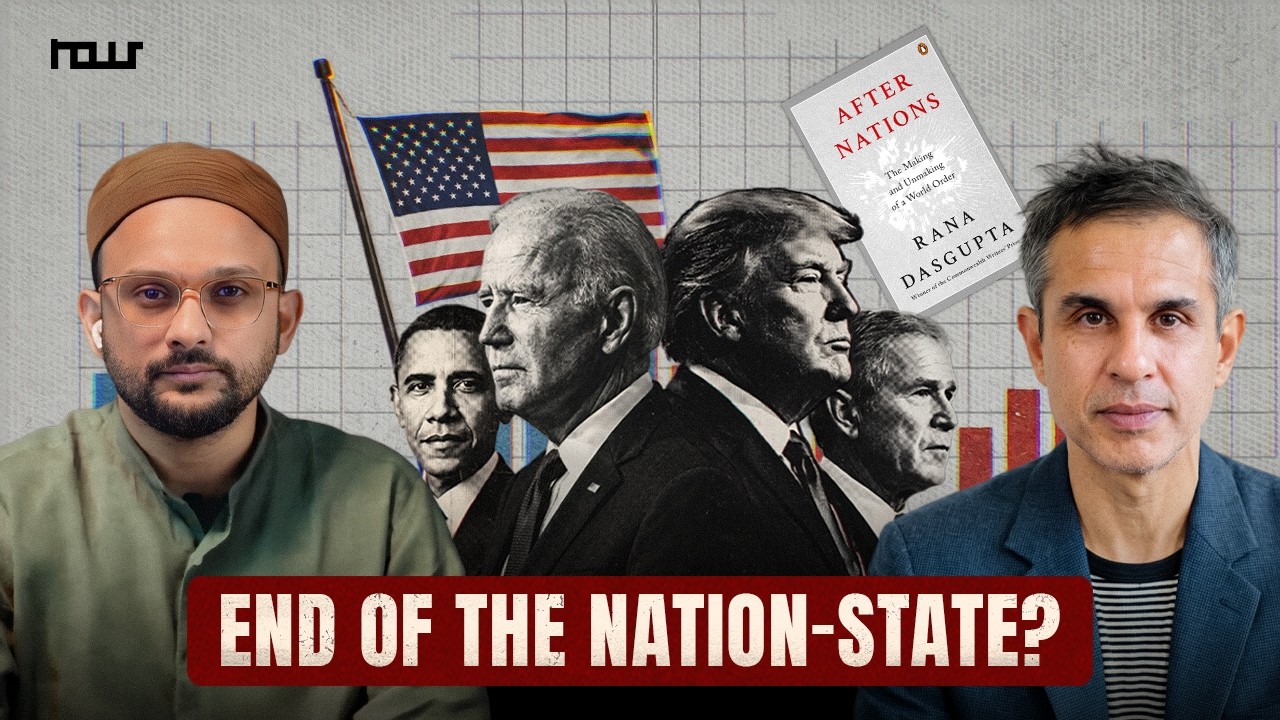
For most people alive today, the nation-state feels like a permanent fact of the world, as old and as given as the mountains and rivers it draws its borders around. Rana Dasgupta, the writer and author of After Nations: The Making and Unmaking of a World Order, argues in a wide-ranging conversation on the Nous Podcast that this feeling is an illusion of recency. The world of roughly two hundred sovereign, territorially bounded states is not an ancient inheritance but a specific historical experiment, assembled after the Second World War when the United States and the Soviet Union used their combined power to dismantle European empires and stamp a single political form across the planet. "Nothing like this has ever existed in the past," Dasgupta said, noting that most of these states are barely seventy or eighty years old and cannot yet claim anything like the multi-century durability of the Ottoman or Chinese empires that preceded them.
What makes the nation-state distinctly modern, in Dasgupta's account, is not that it centralizes power or collects taxes — states have done that for five thousand years. It is the intensity and totality with which the modern state organizes a population: a monopoly on violence enforced by industrial military technology, propaganda delivered through mass education and media to manufacture a shared national mythology, and bureaucracies capable of tracking individual lives from birth to death. Crucially, Dasgupta insists the nation-state cannot be understood in isolation from capitalism. "The nation-state system is the political apparatus of the capitalist system," he said, describing the two as twin arms of a single reality — the state supplying the legal enforcement, labor discipline, and educated workforce that corporations need, while capitalism supplies the states with growth, debt, and the compulsion to compete.
Asia's Weight and Europe's Parasitic Rise
Dasgupta's account of how this order came to be pushes back hard against a Eurocentric telling of modern history. As late as the end of the eighteenth century, he noted, India and China together may have produced close to half of global GDP. Europe's own economic ascent, in his telling, was substantially parasitic on this Asian wealth: European powers spent centuries acquiring silver and gold — much of it mined in Spanish America — specifically to spend it in Asia and the Middle East on textiles, porcelain, spices, and tea. The East India Company's drive into Bengal, he argued, was in large part a scramble to capture one of the world's great reservoirs of silver and taxation revenue, a process that produced catastrophic famine and helped trigger the tax disputes with American colonists that cost Britain its first empire in North America.
Two developments let Europe finally close the gap with Asia: the entwined systems of slavery and the Industrial Revolution, which generated capital fast enough to compete with the vastly larger Asian economies, and the deliberate destruction of Asian economic power itself. Britain, Dasgupta argued, became a true global capitalist superpower not by defeating Napoleon but by dismantling the Mughal Empire and crushing China in two Opium Wars by the 1840s — clearing the way for a worldwide net of European property law and investment. Understanding this sequence matters, in his view, because it reframes the nation-state system not as a neutral framework that later happened to include unequal outcomes, but as an order built, from its origins, on the transfer of wealth out of Asia and into Europe.
Three Empires, Three Blueprints
The eventual global template was not a single design but a convergence of competing imperial logics. France, Dasgupta explained, imagined an empire of integration rather than separation — by the 1930s and 1940s some African colonies were sending deputies to the Paris parliament, and some colonial elites feared independence precisely because they thought a unified French political and commercial zone offered a better future than isolated poverty as small nation-states. That vision died when the United States and the Soviet Union insisted, after 1945, that all dependencies become separate sovereign states. Britain's model, by contrast, was one of maximum territorial occupation in service of free trade, an open sea, and a global currency it controlled directly. The American model, shaped by its long experience managing formally sovereign but economically dependent states across Latin America, dispensed with direct occupation altogether: break the world into nominally independent nations, then organize them from outside through asymmetrical trade, military, and financial power. It is this American blueprint — sovereignty on paper, dependency in practice — that became the template for the postwar world.
1945 and the Roads Not Taken
Dasgupta stressed that the near-universal adoption of the nation-state form after the Second World War was neither inevitable nor uncontested. Socialists in London imagined retaining empire's cosmopolitanism and freedom of movement while distributing its profits globally through a form of world government rather than carving the map into competing nations. Jawaharlal Nehru, hosting the Asian Relations Conference in Delhi in 1947, hoped newly independent Asian nations would reject the competitive, militarist nationalism of their former colonizers in favor of a different, more peaceable sensibility — an aspiration that Dasgupta noted "evaporated shortly afterwards." Albert Einstein, reasoning from the terror of the atomic bomb, argued that a world of rival nuclear-armed nation-states was a world condemned to destroy itself, and called for federation instead. None of these visions prevailed. The nation-state model won, Dasgupta argued, because it was the one outcome that both the most powerful actors (the United States and Soviet Union, who each wanted a mosaic of standardized, controllable client states) and many anti-colonial elites (who wanted sovereignty and their own seats of ministerial power) could simultaneously accept.
Rights Conceded, Not Given
One of the conversation's sharper arguments concerns why Western states ever extended democratic rights to their citizens at all. Britain, Dasgupta pointed out, understood the principles of democracy and civil liberty by the seventeenth century, yet withheld universal suffrage until 1928. What changed in between was not moral enlightenment but economic dependency: once Britain's profits shifted from colonial plunder toward domestic industrial labor in the 1830s and 1840s, the state needed a healthy, literate, disciplined workforce that could not simply be repressed — it had to be persuaded and provided for. Public education, public health, and eventually the welfare state followed not from benevolence but from the leverage that an organized industrial working class had newly acquired. By the 1920s, Dasgupta observed, welfare spending in Europe had for the first time overtaken military spending, a hallmark of what he called the postwar "golden era" for European and American democracy — one paid for, he added, at a cost elites deeply resented, through high taxation and constraints on where capital could move.
That golden era, roughly 1945 to 1975, provoked its own backlash. From the 1970s onward, Dasgupta argued, capital mobilized to escape the constraints states had placed on it: offshore tax havens, the relocation of manufacturing to evade labor and environmental law, and the ability to threaten governments with disinvestment unless they deregulated. This is how, in his telling, a large share of global manufacturing wealth ended up flowing to China, which possessed centuries of experience as "the factory of the world" and a state apparatus well suited to seizing the opportunity. The consequence for Western nation-states has been a historic loss of real economic leverage over their own populations — leverage they now attempt to replace, Dasgupta suggested, not with redistribution but with mythology, telling citizens, in his words, "I can give them a better mythology," in place of material improvement.
The Theological Roots of Sovereignty
Dasgupta locates the deepest justification of state power not in economics but in theology. Every state, he argued, ultimately represents its authority in cosmological terms, and the modern nation-state made an unusually radical version of this claim: unlike the medieval European monarch, who shared authority with the church, the aristocracy, cities, and local custom, the modern state tolerates no rival whatsoever — not family, not religion, not community. This is the context in which Dasgupta places his engagement with Sayyid Qutb, the Egyptian Islamist thinker whose Quranic commentary became foundational to modern political Islam. Qutb's radicalization, Dasgupta explained, grew out of direct experience: revulsion at British and French colonial administration in Egypt, disillusionment after visiting the United States in the 1940s, and then imprisonment and torture under Gamal Abdel Nasser's secular, authoritarian Arab socialism. Out of this came Qutb's doctrine that sovereignty belongs to God alone, and that the nation-state itself — including the compliant, tax-paying Muslim citizen who accepts it — constitutes a form of idolatry.
Dasgupta was careful to place Qutb alongside comparable European critiques, citing the French right-wing Catholic thinker Charles Maurras, who likewise argued that the state had usurped a throne — Thomas Hobbes's "mortal God" — that belonged only to God. The comparison underscores Dasgupta's broader claim that rejections of the totalizing modern state are not a peculiarly Islamic phenomenon but recur across religious traditions confronted with a political form that claims final authority over birth, death, marriage, education, and even, in the debate over assisted dying, one's own body.
A Narrowing Container
Where earlier generations imagined the nation-state as an endlessly expansive, inclusive container — capable of absorbing multiculturalism, extending rights ever outward — Dasgupta sees the opposite trend today: the container narrowing. As economic inequality deepens and states find it harder to deliver material improvement, he argued, governments increasingly attempt to sell citizenship on the basis of exclusion and mythologized grandeur rather than shared prosperity, testing which groups can be defined out of full belonging. He pointed to shifting rhetoric in the United States around immigrants, Muslims, and protesters, and to Hindutva politics in India, as live experiments of this kind, describing leaders as unsure which exclusionary strategies will succeed and adjusting accordingly. Even the avowed neutrality of the postwar liberal order, Dasgupta suggested, is now being abandoned openly: under Donald Trump, he said, the nation-state system's official commitment to democracy and rights has given way to an admission that "there is no real moral distinction between one kind of power and another."
What Came Before, and What Might Come After
If the nation-state is historically contingent, Dasgupta is equally interested in what other political forms managed better on certain fronts. He cited the Ottoman Empire's millet system, under which minority communities — including Jewish communities that flourished in cities like Salonica — retained considerable autonomy over marriage, education, and religious practice in exchange for basic loyalty and taxation, a much lighter demand than the modern state's totalizing claim on identity. He argued this history matters directly for the present Middle East, where he sees the nation-state as structurally incapable of producing peace: Israel's pursuit of total security by reducing its neighbors to failed states, matched by regional actors constitutionally opposed to Israel's existence, describes a closed loop that only pre-national, civilizational, or transnational arrangements might escape. He pointed similarly to Southeast Asia, arguing that organizations like ASEAN function partly because they carry an imprint of much older, pre-national trading and cultural connections across the Indian Ocean and beyond.
Even so, Dasgupta was emphatic that he does not expect, or even necessarily want, the collapse of the nation-state or capitalism, both of which he called remarkably "robust and flexible" systems that deliver real goods to enormous numbers of people. His proposal instead is to rebuild something like the historic "commons" — the shared land, resources, or mutual protections that let people excluded from formal wealth systems survive regardless. In a digital age, he suggested, the commons might take new forms: community-owned currencies, transnational labor and trade platforms, or migration frameworks that exist alongside, rather than in place of, the nation-state and capitalist system.
Territoriality and the Coming Test
The conversation's final and, in some ways, most urgent theme was migration. Dasgupta described the nation-state system bluntly as an engine for concentrating wealth in some regions while immobilizing the populations of others — since freely transferring wealth toward the wealthy only works if the poor cannot simply follow it. "This is a self-made problem," he said, arguing that two centuries of nation-state history have not narrowed, but entrenched, the gap in wealth between regions. That immobilization strategy, he warned, is now colliding with two forces it cannot contain: near-universal digital visibility of the disparity in living standards, and mass displacement driven by climate change, particularly across agrarian South Asia. He described the movement of displaced people in the coming decades as "the really definitive test of the nation-state system," noting that even the arrival of relatively small numbers of migrants has already destabilized European politics.
Dasgupta sketched two starkly different futures. In the pessimistic scenario, nations respond to climate migration with militarized borders and violence, a slide toward something like permanent civil war along frontiers. In the more hopeful one, new territory opening in the melting Arctic and deliberately organized migration corridors could allow humanity to reorganize both economic geography and the very idea of citizenship. He was skeptical, however, that such coordination could be organized from the top down, given the collapse of international forums for serious multilateral discussion, and thought change was more likely to emerge from bottom-up platforms and technologies that eventually force states to accommodate them.
Empire by Other Means
Dasgupta closed by rejecting the idea that formal decolonization ever really ended empire. What changed after the mid-twentieth century, he argued, was the mechanism: empire no longer required direct bureaucratic occupation once it could be sustained through international law, debt, and finance — most visibly through the Washington Consensus-era leverage that the IMF and World Bank exercised over indebted postcolonial states from the 1980s onward to force privatization and capital liberalization. This is why, he said, the distribution of global wealth and poverty has remained so remarkably stable across two centuries: not a natural outcome, but the product of "a much more sophisticated and invisible system" of legal and financial power succeeding the crude, visible empire of soldiers and administrators.
That system, Dasgupta argued, ultimately depends on a kind of shared faith — a cosmological plan that participants accept as legitimate — and it is precisely that faith which he sees collapsing now, amid events like the war in Gaza and the recent conflict involving Iran and Israel. "Reality is so open today," he said, because the legitimating story the United States built after 1945 is losing its believers, and states and peoples across the world are beginning to imagine designing the architecture of sovereignty, rights, and belonging differently. Whether that opening produces renewed catastrophe or genuinely new political forms, Dasgupta suggested, is not yet written — and may be decided less by treaties and institutions than by the accumulated, unpredictable choices of societies working out, often painfully, what they will and will not accept.


Discussion
0Readers only · Comments are reviewed by the desk before they appear
The journalism is free for everyone — create a free account to join the discussion.